Sausage Casing Calculator
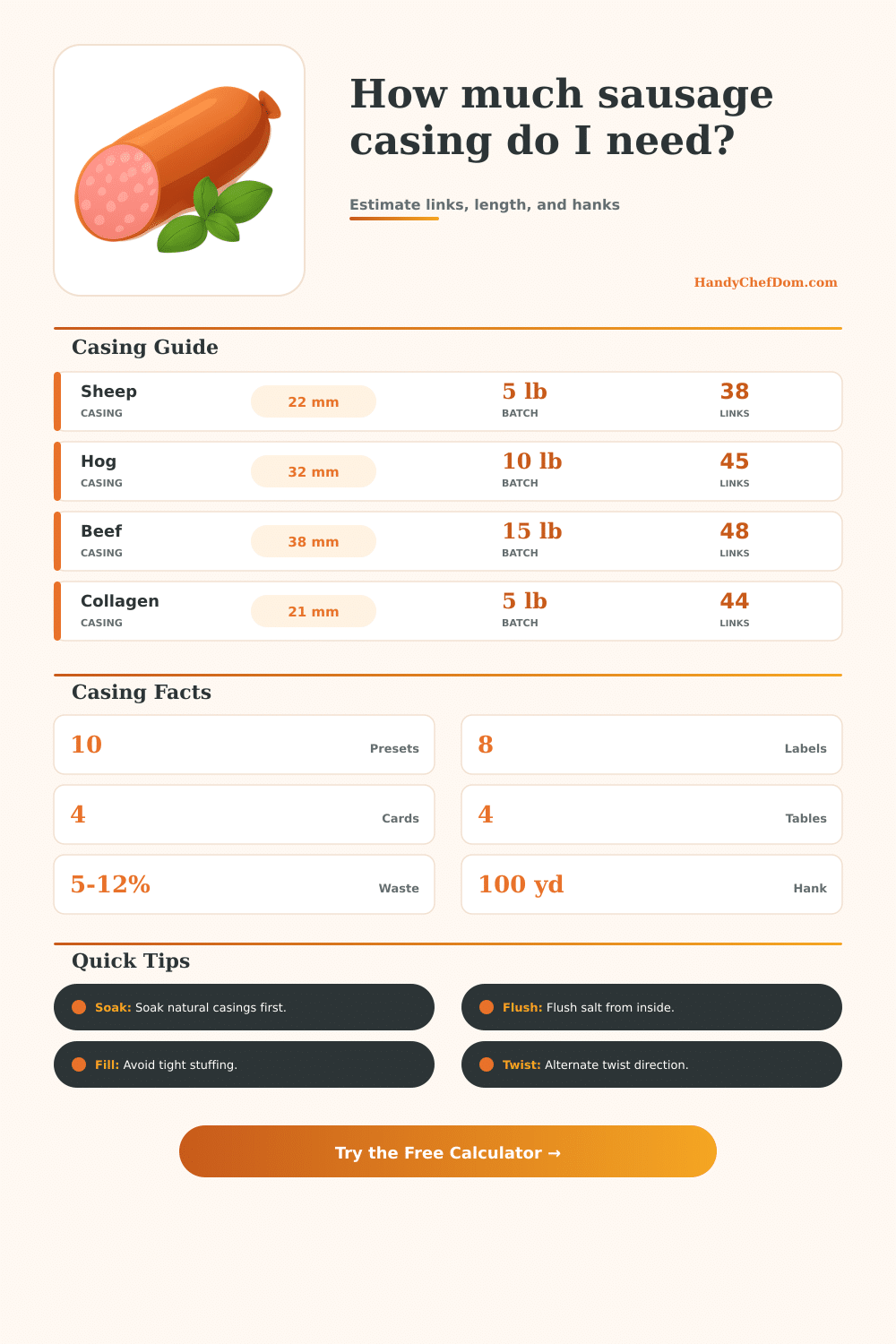
Estimate how many feet, meters, hanks, coils, and links of sausage casing you need from batch weight, casing diameter, stuffing fill, waste allowance, and link length.
1Pick a real sausage preset
Presets fill in practical casing sizes and stuffing assumptions. You can change every value before calculating.
2Enter batch and casing details
3Casing comparison grid
4Reference tables
| Sausage | Casing | Diameter | Link Length | Best Note |
|---|---|---|---|---|
| Breakfast link | Sheep | 20-22 mm | 3-4 in | Small breakfast portions |
| Hot dog | Sheep | 22-24 mm | 5-6 in | Smooth emulsified mix |
| Snack stick | Collagen | 17-21 mm | 6-8 in | Even drying sticks |
| Bratwurst | Hog | 29-32 mm | 5-6 in | Classic grilling size |
| Italian link | Hog | 32-35 mm | 6-7 in | Juicy dinner links |
| Kielbasa | Hog or beef | 35-42 mm | 12-18 in | Rings or ropes |
| Andouille | Beef round | 38-42 mm | 8-10 in | Smoked firm links |
| Dry salami | Beef middle | 45-60 mm | 10-18 in | Needs fermentation plan |
| Casing Type | Common Pack | Approx Yield | Soak Time | Handling |
|---|---|---|---|---|
| Sheep natural | 100 yd hank | 45-55 lb | 30 min | Delicate, tender bite |
| Hog natural | 100 yd hank | 90-125 lb | 30-60 min | Flexible all-rounder |
| Beef round | 30 yd bundle | 80-115 lb | 60 min | Strong smoked casing |
| Beef middle | 30 yd bundle | 120-180 lb | 60 min | Large cured sausages |
| Collagen edible | 50 ft strand | 8-20 lb | None | Uniform and quick |
| Fibrous | 25 pieces | Varies | 20 min | Peel before eating |
| Diameter | Ounces per Foot | Pounds per 10 ft | Typical Use | Fill Advice |
|---|---|---|---|---|
| 19 mm | 1.8 oz | 1.1 lb | Snack sticks | Firm but not tight |
| 22 mm | 2.4 oz | 1.5 lb | Hot dogs | Gentle pressure |
| 29 mm | 4.1 oz | 2.6 lb | Brats | Leave twist room |
| 32 mm | 5.0 oz | 3.1 lb | Italian links | Medium firm |
| 38 mm | 7.1 oz | 4.4 lb | Kielbasa | Support long ropes |
| 50 mm | 12.2 oz | 7.6 lb | Salami | Prevent air pockets |
| Batch | 20 mm Sheep | 32 mm Hog | 38 mm Beef | Waste Plan |
|---|---|---|---|---|
| 5 lb | 31 ft | 16 ft | 11 ft | Add 2-4 ft |
| 10 lb | 62 ft | 32 ft | 23 ft | Add 4-7 ft |
| 15 lb | 93 ft | 48 ft | 34 ft | Add 6-10 ft |
| 25 lb | 155 ft | 80 ft | 57 ft | Add 10-16 ft |
| 50 lb | 310 ft | 160 ft | 114 ft | Add 20-32 ft |
How the casing estimate works
The calculator treats sausage as a filled cylinder. It converts your batch weight to grams, estimates grams per inch from the stuffed diameter and density, then divides the batch by that rate to get casing length. The fill percentage increases required length when you stuff softer for twisting.
Natural casings vary by animal, strand, and soaking, so the waste allowance matters. For a first batch, 8 to 12 percent is sensible. For collagen or measured fibrous casings, you can lower waste if your horn size and stuffing speed are dialed in.
You can use the sausage casing calculator to determine how much sausage casing you need to order for your batch of meat. The sausage casing calculator ask for the weight of the meat that you will use, the diameters of the casings that you will use, and the percentage of waste that you will allow in the sausage making process. The weight of the meat and the diameter of the casings will change how much casing the batch of sausage links will use.
A higher percentage of waste allowance will provide extra casings to account for casing mistake during the sausage making process, as well as for the casings that cannot be used in the links due to the ends of the casings. Sausage makers often choose natural casings due to the specific texture that they provide to the links. The casings made from sheep肠are the smallest in diameter, and are therefore used to make small breakfast sausage links.
How Much Sausage Casing Do You Need
Hog casings is of a larger diameter than sheeps casings and are used to make larger sausages, like brats and Italian sausages. Beef casings are of a large diameter compared to hog casings and are used to make large sausages, like smoked rings or salami. These natural casings must be soak in water prior to use.
Casings made from sheep肠are the most delicate when soaked in water, while beef casings requires soaking in water for longer periods of time in order to remove the salt flavors that is naturally present in the casings. Collagen casings are different than natural casings in that they are dried when they are delivered to the sausage maker. Therefore, they dont need to be soaked prior to use, and they maintain their diameter from start to end of the casing links.
Collagen casings is often used to make snack sticks. However, they may feel different to the consumer compared to natural casings. The sausage casing calculator allows the individual to select whether they would like to use natural or collagen casings in the sausage making process.
The density of the meat will impact the amount of casing that the meat will require. If the meat is of high density it will take up less space than less dense meat. If the meat contain many fillers it will be less dense than a meat that does not contain many fillers.
Therefore, the meat with a lower density will require more sausage casing. It is important to consider the density of the meat that will be used in the link. A waste allowance is incorporated into the total amount of sausage casing that will be ordered for the batch.
A waste allowance is used to account for the fact that some of the casing may break during the sausage making process, as well as to account for the casing that may be lost when using knots or test links. Five percent waste is often used for small batches of sausages. However, a sausage maker should of choose between ten and twelve percent waste to ensure that there is enough casing to account for these potential loss.
The allowance for waste will be incorporated into the total length of the sausage links that the batch is to be made by. The length of each link of sausage that is made will determine how much casing will be used for each link. Four inch links are common for breakfast sausages, while six inch links are common for sausages that are to be served on buns.
The length of each link will impact the total amount of casing that is required for the batch. The sausage casing calculator can help the sausage maker to decide on the length of each link in the batch to ensure that each link is the same size. The reference tables include the diameters of the casings that are used for different types of sausages.
For instance, a 32-millimeter casing made from hog肠is used for dinner links, while 38 or 42-millimeter hog casings are used for links that are of a larger diameter, like kielbasa links. These measurements are provided as a starting point for the casings that will be used for each type of links; however, the specific measurements should always be checked. Finally, notes should be made regarding the making of the sausages.
These notes will help to determine how dense the meat is for each batch of sausage, as well as the diameter of the equipment that will be used in the sausage making process. These factors will impact the amount of sausage casing that is needed for the batch of sausage links.