Orange Carb Calculator
Estimate total carbs, net carbs, fiber, juice yield, and per-serving orange nutrition from variety, peeled weight, segments, juice, recipe use, and zest.
Your Orange Carb Breakdown
Values are practical planning estimates based on common raw orange and orange juice nutrition references; natural fruit varies by ripeness and size.
| Variety | Total Carbs | Fiber | Net Carbs | Calories |
|---|---|---|---|---|
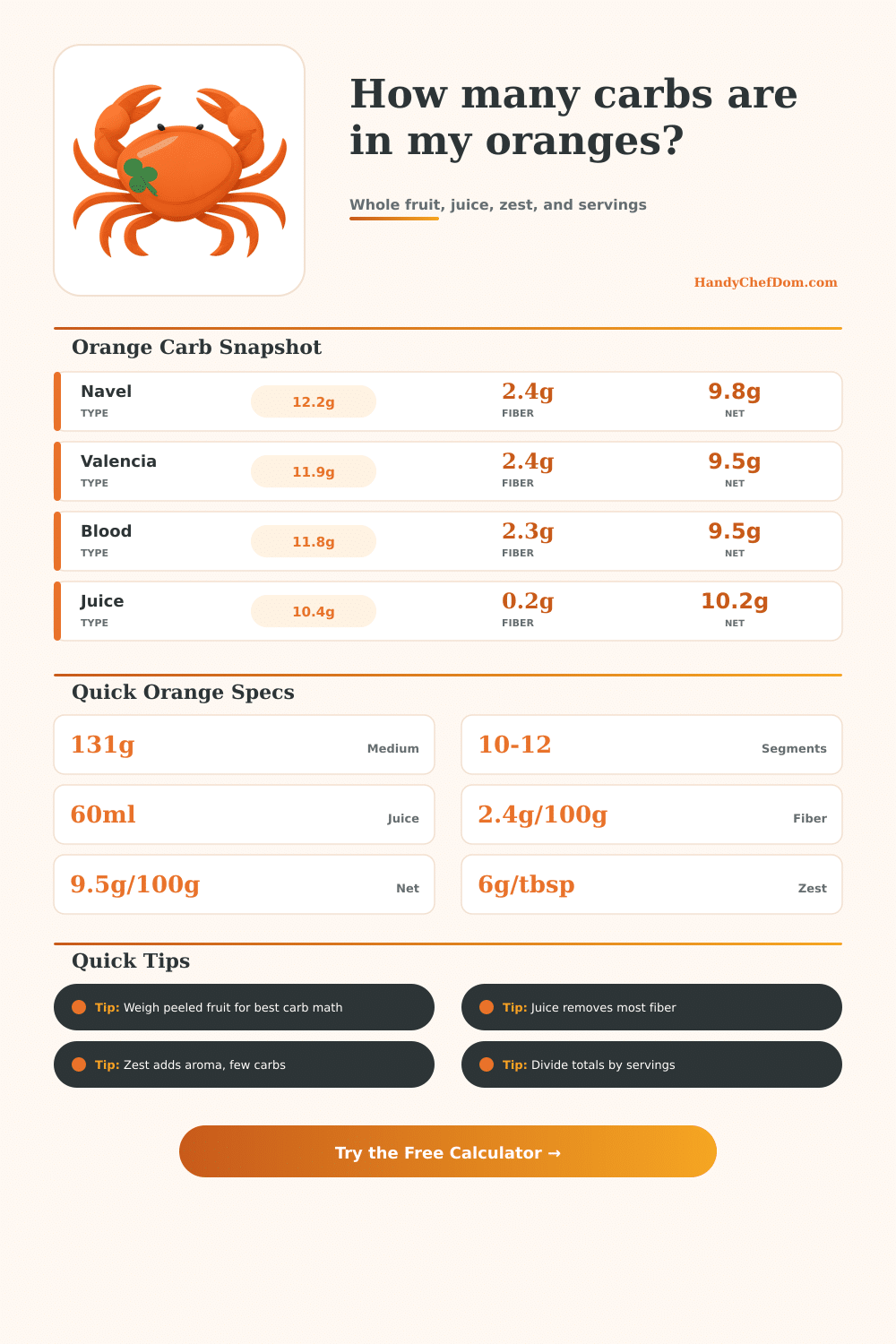
| Navel orange | 12.2 g | 2.4 g | 9.8 g | 49 |
| Valencia orange | 11.9 g | 2.4 g | 9.5 g | 47 |
| Blood orange | 11.8 g | 2.3 g | 9.5 g | 48 |
| Cara Cara orange | 12.0 g | 2.4 g | 9.6 g | 49 |
| Mandarin orange | 12.0 g | 1.8 g | 10.2 g | 53 |
| Clementine | 12.0 g | 1.7 g | 10.3 g | 47 |
| Tangerine | 13.3 g | 1.8 g | 11.5 g | 53 |
| Seville bitter orange | 11.5 g | 2.4 g | 9.1 g | 45 |
| Orange Form | Common Portion | Total Carbs | Fiber | Net Carbs |
|---|---|---|---|---|
| Whole medium orange | 131 g edible | 15.4 to 16.0 g | 3.0 to 3.2 g | 12.3 to 12.8 g |
| Orange sections | 1 cup, 180 g | 21.2 to 22.0 g | 4.1 to 4.3 g | 17.0 to 17.8 g |
| Fresh orange juice | 1 cup, 240 ml | 24.8 to 26.0 g | 0.5 g | 24.3 to 25.5 g |
| Fresh orange zest | 1 tbsp, 6 g | 1.5 g | 0.6 g | 0.9 g |
| Starting Point | Edible Weight | Typical Segments | Juice Yield | Best Use |
|---|---|---|---|---|
| Small orange | 95 to 105 g | 9 to 10 | 40 to 50 ml | Snack |
| Medium orange | 125 to 135 g | 10 to 12 | 55 to 70 ml | Daily portion |
| Large orange | 155 to 170 g | 11 to 13 | 70 to 90 ml | Salad |
| Extra large orange | 185 to 205 g | 12 to 14 | 90 to 115 ml | Juicing |
| Clementine | 70 to 80 g | 8 to 10 | 25 to 35 ml | Lunchbox |
| Recipe Use | Orange Amount | Estimated Net | Fiber Kept | Serving Idea |
|---|---|---|---|---|
| Fruit salad | 2 medium oranges | 24 to 26 g | 6.0 g | 4 servings |
| Smoothie | 1 orange plus 60 ml juice | 18 to 20 g | 3.0 g | 2 servings |
| Citrus glaze | 120 ml juice | 12 to 13 g | 0.2 g | 6 servings |
| Zested bake | 12 g zest plus sections | 14 to 16 g | 4.2 g | 8 slices |
We tend to lump all oranges together as carbohydrate sources, which is true until someone squeezes one into a glass and drinks it, or cuts up some segments for a salad bowl. Drinking an orange’s liquid versus biting into the fruit itself isn’t merely a matter of mouthfeel; it’s a very different experience for your body regarding the sugar within. While one approach preserves the fiber, the other removes it entirely, leaving a pure river of glucose coursing through your system at breakneck speed. If you’re monitoring net carb intake (for whatever reason), knowing this makes a world of difference. And it can help maintain even energy levels across the day.
This tool shows you the visual impact by breaking out whole fruit information from juice yield and zest additions.
Why Whole Oranges Are Better Than Juice
And there’s also the matter of variety, which has more influence than most consumers understand. A Navel orange is sturdy and sweet, making it perfect to grab when you’re grabbing something to eat on the go. A Blood orange is tart and distinctive. It is a real star when used as part of a dessert or even a savory glaze. And even within these varieties, the size factor makes a huge difference in the math. One orange may have ten segments inside; another, twice its size, may contain up to fourteen, plus much more sugar. Without knowing how big your orange actualy was, and what your own individual serving size is, the numbers will stray from the truth. To correct that, choose whatever variety fits your needs and then estimate (or weigh) the size to determine roughly how many segments it contains: not all “medium” oranges is created equal.
Nutritionally speaking, it’s as if it’s a different food altogether. Depending on how you’re preparing it. Most of an orange’s fiber resides in its membrane and pith, which is what gets left behind when you’re peeling and eating a piece of whole fruit. This keeps things moving slowly; fiber-rich foods is digested gradually, releasing energy steadily. But when you eat juiced oranges, whether via machine or by hand, you’re stripping away the structure that holds that fiber in place. What you get is a concentrated stream of sugar without much of the fiber that tempers its uptake. So, juice raises blood-sugar levels quicker then an actual orange does.
So if blood-sugar management is important to you, retaining the pulp (if making your own juice) or opting for whole segments (instead of drinking juice) starts to make sense, not because they taste better, necessarily, but because they have a practical use.
Carb-counters frequently forget about zesting, since at first glance it appears to contain little enough weight that its presence doesn’t make much difference. However, zest contains flavor-adding parts that let you cut back on other sweeteners in your dish. By grating just the peel off a piece of fruit, you’re introducing bright citrus notes and essential oils, without contributing too many digestible carbs or bulk volume to the dish. While a tablespoon of zest will contribute maybe a gram or two of carbs (primarily in the form of trace fibers), the cooking reward is enormous. You get to boost a vinaigrette or a cake with maximum orange-y goodness, while reducing the amount of straight sugar needed to reach the desired taste.
Thinking about recipes in terms of portions instead of whole units makes recipe-planning more exact. For example, if a recipe asks for the juice from half an orange, you can take into account just this portion of an orange on its own nutrition label and account for it accordingly in your finished product. Splitting the total into serving sizes is helpful because you can avoid accidentally over-estimating your nutrition label if you’re splitting something up between multiple people. It’s also useful if you meal prep or batch cook. Having consistent amounts across all of your box in the fridge will allow you to reach your macros with each box without having to recalculate everything throughout the week. It is important to get the fractional math correct so that each box in your fridge lines up with your desired macro targets.
As much as possible, I weigh peeled fruit on a scale. This is more precise than counting how many segments there are (which is fine if you just want to track casually). Scales eliminate the guesswork regarding things like seed weight or how thick the pith is. If you’re really getting serious about planning meals around fruit, understanding its actual edible weight closes the gap between theory (nutrition label) and practice (what gets onto your plate). It provides you with useful facts from each variety/batch that you can rely on regardless of which one you grab next.
In short: thinking about orange(s) as an ingredient with different uses (instead of a commodity that’s stuck in one place) helps you make intelligent food choices. It lets you decide how much fiber you get from eating it, such as by having whole segments for breakfast. It also lets you decide when and where you want to get it from, such as blended into smoothies that already have plenty of fiber. It helps you avoid extra sweetness (by using zest for depth, not volume). And it lets a calculator do all the complicated math.
This way, you can enjoy thinking about what the food is doing for you, or just taste it. There’s a lot more to an orange than most of us realize. While it looks all shiny on the outside, as you peel away those layers you’ll see that there are only so many variables. They’re all important. Get them dialed in and choosing your oranges turns from chance into science. This results in clearer math and better food.