🍲 Soy Sauce in Adobo Calculator
Estimate soy sauce cups and ml for adobo using meat weight, vinegar balance, soy sauce sodium style, marinade time, and simmer reduction.
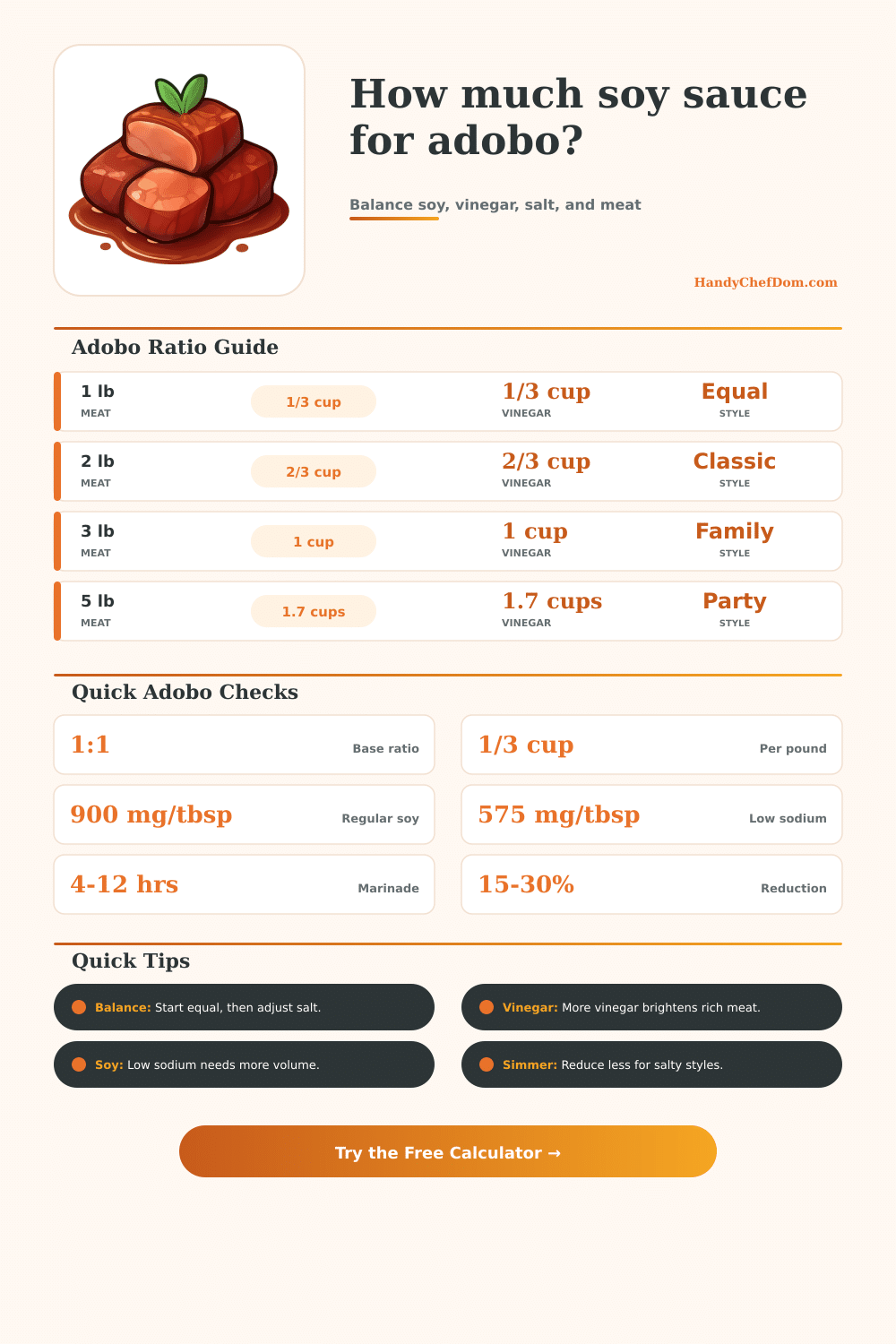
Many adobo recipes begin near equal soy sauce and vinegar. This calculator starts from that classic 1:1 idea, then adjusts for meat amount, sodium style, saltiness target, marinade time, and simmer concentration.
| Batch | Meat | Soy | Vinegar | Style |
|---|---|---|---|---|
| Small | 1 lb | 1/3 cup | 1/3 cup | Equal |
| Family | 2 lb | 2/3 cup | 2/3 cup | Classic |
| Large | 3 lb | 1 cup | 1 cup | Balanced |
| Party | 5 lb | 1 2/3 cup | 1 2/3 cup | Saucy |
| Tangy | 3 lb | 3/4 cup | 1 cup | Bright |
| Savory | 3 lb | 1 1/8 cup | 1 cup | Salty |
| Soy style | Mg per tbsp | Flavor role | Calculator adjust |
|---|---|---|---|
| Regular | 900 mg | Classic salt | 1.00x |
| Low sodium | 575 mg | Gentler salt | 1.28x |
| Light soy | 780 mg | Clean savory | 1.08x |
| Dark soy | 640 mg | Color depth | 1.12x |
| Tamari | 1000 mg | Deep umami | 0.92x |
| Coconut aminos | 300 mg | Mild sweet | 1.45x |
| Meat cut | Raw amount | Cooked yield | Serving cue |
|---|---|---|---|
| Chicken thighs | 1 lb | 78 percent | 2 to 3 |
| Chicken drum | 1 lb | 70 percent | 2 |
| Pork shoulder | 1 lb | 72 percent | 2 to 3 |
| Pork belly | 1 lb | 68 percent | 2 |
| Mixed cuts | 1 lb | 73 percent | 2 to 3 |
| Lean pork | 1 lb | 76 percent | 3 |
| Vinegar | Acidity feel | Flavor | Best fit |
|---|---|---|---|
| Cane | Medium | Clean tang | Chicken |
| Coconut | Medium | Round tang | Pork |
| Rice | Mild | Soft edge | Low salt |
| White | Sharp | Bright bite | Rich cuts |
| Apple cider | Mild | Fruit note | Sweet style |
| Palm | Medium | Earthy tang | Classic pot |
In adobo, the interplay of vinegar and soy sauce matter. Most home cooks learns this the hard way: Their adobo tastes overly salty or flat. Here’s what you need to know: Soy sauce isn’t just for adding salt; it’s also for increasing savory flavor and color. And it evolves with time in a simmering pot. Mess up one component, and all the other shift accordingly. That’s why cooking in proportion is difficult when you change recipe amount.
To use it: You plug in how much meat you’re cooking, what style of soy you want to use (light or dark), what level of saltiness you prefer, and how long you’re going to simmer things. That’s important because a tablespoon of regular soy sauce has roughly 900 milligrams of sodium. A low-sodium version have more like 575 milligrams. So if you switch from one to the other but don’t adjust amount, the dish won’t taste quite right. And the ratio will appear unchanged. The calculator do take that into account.
How to Balance Salt and Vinegar in Adobo
And it takes into consideration soak time, too; the longer something is marinating, the more deeply salt penetrates, making flavor of the soy stronger. Simmer reduction vs. Marinade time are inversely proportional. A short 4 hour marinade with moderate reduction result in a lighter, brighter sauce. An overnight marinade with more reduction makes the flavor strongerer.
So how do you reduce salt if you use to much? Reduce soy as the calculator recommends. In the measuring cup that change seem minor, yet on the plate it can make all the difference. It’s this type of tradeoff that most recipes don’t let you know about.
The equation is also affected by meat type and cut. A chicken thigh is going to give off more liquid than a lean pork chop while cooking. That’s diluted sauce, softening the edge of it. Fat-rendering pork shoulder gets tighter so the same initial ratio taste saltier at the end. These yield differences is illustrated in reference tables on the page, which allow you to guess how much extra vinegar (or water) your finished sauce may require.
Sugars and aromatics are less prominent; they also change the taste but in more subtle ways. Adding a little sugar balance out vinegar sharpness without making things too sweet. Doubling up on those other flavoring agents (garlic, bay leaves) makes them more prominent, and they mute saltiness. Do the math; it is not a waste of ingredient to try something just once.
What’s valuable about running the numbers is that it frees you from thinking of adobo as a fixed recipe. You begin to think about it as a system. How does this change based off the weight of the meat? What happens when I use light soy rather than dark? When your friend brings along an additional pound of chicken, what do you do? Suddenly you’re able to play with these factors as you go, which reduces wasted batches while you learn same lesson over again.