🥩 Prime Rib Defrost Time Calculator
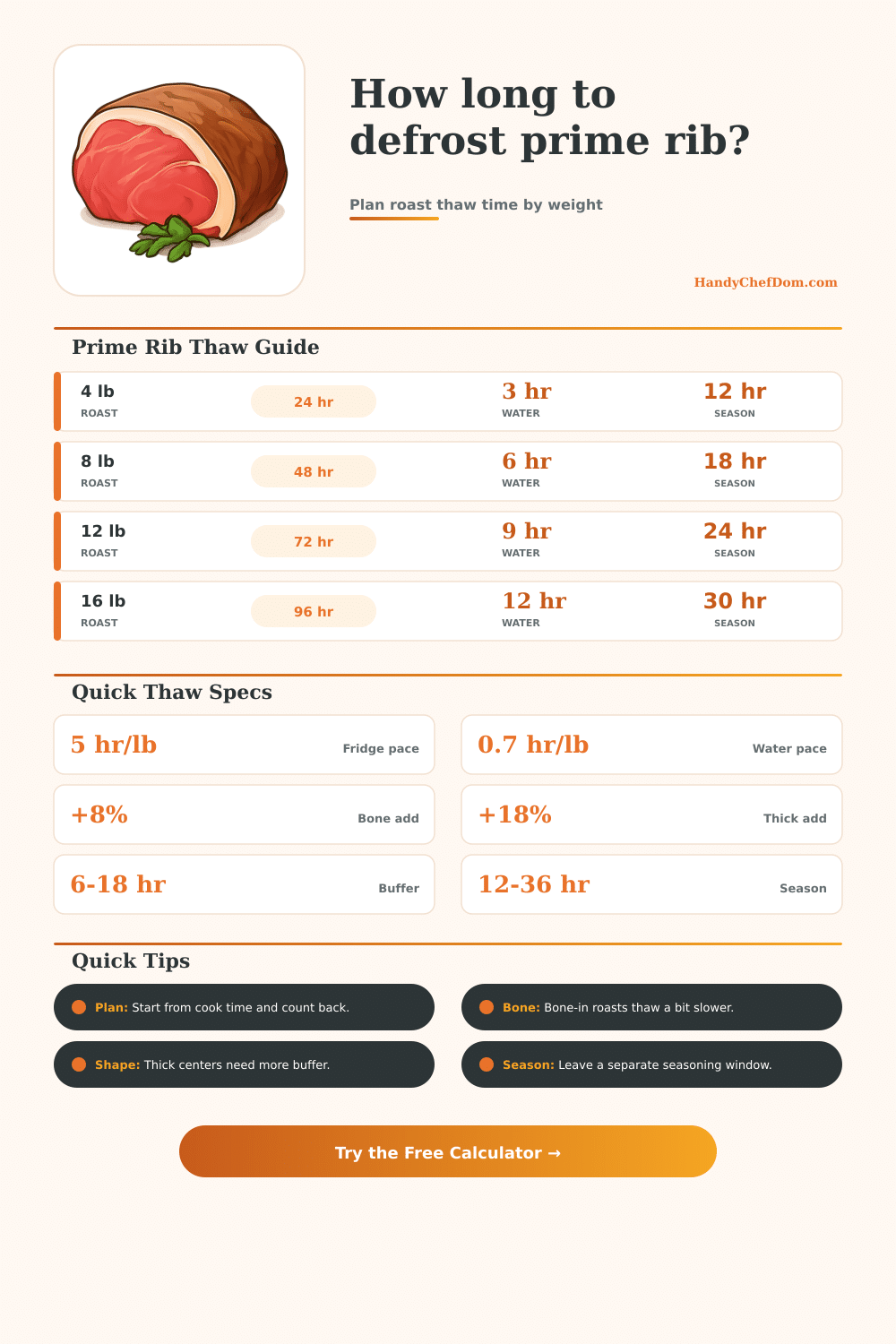
Schedule prime rib thawing from roast weight, bone style, center thickness, thaw method, seasoning window, and your planned cook date.
Enter the frozen roast details and the calculator counts backward from your cook date, adding shape and seasoning windows so the roast is ready before prep begins.
| Roast weight | Boneless fridge | Bone-in fridge | Best seasoning window |
|---|---|---|---|
| 3 to 4 lb prime rib | 18 to 24 hr | 24 to 30 hr | 6 to 12 hr |
| 5 to 6 lb prime rib | 30 to 36 hr | 36 to 44 hr | 12 to 18 hr |
| 7 to 8 lb prime rib | 42 to 50 hr | 48 to 60 hr | 18 to 24 hr |
| 9 to 10 lb prime rib | 54 to 64 hr | 62 to 76 hr | 18 to 30 hr |
| 11 to 12 lb prime rib | 66 to 78 hr | 76 to 92 hr | 24 to 36 hr |
| 14 to 16 lb prime rib | 84 to 104 hr | 96 to 122 hr | 30 to 36 hr |
| Center thickness | Shape note | Fridge adjustment | Water adjustment |
|---|---|---|---|
| 3 inches or less | Small boneless roast | Subtract 6% | Subtract 5% |
| 4 inches | Typical small roast | No change | No change |
| 5 inches | Average rib roast | Add 6% | Add 8% |
| 6 inches | Thick center roast | Add 12% | Add 15% |
| 7 inches or more | Dense holiday roast | Add 18% | Add 22% |
| Method choice | Best use | Timing style | Calculator assumption |
|---|---|---|---|
| Refrigerator method | Planned holiday roast | Slow count-back | About 5 hr per lb |
| Cold-water method | Shorter schedule | Active blocks | About 0.7 hr per lb |
| Fridge plus water finish | Partly thawed center | Split schedule | 70% fridge, 30% water |
| Split roasts | Two equal smaller roasts | Thaw by largest piece | Uses 82% time factor |
| Cook target | Season window | Buffer to add | Start planning rule |
|---|---|---|---|
| Same evening | 6 to 12 hr | 4 to 6 hr | Choose faster method only if schedule is tight |
| Next day lunch | 12 to 18 hr | 6 to 8 hr | Start before the prior evening prep block |
| Holiday dinner | 18 to 24 hr | 8 to 12 hr | Count back before grocery storage fills up |
| Large event roast | 24 to 36 hr | 12 to 18 hr | Give the thick center a full extra cushion |
Cooking a prime rib roast require many days of preparation before the roast is ready for be cooked. Before you can cook a prime rib roast, it must first be thawed complete. If the prime rib roast are still frozen, the roast will not thaw even because the center of the roast will remain cold even when the exterior of the roast reach temperatures that indicate that the roast has thawed.
Because the thawing of a prime rib roast is an uneven process, the timing of the thawing of the roast must be carefully planned prior to seasoning and cooking the roast. The weight of the roast will play a factor in the time it take for the roast to thaw. However, the weight of the roast is not the only factor that will impact the thawing time of the roast.
When and How to Thaw and Season a Prime Rib Roast
A bone-in prime rib roast will take longer to thaw than a boneless roast of the same weight due to the thermal mass of the bones in the roast. Additionally, another factor that will impact the thawing time of the roast is the thickness of the roast. A thicker roast will take longer to thaw than a thinner roast of the same weight.
Thus, two roasts of the same weight may take different time to thaw due to the thickness of each roast and the presence or the absence of bones within each roast. There are different methods for thawing a prime rib roast. One method is to thaw the roast in the refrigerator.
This method is slow, but ensures that the roast is always in a safe temperature zone. Another method for thawing the roast is to thaw the roast in cold water. This method is faster than refrigeration because water transfer heat to the roast better than air does.
However, you must change the water every thirty to ninety minutes to ensure that the roast does not rise in temperature. A third method is to combine the use of the refrigerator and cold water thawing methods. This method allow the roast to be thawed in the refrigerator for a period of time, and then allows the roast to be placed in a water bath once the center of the roast is no longer hard to the touch.
Another step in the preparation of a prime rib roast is seasoning the roast. Seasoning require its own period of time to allow the salt to penetrate the roast to the center of the roast. This process works best when the roast has attained a workable temperature.
Thus, you should not attempt to overlap seasoning with the time required for thawing the roast. Overlapping these two steps may result in the roast not fully thawing prior to seasoning. The calculator included in this guide will mathematically determine the schedule that is required for each step of the process.
After entering the weight of the roast, the style of bone within the roast, the thickness of the roast, and the thawing method that will be utilized, the calculator will determine how many days to count back from the date that you would like to begin cooking the roast. The calculator will indicate on what date the roast must be removed from the freezer. The calculator also allow you to view the specific time when you should begin seasoning your roast and the amount of time you have remaining to begin seasoning.
This feature eliminate the need to calculate the start time of seasoning for the roast yourself. Many individuals make the mistake of assuming that the interior of the roast will be fully thawed when the exterior of the roast begins to feel soft. The center of the roast will remain well below 40 degrees Fahrenheit while the exterior of the roast reach its safe temperature.
Furthermore, refrigerators that are filled with various food items will reach a higher internal temperature than refrigerators that are empty. This higher refrigerator temperature will slow the thawing rate of the roast. The physical feature of the roast can impact the thawing rate of the roast.
For instance, if the roast is tightly wrapped in plastic or placed in a corner of the refrigerator, it will thaw at a slower rate than if it was exposed to air. Roasts that are tightly wrapped will have the thawing time increased in the calculation to account for the impact of dense packaging on the thawing rate of the roast. You should keep the vacuum seal on the roast while thawing in the refrigerator to retain the moisture in the roast.
However, you can break the seal in the last stage of thawing if a water bath will be used to thaw the roast. During the holidays, the refrigerator often becomes filled with various food item. These food items can reduce the amount of air that circulates in the refrigerator and can cause the refrigerator to reach a higher internal temperature.
Using a higher internal refrigerator temperature will impact the thawing rate of the roast. Therefore, it is a recommended process to start the thawing process one extra day early. This buffer time can be entered into the buffer field within the calculator.
A buffer of six to eight hours is recommended because a buffer account for additional time in case the roast reaches the desired temperature but the center of the roast is still colder than expected. When the roast reach the proper temperature, the exterior will feel cool to the touch but not stiff. At this temperature, the roast will readily accept the seasoning that is applied to it.
Applying the seasoning too early will result in seasoning that is not evenly distribute along the roast and a gray band of meat that form under the crust. It is important to perform the thawing and seasoning of the roast as separate processes to ensure the best result. The most important part of preparing a prime rib roast that is to be seasoned is recognizing that time is a vital component of properly seasoning the roast.
The roast will only respond to the specific temperature that it experiences during the thawing and seasoning process. If you establish the schedule for the roast in a manner that begins to build backward from the date on which the roast will be cooked, the results of the roast will be as expected. It should of been done carefuly.
Dont forget to check the roasts center. Youll want to recieve the best results possible. Most people think it is easyer then it actually is.
Its more complex than it looks. If you follow these steps, you can make a delicius meal.