Hot Dog Carb Calculator
Estimate total carbs, fiber, and net carbs for franks, buns, ketchup, relish, onions, low-carb swaps, and party tray scaling.
Hot Dog Carb Results
Classic Ballpark Dog
Low-Carb Bun Dog
No-Bun Plate
| Frank Type | Reference Weight | Total Carbs | Fiber | Net Carbs | Best Use |
|---|---|---|---|---|---|
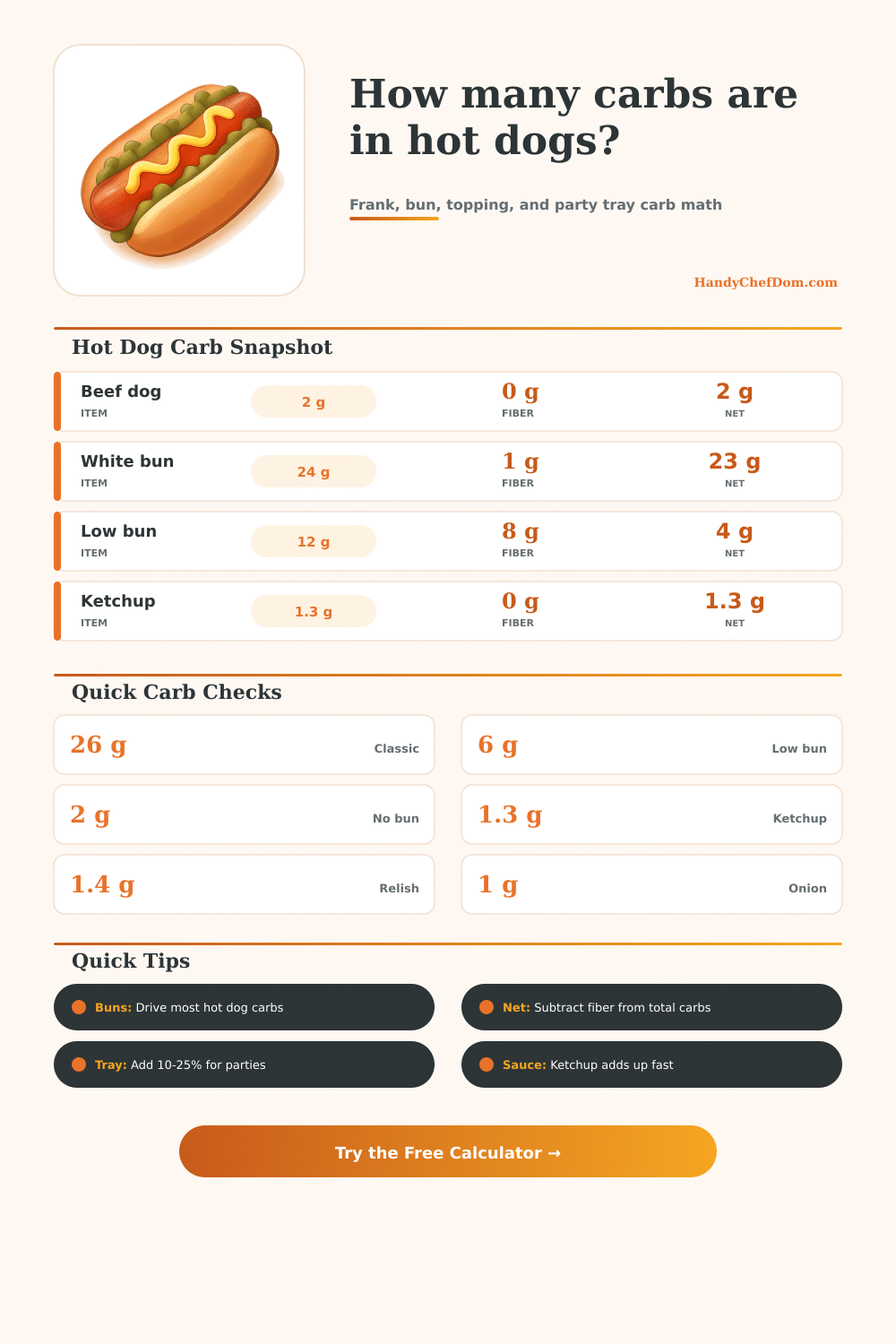
| Beef frank | 1.6 oz / 45 g | 2 g | 0 g | 2 g | Classic cookout math |
| Pork and beef frank | 1.6 oz / 45 g | 2.5 g | 0 g | 2.5 g | Standard mixed franks |
| Turkey frank | 1.6 oz / 45 g | 3 g | 0 g | 3 g | Leaner plate estimate |
| Chicken frank | 1.6 oz / 45 g | 2 g | 0 g | 2 g | Light poultry option |
| Plant-based frank | 1.8 oz / 51 g | 7 g | 2 g | 5 g | Veggie picnic planning |
| Jumbo beef frank | 3.0 oz / 85 g | 4 g | 0 g | 4 g | Stadium-style servings |
| Mini cocktail frank | 0.5 oz / 14 g | 0.7 g | 0 g | 0.7 g | Appetizer trays |
| Cheese-filled frank | 1.8 oz / 51 g | 3 g | 0 g | 3 g | Richer single servings |
| Bun Choice | Total Carbs | Fiber | Net Carbs | Calculator Note |
|---|---|---|---|---|
| Standard white bun | 24 g | 1 g | 23 g | Most classic hot dog carb counts land here |
| Whole wheat bun | 23 g | 3 g | 20 g | Slightly lower net due to fiber |
| Potato bun | 27 g | 1 g | 26 g | Often a higher-carb bun choice |
| Brioche bun | 28 g | 1 g | 27 g | Use for richer cookout buns |
| Low-carb high-fiber bun | 12 g | 8 g | 4 g | Best bun option for net-carb targets |
| Lettuce wrap | 1 g | 0.5 g | 0.5 g | Use when replacing a bun with greens |
| No bun / bowl | 0 g | 0 g | 0 g | Frank and toppings only |
| Topping | Serving Used | Total Carbs | Fiber | Net Carbs | Carb Pattern |
|---|---|---|---|---|---|
| Ketchup | 1 tsp | 1.3 g | 0 g | 1.3 g | Sugary sauce; teaspoons matter |
| Sweet relish | 1 tsp | 1.4 g | 0.1 g | 1.3 g | Sweet pickle relish adds fast |
| Diced onion | 1 tbsp | 1.1 g | 0.2 g | 0.9 g | Moderate carb, small fiber offset |
| Yellow mustard | 1 tsp | 0.2 g | 0.1 g | 0.1 g | Usually a low-carb topping |
| Event Size | Franks Each | Exact Franks | With 20% Buffer | Buns Needed | Planning Note |
|---|---|---|---|---|---|
| Dinner for 4 | 1 | 4 | 5 | 5 | Good for a family meal |
| Family of 6 | 1.25 | 8 | 9 | 9 | Allows a few second halves |
| BBQ for 12 | 1.5 | 18 | 22 | 22 | Useful for mixed appetites |
| Potluck for 25 | 1.25 | 32 | 38 | 38 | Tray buffer prevents short counts |
| Event for 50 | 1.2 | 60 | 72 | 72 | Scale condiments by frank count |
The Bun does not manage carbs by skipping dessert. You might think you are managing your carbs because you skipped dessert, but you didn’t skip the bun. It sounds obvious but most folks don’t realize that the bun contain about 24 grams of carbs (which dwarfs the two or three grams in the frank itself). And those aren’t just empty carbs: there’s two to three gram of carbs in the frank, plus sugar from ketchup and sweet relish on top.
With this tool, simply enter ingredients for the hot dog (frank, bun, condiments) and the party buffer (second helpings and unexpected guests) and keep track of how many carbs you’re taking in with each hot dog. No mental math required when the chips are down at the grill.
Simple Ways to Count Carbs in Hot Dogs
So what kind of sausage? It is not as important than you think. Standard versions of beef, turkey, even plant-based types has similar carb levels (unless you’re looking at a highly processed vegetable version). But again: It’s all about the container. A white bun? No problem. High-fiber low-carb substitute? More like whoa boy. Fiber counts toward your total carb intake; so swapping in high-fiber bun cuts net carbs over 50 percent.
And here’s where things get tricky: Most labels don’t make that clear. To figure out which carbs will affect your blood sugar, you’ve got to examine the column labeled “dietary fiber” vs. “total carbohydrates.” The calculator separates these cleanly… So you see when the no-bun bowl or lettuce wrap version tip the scales away from starch and toward fat and protein.
The biggest sneaky carb culprits are frequently toppings: Ketchup is just boiled-down sugar, a single tablespoon packs roughly as many carbs as a bun (four). Most folks don’t bother to measure, so they double the quantity they put on. Relish is similar because it is made with sugar (cane or high-fructose corn) to keep its bright taste and crunch. By comparison, mustard is nearly free of carbs and piles on some zest without any Glycemic Load.
Use the condiment input field to model how you typicaly eat: If you almost never have ketchup, but stick to mustard like glue, the numbers will reflect those real-world eating patterns instead of assuming a typical ballpark carb count. That accuracy lets you see at a glance whether a given meal matches your macros, or if you’ll have to scale back somewhere else during the day.
There’s another wrinkle: party planning. A formula that multiplies the number of guests won’t cut it when feeding people in groups. They tend to consume more food together then they would individually. The scale-up factor accounts for both second helpings and surprise visitors while avoiding wastefulness. It also scales down the grand total (which we use for our carb inventory) in order to get a reasonable expectation of how many hot dogs will actualy be eaten. In other words, as much as this is an exercise in nutrition, it’s also one of logistics.
How many buns should you purchase? Buy enough to ensure no lonely, forsaken hot dog stare back at you from the serving platter, but not so many that all your bread goes stale before you can finish it. It goes beyond the numbers.
What’s happening around them also matters: How fast carbs get digested depends on the temperature of the food. For example, warm bread breaks down more rapidly than cold bread. Fatty toppings can slow absorption slightly. It’s biochemistry, but you won’t find it on the spreadsheet. However, it impact how it feels.
If you’re keeping tight tabs for healthy reasons, know that combining higher carb ingredients with some fiber and/or protein sources will help blunt the effect. That’s where your expertise comes in. Use the baseline data provided by the calculator, and then interpret it based off the rest of your meal. The number of molecules matters less than their relative proportions in planning a hot dog spread. By avoiding sugary sauces and selecting a proper bun, you’re controlling the ratio.
When you eliminate guesswork from the bulk ingredients and condiments, its easy math. Before diving headfirst into a recipe, check out the reference tables to help you make comparisons side by side. This method turns an out-of-control cookout into a carefully planned nutrition strategy, all while keeping the convenience and flavor of your favorite comfort food. It’s still the same filling meal, only this time you know exactly what it’s costing your body.
At the end of the day, it’s all about being educated, and thus empowered, when sitting at the grill. You know where most of the carb intake is coming from (hint: it’s not the dogs), and now you can make the right swaps without going hungry. Stay in control and still have all the good stuff you love.
And be aware that even a tablespoon of ketchup adds about four grams of carbs to your grand total. Use this to do the math, so you can sit back and flip the dog (rather than stress about reading labels). Leaving the backyard stuffed AND armed with some hard data? That’s a double victory. It is all about eating smart while having fun along the way.