Broccoli Fiber Calculator
Estimate fiber from broccoli florets, cups, grams, stems, fresh or frozen yield, and meal prep batch scaling.
Values use typical broccoli fiber references per 100 g and adjust for cup density, cooking shrink, stems, frozen drainage, serving count, and batch multiplier.
| Broccoli form | Prep method | Typical cup weight | Fiber per cup | Best use in calculator |
|---|---|---|---|---|
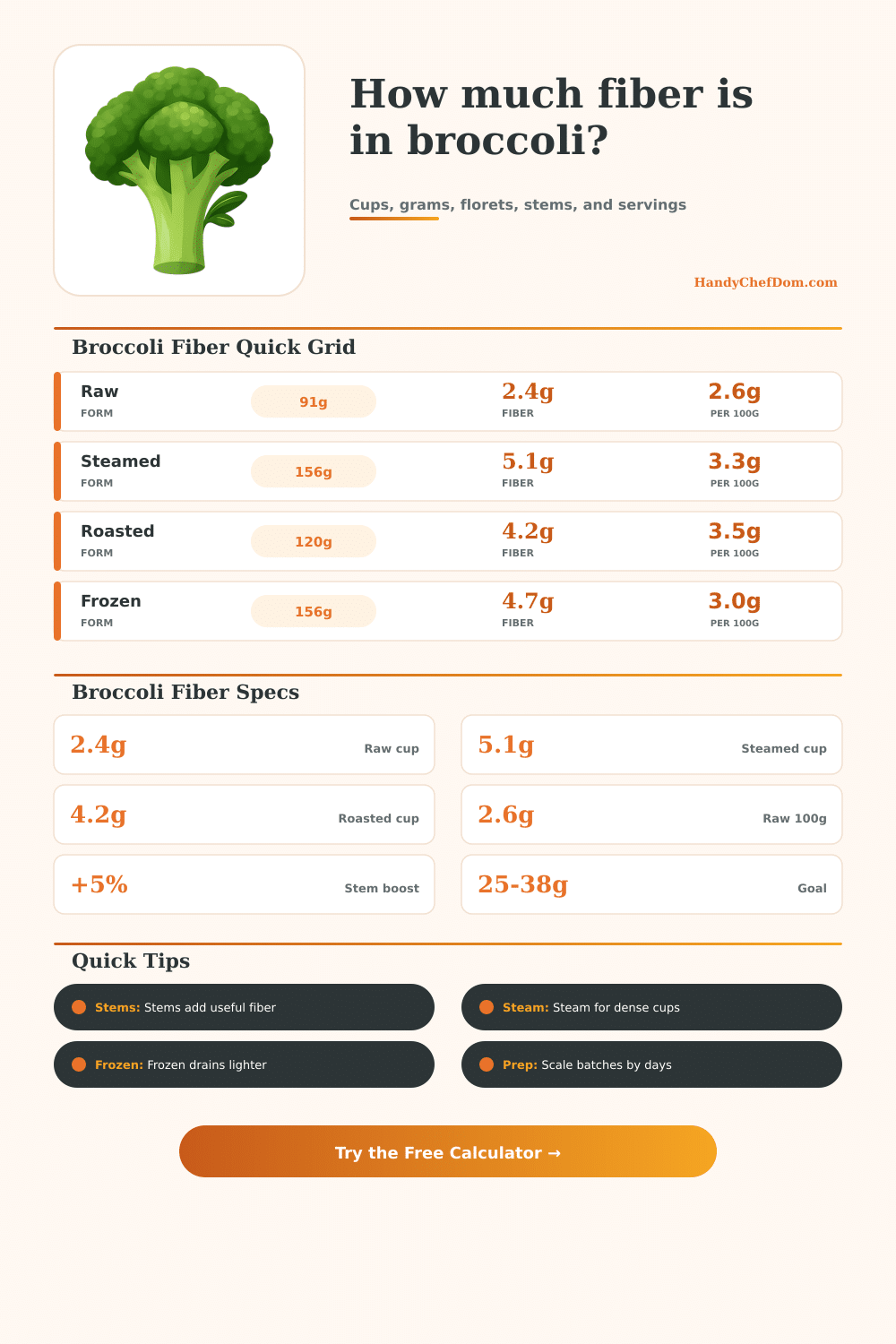
| Fresh chopped florets | Raw | 91 g | 2.4 g | Snack trays and salads |
| Fresh florets | Steamed | 156 g | 5.1 g | Dinner sides and bowls |
| Fresh florets | Roasted | 120 g | 4.2 g | Sheet-pan batches |
| Frozen florets | Steamed | 156 g | 4.7 g | Drained frozen portions |
| Whole head trimmed | Raw or steamed | 88-156 g | 2.3-5.1 g | Fresh yield planning |
| Stems only | Raw or cooked | 100-145 g | 3.0-4.8 g | Slaws and stem-heavy prep |
| Measurement | Raw fresh estimate | Steamed estimate | Roasted estimate | Calculator note |
|---|---|---|---|---|
| 1 cup chopped | 91 g, 2.4 g fiber | 156 g, 5.1 g fiber | 120 g, 4.2 g fiber | Cooked cups are denser |
| 10 medium florets | 120 g, 3.1 g fiber | About 0.8 cup cooked | About 1 cup roasted | Uses 12 g per floret |
| 1 pound fresh | 454 g before yield | About 3 cups cooked | About 3.8 cups roasted | Trim factor may apply |
| 12 oz frozen bag | 340 g frozen | About 2 cups drained | About 2.4 cups roasted | Drain factor may apply |
| Stem-heavy mix | Fiber rises slightly | Dense after cooking | Good for batches | Stem boost is included |
| Scenario | Broccoli amount | Servings | Estimated fiber | Per serving |
|---|---|---|---|---|
| Raw snack bowl | 3 cups raw | 3 | 7.1 g | 2.4 g |
| Steamed dinner side | 4 cups steamed | 4 | 20.6 g | 5.1 g |
| Roasted sheet pan | 5 cups roasted | 6 | 21.0 g | 3.5 g |
| Frozen family side | 2 bags, 24 oz | 6 | 18.4 g | 3.1 g |
| Five lunch boxes | 10 cups steamed | 5 | 51.5 g | 10.3 g |
| Broccoli serving | Fiber estimate | Share of 25 g goal | Share of 28 g goal | Share of 38 g goal |
|---|---|---|---|---|
| 1 cup raw chopped | 2.4 g | 10% | 9% | 6% |
| 1 cup steamed | 5.1 g | 21% | 18% | 14% |
| 1 cup roasted | 4.2 g | 17% | 15% | 11% |
| 2 cups steamed meal prep | 10.3 g | 41% | 37% | 27% |
In most meal prep containers, broccoli are an afterthought. It is a green garnish on your chicken that makes it appear healthiar but doesn’t really provide any substance.
But what if you started thinking about broccoli as major source of fiber? Suddenly the math look different.
How to Measure Broccoli Correctly
One cup of broccoli is not always equal to one cup of broccoli. People always think one cup of broccoli mean one cup of broccoli. This leads them to fail at tracking their diet before they even start. The calculator above figure all this out for you. It takes into account waste and density shifts to let you know exactly how much you’re eating.
The greatest variable in broccoli fiber is water. Most home cooks is confused by that fact, since raw chopped florets have lots of air space in them. If you measure out one cup of chopped broccoli florets, you’ll think there’s more plant matter in that standard measuring cup then there actualy is. Roast or steam your broccoli, however, and all that moisture are lost as the florets collapse on themselves. As they compact, their structure makes the vegetable much denser by volume. Cooked broccoli will weigh much more per cup than raw broccoli pieces because it is packed more tight. In other words, cooked cups gives you way more fiber per unit of the container. Nothing changes with the total nutrients of the vegetable itself; only the packing efficiency.
We often throw away some valuable nutrients when eating broccoli stems out of habit. It takes a little more work… It’s got to be peeled, and then there’s that pesky white stalk you want to throw away. Turns out, though, that the stalks is pretty fibrous. Adding the stem into the equation will clearly increase the total fiber you’ll recieve per pound of what you bought at store. When you’re meal prepping for five days, you don’t want to trim off half your vegetable. Doing so would of been a waste of time and inefficient. The tool allows you to adjust for how much of the stem is included in whatever you’re eating. Is it all floret? Or is it a mixed bag with large amounts of the white stalk as well?
Frozen broccoli brings up some extra things to think about regarding moisture content and yield. If the frozen broccoli isn’t drained thoroughly, the remaining melted ice crystals will dilute your final volume. You could have one-pound bags of broccoli resulting in widely varying serving sizes, depending on whether you’ve tossed them directly into a stir fry or allowed them to drain off excess water in a colander first. Depending on the frozen product level of drainage, you can adjust for this within the calculator. Adjusting here is useful if you’re looking to meet certain nutritional goals for each container.
The way something’s prepared also changes its texture and therefore its fullness (how filling it will be), which can impact portion size indirectly. For example, I prefer roasted broccoli over steamed because it’s chewy; maybe you do too? Maybe you’ll want more of that kind! And then there’s the question of “how much of ____ is needed to make me feel satisfied?” It varies based off texture. Knowing that may help you plan for just the right amount of food to leave you feeling full but not stuffed. You won’t need high-calorie filler foods at all.
For instance, if hitting your recommended daily fiber intake of 25-38g per day is one of your goals, does your broccoli side dish count as two grams or five? When you know what a food will add to your total intake, you can plan the rest of the meal accordingly. The reference data bridges the gap between what it says on the package at the grocery store and what you will actualy end up eating. It may be an impressive-looking raw snack bowl but it might not deliver much more fiber than a heaping serving of roasted greens at dinner time. Having realistic outputs from the planning process means you won’t get frustrated when you find out you’ve short-changed yourself. By knowing how many meals the number represent, you’ll know exactly what size batch to make so you can use it for the rest of the week with confidence. And best of all, it takes something fuzzy like “I should eat more healthily” and translates it into something specific, a plan that is possible in real life.
Next time you cut up a head of broccoli, think about the density too: color isn’t everything. Fill only as much as necessary; let the math tell you how big or small to go.