🧈 Butter Cups to Sticks Converter
Convert cups of butter into sticks, tablespoons, ounces, and grams, then scale the amount for baking batches with salted and melted-butter notes.
Enter the butter amount from a recipe, choose how it is measured, and set the original and new batch yield. Cups are treated as US measuring cups unless metric grams are selected.
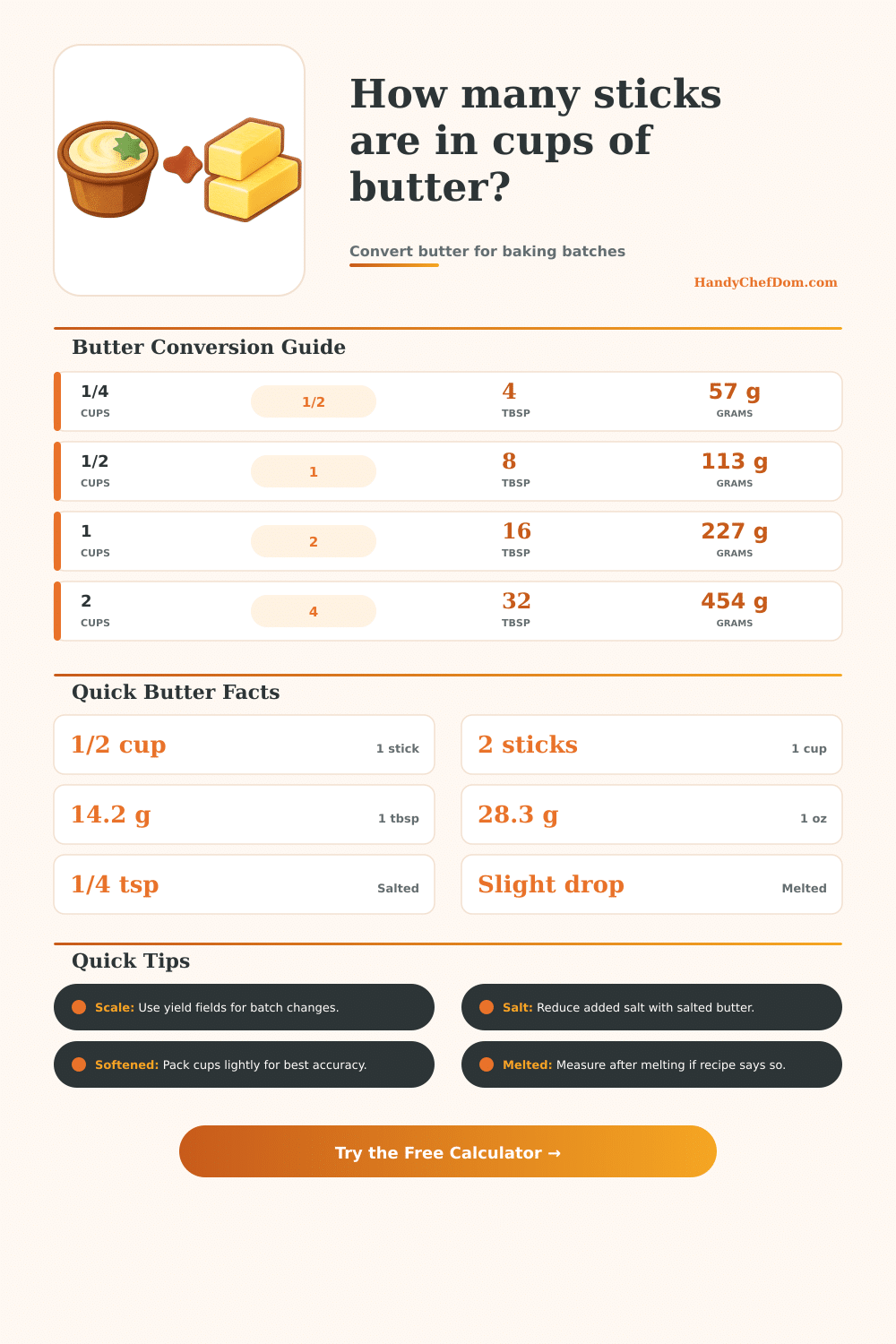
| Cups butter | Sticks | Tablespoons | Ounces | Grams |
|---|---|---|---|---|
| 1/8 cup | 1/4 stick | 2 tbsp | 1 oz | 28 g |
| 1/4 cup | 1/2 stick | 4 tbsp | 2 oz | 57 g |
| 1/3 cup | 2/3 stick | 5 1/3 tbsp | 2.67 oz | 76 g |
| 1/2 cup | 1 stick | 8 tbsp | 4 oz | 113 g |
| 2/3 cup | 1 1/3 sticks | 10 2/3 tbsp | 5.33 oz | 151 g |
| 3/4 cup | 1 1/2 sticks | 12 tbsp | 6 oz | 170 g |
| 1 cup | 2 sticks | 16 tbsp | 8 oz | 227 g |
| 2 cups | 4 sticks | 32 tbsp | 16 oz | 454 g |
| Butter state | Typical cup weight | Best measuring method | Conversion note |
|---|---|---|---|
| Cold or packed solid | 227 g per cup | Use wrapper marks or scale | Standard 1 cup equals 2 sticks |
| Softened scoop cup | 215 g per cup | Press lightly, level flat | May need a little more volume |
| Melted liquid measure | 227 g per cup | Read liquid line at eye level | Melting packed butter can look lower |
| Whipped tub style | 150 g per cup | Weigh before replacing sticks | Air makes volume much lighter |
| Batch change | Scaling factor | 1 cup butter becomes | Kitchen shortcut |
|---|---|---|---|
| Half batch | 0.50x | 1 stick | 8 tbsp or 113 g |
| Two-thirds batch | 0.67x | 1 1/3 sticks | 10 2/3 tbsp or 151 g |
| Double batch | 2.00x | 4 sticks | 32 tbsp or 454 g |
| Triple batch | 3.00x | 6 sticks | 48 tbsp or 680 g |
| Butter type | Approx salt per stick | Best use | Recipe adjustment |
|---|---|---|---|
| Unsalted sweet cream | 0 tsp | Baking control | Use recipe salt as written |
| Salted butter | 1/4 tsp | Cookies and simple bakes | Reduce added salt by estimate |
| Lightly salted butter | 1/6 tsp | Everyday swaps | Reduce salt slightly |
| European unsalted | 0 tsp | Pastry and laminated dough | Weigh for higher fat style |
| Cultured unsalted | 0 tsp | Rich flavor bakes | Use recipe salt as written |
| Vegan baking stick | 1/6 tsp | Dairy-free baking | Check label if salt matters |
Two sticks is one cup of butter. That’s a direct relationship, something I like in my baking, as it makes seeing amounts easier than making careful measurements of each substance. A half stick is a quarter cup. A stick and a half are three quarters. No need for graduated cylinders here. Math has become something real you can hold in your hands.
For example, sometimes a fraction is not enough. Like trying to turn 12 cookies into 30 cookies. Sometimes it’s about adjusting measurement units, such as converting grams to tablespoons in US units.
Tips for Using Butter in Baking
Beyond straight math, some things behave different depending on their fat content or temperature (like butter). Packed cold butter is denser than softened butter, which means it will take up a greater volume then the same amount of soft butter. And melted butter shrinks even further because air pockets collapses. That’s why if you pour melted butter in a cup, and then go back later and pour out what was originaly solid butter, your measurement isn’t going to be right anymore, there is less liquid at top now that the air bubbles have collapsed.
For something delicate like a soufflé or cake, precision counts. The tool lets you adjust butter density to account for this difference between states.
The other factor is salt. I know many people who prefers salted butter on their toast because of how it tastes. But throw that salted butter into sponge cake, and you’re going to be out of luck. Butter brands vary in salt levels. If you are using salted butter, consider cutting down on the added salt in your recipe.
Also, butter labeled as “European” style will contain more fat than American-style butter, and there will be less water. These differences affects dough behavior. For example, substituting high-fat cultured butter without making up for the moisture might result in cookies spreading so thin they lose shape. Pie crusts will turn tough. The converter lets you understand these trade-offs visually. Just choose your butter type and see what it does to both volume and weight.
Another variable is scaling up in batches. A double batch doesn’t necessarily translate into 100% of each ingredient being doubled. You might be limited by the size of your pan or oven. Increasing amount may change the surface area, which will affect moisture and browning.
The butter serves a structural purpose and carries flavors. Not enough butter result in dry baked goods. Too much results in greasy baked goods. How much do you need? Understanding the role of fat can help guide you on whether it’s worth measuring out exactly to the gram. Butter gives cookies there chewy texture. In cakes, it aerates when creamed with sugar. In pastries, it adds flakiness due to steam.
Perfection isn’t what baking’s all about; it’s all about consistency. No need for a laboratory scale when making batch of muffins. But learning to convert between weight and volume spares you experiments gone wrong. You should of used it. Knowing how much butter you have gives you confidence whether you’re cooking for crowd or adjusting for altitude. Butter becomes less of a confusing ingredient and more of a dependable part. Respect the state of the butter, trust the numbers, bake by intention, not guesswork.