Chickpeas Fiber Calculator
Estimate fiber from cooked chickpeas, canned drained chickpeas, dry-to-cooked batches, hummus, and roasted chickpea servings with daily goal and soluble fiber estimates.
Chickpea Fiber Estimate
| Chickpea Form | Typical Measure | Gram Weight | Estimated Fiber |
|---|---|---|---|
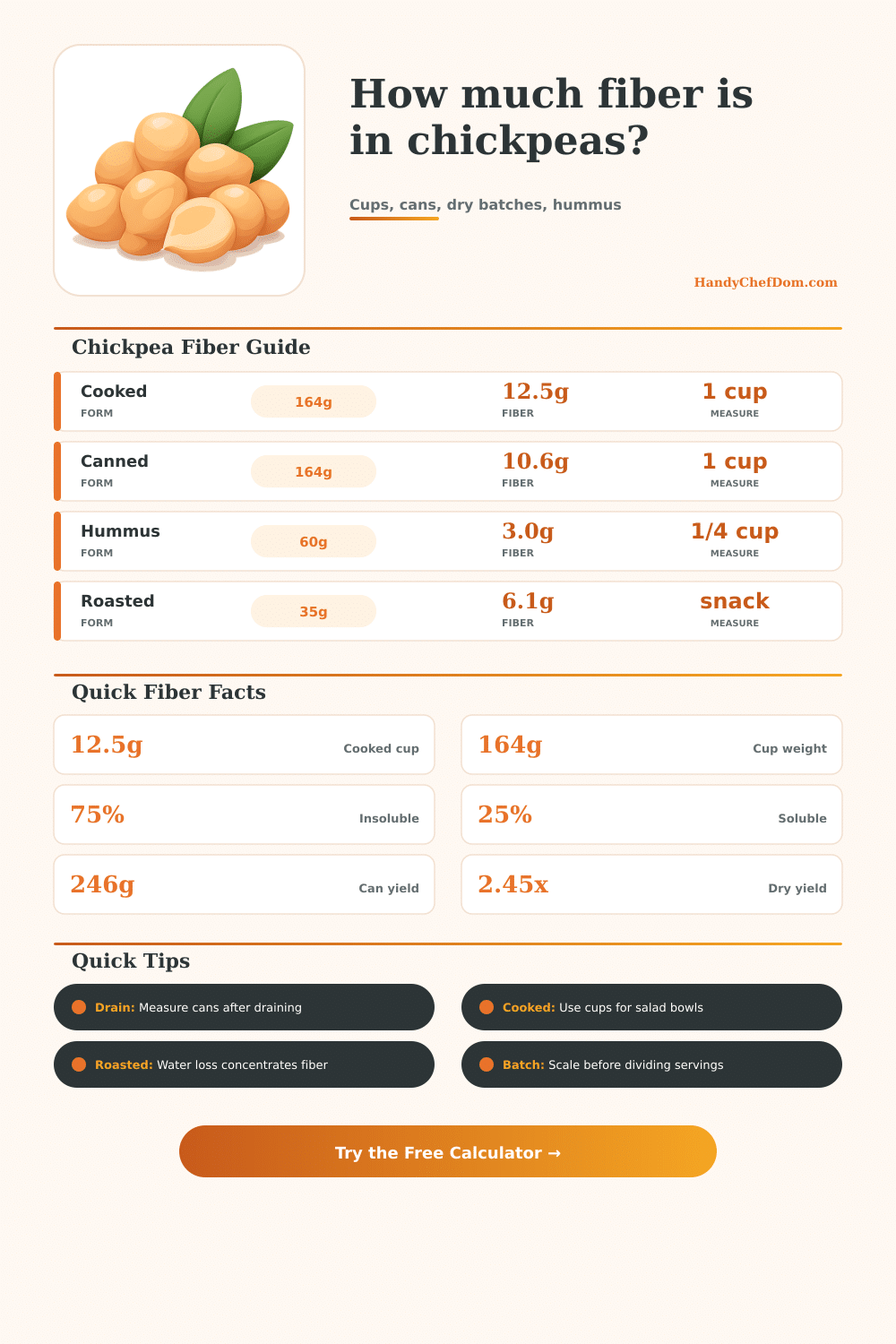
| Cooked whole chickpeas | 1 cup | 164 g | 12.5 g |
| Canned drained chickpeas | 1 cup drained | 164 g | 10.6 g |
| Dry chickpeas after cooking | 1 cup cooked yield | 164 g cooked | 12.5 g |
| Hummus or chickpea dip | 1/4 cup | 60 g | 3.0 g |
| Roasted chickpea snack | Small snack portion | 35 g | 6.1 g |
| Conversion | Starting Amount | Finished Yield | Fiber Planning Note |
|---|---|---|---|
| Dry to cooked | 100 g dry | About 245 g cooked | Use cooked weight for final fiber |
| Dry cups to cooked cups | 1 cup dry, about 200 g | About 3 cooked cups | Best for large batch scaling |
| Canned drained yield | 1 standard 15 oz can | About 246 g drained | Use the drained label if different |
| Cooked cup weight | 1 level cooked cup | About 164 g | Measure after draining surface liquid |
| Serving Plan | Chickpea Role | Common Portion | Fiber Per Person |
|---|---|---|---|
| Side salad topping | Light add-in | 1/4 cup cooked | About 3.1 g |
| Grain bowl protein | Main bean portion | 1/2 cup cooked | About 6.3 g |
| Chickpea-forward meal | Large portion | 3/4 cup cooked | About 9.4 g |
| Hummus snack tray | Dip portion | 1/4 cup hummus | About 3.0 g |
| Batch Scale | Cooked Cups | Approx Servings | Total Fiber |
|---|---|---|---|
| Small dinner | 2 cups | 4 half-cup servings | About 25 g |
| Meal prep | 4 cups | 8 half-cup servings | About 50 g |
| Potluck bowl | 8 cups | 16 half-cup servings | About 100 g |
| Event pan | 16 cups | 32 half-cup servings | About 200 g |
A bag of dried beans or a can of chickpeas labels itself as healthy, offering protein and heart-healthy benefits, yet it doesn’t specify just how many grams of fiber you will recieve. So there you are, standing in the pantry, eyeing the label, does it really live up to its claims? Enter this calculator: a way to close the gap from general nutrition claims to the real-life number of grams going into your belly. It do the math for you by converting chickpeas into other forms.
The density changes depending on whether they are dried or cooked, so you don’t need to remember those numbers. Whether it’s a bag of dry beans that expands dramatically after cooking, a can of beans without liquid, or even hummus made into a spread, each form alter the weight. And that alteration massively impacts the resulting amount of fiber.
Why Use This Chickpea Fiber Calculator
You’ll notice this tracker keeps tabs on both insoluble and soluble fiber… Why does that matter? It is more important than many realize. Most chickpea fiber is the insoluble variety, which adds bulk to your diet and helps keep things moving along in your digestive tract. There is also some soluble fiber, which dissolves in water and help control blood sugar levels.
Using this calculator, you can change the estimate of soluble fiber as a percentage, depending on the level of processing on the beans. Whole cooked chickpeas may lean one way or the other, whereas smooth hummus made with added oils changes not only the texture, but maybe the digestion profile. Tweak these to make them more personally relevant to you in order to get a better picture of what those numbers mean for your gut health.
Another variable that gets meal preppers is that cooking dry chickpeas (from scratch) means there’s another number to juggle. Dry beans don’t magically become bigger; they soak up water and grow many times in size when cooked. That means the number of cooked cups at the end is way more than the number of dry cups you started with. The calculator has a default yield multiplier based off typical beans; this helps meal preppers who do their own batch cooking estimate the servings accurately without first having to boil any water.
In other words, does one cup of dry beans make 1/2 cup cooked, or 3 cups? This matters if you are serving a large potluck dish! How many servings will you need to serve all of your friends? The input scales to let you see what the total fiber output would be across an entire group, not just per-person guesses.
Besides being convenient, there are some odd things about how canned food is measured. For example, did you know that fifteen-ounces of chickpeas doesn’t end up weighing fifteen ounces? That’s because the beans need to be drained, and a bunch of water gets thrown out when you do that. A lot of recipes will ask for cups of drained beans. This means you’ll want to enter how many grams of drained product you’re dealing with.
Alternatively, you might use the number of cans as the input field. Knowing exactly what you weigh will prevent you from thinking every can holds the same amount. This isn’t true, as some brands put more into each can than other brands. It makes a difference if you’re tracking fiber, for instance, and trying to meet a certain daily fiber intake goal.
There’s no one size fits all when it comes to daily fiber goals (they differ by gender, age, physical activity levels), but in general, adults should aim for about 25-38 grams/day. Enter your target into the calculator to see what percentage of that amount each serving provide. That makes the data actionable: I know I consumed 12 grams of fiber. Great! But I also know that’s 40% of my day’s worth.
That tells me how to round out the other parts of my meal. If my chickpea salad provides half my daily amount, maybe I’ll skip the bran cereal later and have something lighter. This nutritional profile makes for some interesting twists, like roasted chickpeas, where the water has been cooked off and the nutrients concentrated during roasting.
Because they are roasted, they pack more fiber into a small handful of crunchy snacks different than a handful of soft cooked beans, which take up more space but offer less fiber. That’s where the focus on weights gets really key in the calculations, foods that are dried or roasted concentrate the nutrients, and volume can be a misleading measurement here. There’s a set of reference tables provided on the page that lays out these differences, so you can see how the various forms compare side by side, without having to do any math in your head.
In the end, this isn’t really about being perfect as much as it’s about being consistent. Tracking what you’re eating doesn’t mean you should of weighed each individual bean… Improving your health comes from incorporating habits over time. When you have an idea of what you’re putting into your body, you feel good about it, whether that means you’ve prepped for the week ahead or simply tossed some ingredients into a quick bowl.
Run the numbers through our calculator above so you don’t have to worry about doing the math while you’re eating and cooking. Adjust to however many servings you’d like and get creative with whatever form works best for you. See where it falls in your diet.