🥜 Peanut Butter Sugar Calculator
Estimate sugar in peanut butter by tablespoons, grams, type, texture, serving count, and kitchen use, including teaspoons equivalent and sugar-to-fiber ratio.
Enter peanut butter as tablespoons or grams. Choose natural, sweetened, flavored, or powdered style, then set texture, serving count, recipe use, and any added sugar used in the same batch.
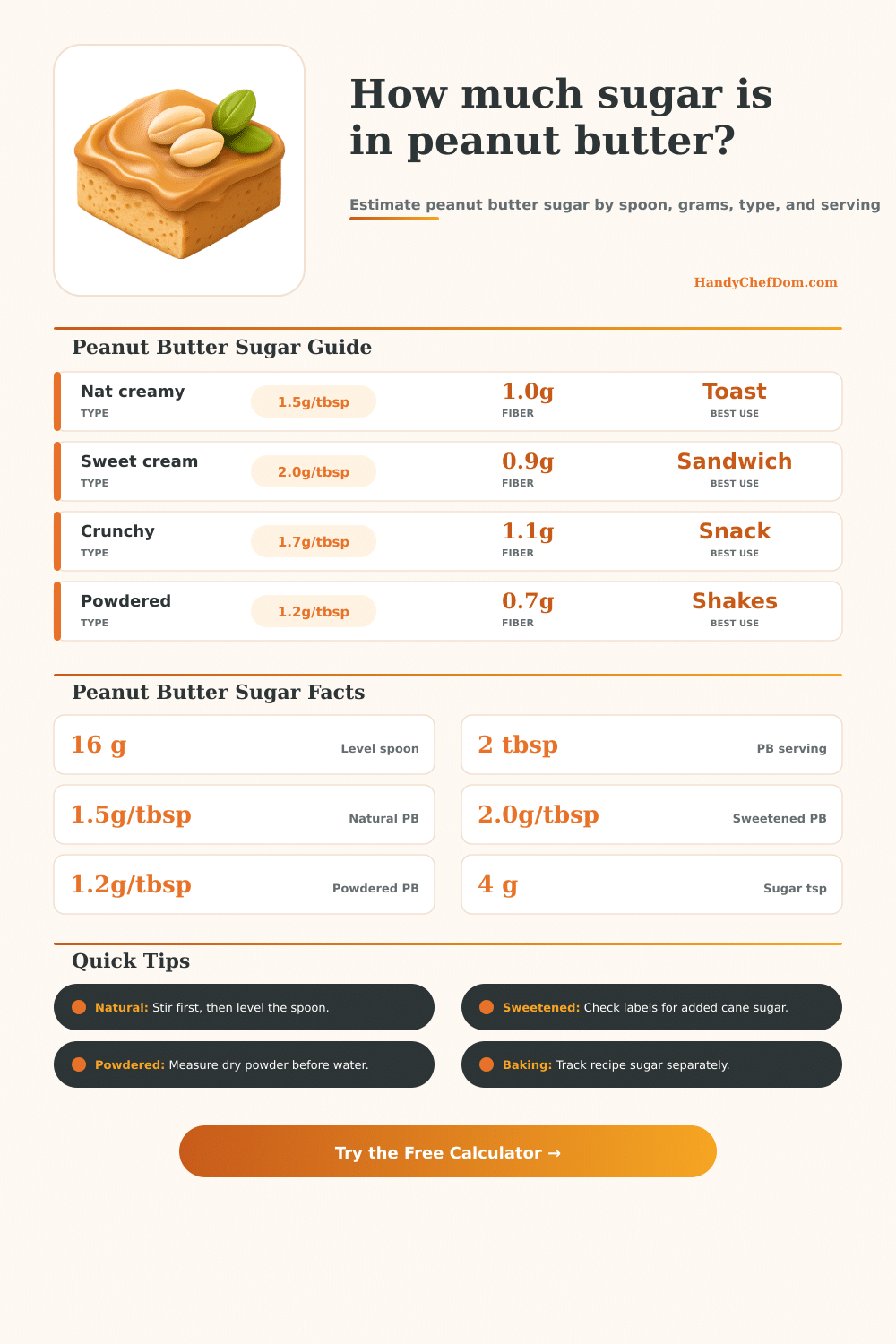
| Peanut butter type | g per tbsp | Sugar per tbsp | Fiber per tbsp | Best calculator use |
|---|---|---|---|---|
| Natural creamy, no added sugar | 16.0 g | 1.5 g | 1.0 g | Toast, oatmeal, ingredient labels with peanuts and salt |
| Natural crunchy, no added sugar | 16.5 g | 1.6 g | 1.1 g | Snack plates and crunchy sandwich spreads |
| Sweetened creamy peanut butter | 16.0 g | 2.0 g | 0.9 g | Classic PB sandwiches and kids lunches |
| Sweetened crunchy peanut butter | 16.5 g | 2.1 g | 1.0 g | Crackers, celery sticks, and lunch plates |
| Honey roasted peanut butter | 16.0 g | 2.6 g | 0.8 g | Sweet toast, snack dips, dessert bars |
| Chocolate peanut butter spread | 16.0 g | 4.0 g | 0.6 g | Sweet snacks and dessert-style fillings |
| Powdered peanut butter original | 6.5 g | 1.2 g | 0.7 g | Protein shakes, yogurt, smoothies |
| Powdered chocolate peanut butter | 6.5 g | 1.5 g | 0.6 g | Chocolate shakes and low-fat baking |
| Reduced-fat sweetened peanut butter | 16.0 g | 2.7 g | 0.8 g | Reduced-fat labels that replace fat with sweeteners |
| Use case | Typical peanut butter | Typical sugar | Serving note | Best entry mode |
|---|---|---|---|---|
| Classic sandwich | 2 tbsp sweetened creamy | 4.0 g | One filling layer before jelly or honey | Tablespoons per serving |
| Toast spread | 1 tbsp natural creamy | 1.5 g | Thin breakfast spread | Tablespoons per serving |
| Fruit snack dip | 2 tbsp crunchy or creamy | 3.0-4.2 g | Divide by snack plates | Grams per serving |
| Powdered shake | 2 tbsp powdered PB | 2.4 g | Measure dry powder before liquid | Tablespoons per serving |
| Cookie batter | 8 tbsp peanut butter | 12-32 g | Add recipe sugar separately | Batch tablespoons |
| Savory sauce | 4 tbsp natural or sweetened | 6-8 g | Count sauce servings after thinning | Batch tablespoons |
| Amount | Natural creamy sugar | Sweetened creamy sugar | Powdered original sugar | Teaspoons equivalent |
|---|---|---|---|---|
| 0.5 tbsp | 0.8 g | 1.0 g | 0.6 g | 0.2-0.3 tsp |
| 1 tbsp | 1.5 g | 2.0 g | 1.2 g | 0.3-0.5 tsp |
| 1.5 tbsp | 2.3 g | 3.0 g | 1.8 g | 0.5-0.8 tsp |
| 2 tbsp | 3.0 g | 4.0 g | 2.4 g | 0.6-1.0 tsp |
| 4 tbsp | 6.0 g | 8.0 g | 4.8 g | 1.2-2.0 tsp |
| 8 tbsp | 12.0 g | 16.0 g | 9.6 g | 2.4-4.0 tsp |
| Texture | Spoon weight factor | Sugar adjustment | Fiber adjustment | When to use it |
|---|---|---|---|---|
| Creamy level spoon | 1.00x | 1.00x | 1.00x | Smooth jars, level measuring spoon |
| Crunchy packed spoon | 1.03x | 1.00x | 1.10x | Chunky jars with peanut pieces |
| Drippy natural spoon | 0.97x | 0.98x | 0.96x | Oil-separated natural jars after stirring |
| Dry powdered scoop | 1.00x | 1.00x | 1.00x | Powder measured before rehydrating |
Sugar and fiber estimates vary by brand, roast level, sweetener, and how tightly a spoon is packed. Use grams and the jar-label override when exact label tracking matters.
Here’s what it looks like: Two almost identical-looking jars of peanut butter sitting on your pantry shelf… One has salt and peanuts; the other has peanuts plus some sort of smoothness and sweetness. The reason why this can be a dilemma lies in choice between types and their sugar content. But it’s not just about consistency. It’s sugar. Because even though both are legume-based, addition of sweetener in commercial varieties completely alters metabolic impact. If you’re on an anti-hidden-carb diet or tracking energy input/output daily for energy balance, knowing exactly how much sugar is in every spoonful will help you to makes more informed decisions.
After entering in what you’re eating, it’s up to the tool (above) to do the math. There’s no need to guesstimate weight of a level spoon vs. A packed spoon (is that more grams?) or remember to convert between textures. Because the real world doesn’t behave like that… One spoonful has more fiber (and is a little heavier!) if it’s crunchier than another that’s more creamy (the calculator takes that into account). It will even considers what kind of peanut butter you pick. Powdered peanut butter is different based off its density and amount of added sugar. That’s where the inputs come in: Pick the right serving size and the right texture, and output should reflect what you actualy ate (not some made-up-average that may or may not align with contents of your jar).
Why Sugar Content Varies in Peanut Butter
One-and-a-half grams is roughly how much sugar there is in a tablespoon of natural peanut butter. But unlike sugar added via high fructose corn syrup or cane, this sugar come from the peanuts themselves. It is held within their natural structure alongside fiber and protein, which together slow its absorption. Sweetened creamy peanut butter can reach up to two grams of sugar per tablespoon. Varieties that includes chocolate swirls or honey roasted go still further. While individually these figures might not look like anything to be alarmed at, consider how fast that adds up if you put a dollop of PB on some toast, stir a spoonful into your oatmeal, or dunk some apple slices into it. Multiply the amount of sugar per serving by total servings in any given day or batch and the calculator let you visualize the total effect.
How does texture affect accurate tracking? Turns out that it matters quite a bit. Compare a heaping spoonful of crunchy peanut butter to one with the same size but with a lot more cream. The peanuts increases the weight but not the sweetness. Same goes for level spoon. Powdered forms for protein shakes alter math further: you measure dry mass first, then hydrate later. The table on the page breaks these types down. Sugar vary greatly based on added ingredients and process; fiber remains fairly stable across brands. If your particular brand indicates something different, you can change defaults. This is important as companies’ recipes frequently change, and differ widely by region.
Peanut butter is one example where separating out sugar added as an ingredient from sugar added during cooking makes all the difference. Depending on the type of peanut butter you use, it could of being contributing upwards of a dozen grams of sugar by itself. Add an additional cup of either brown or white sugar, and that number go up quickly. Separating them helps eliminate double counting and paints a more accurate picture of how sweet final baked good will be. It also help you modify other components in your batter while avoiding adding extra sweetener inadvertantly. Especially if you’re making multiples for meal prep, knowing exactly what is going into each serving and ensuring they fits into your target nutritional window eliminates any guesswork.
So here’s the takeaway: Peanut butter sugar isn’t one thing; it all depends on the context. Does it depend on how much you put in your bowl? How do you use peanut butter in your food? What else is in the jar?