🌿 Oregano in Spaghetti Sauce Calculator
Scale dried or fresh oregano for tomato volume, simmer length, basil balance, garlic level, meat style, acidity, steep time, and pasta servings.
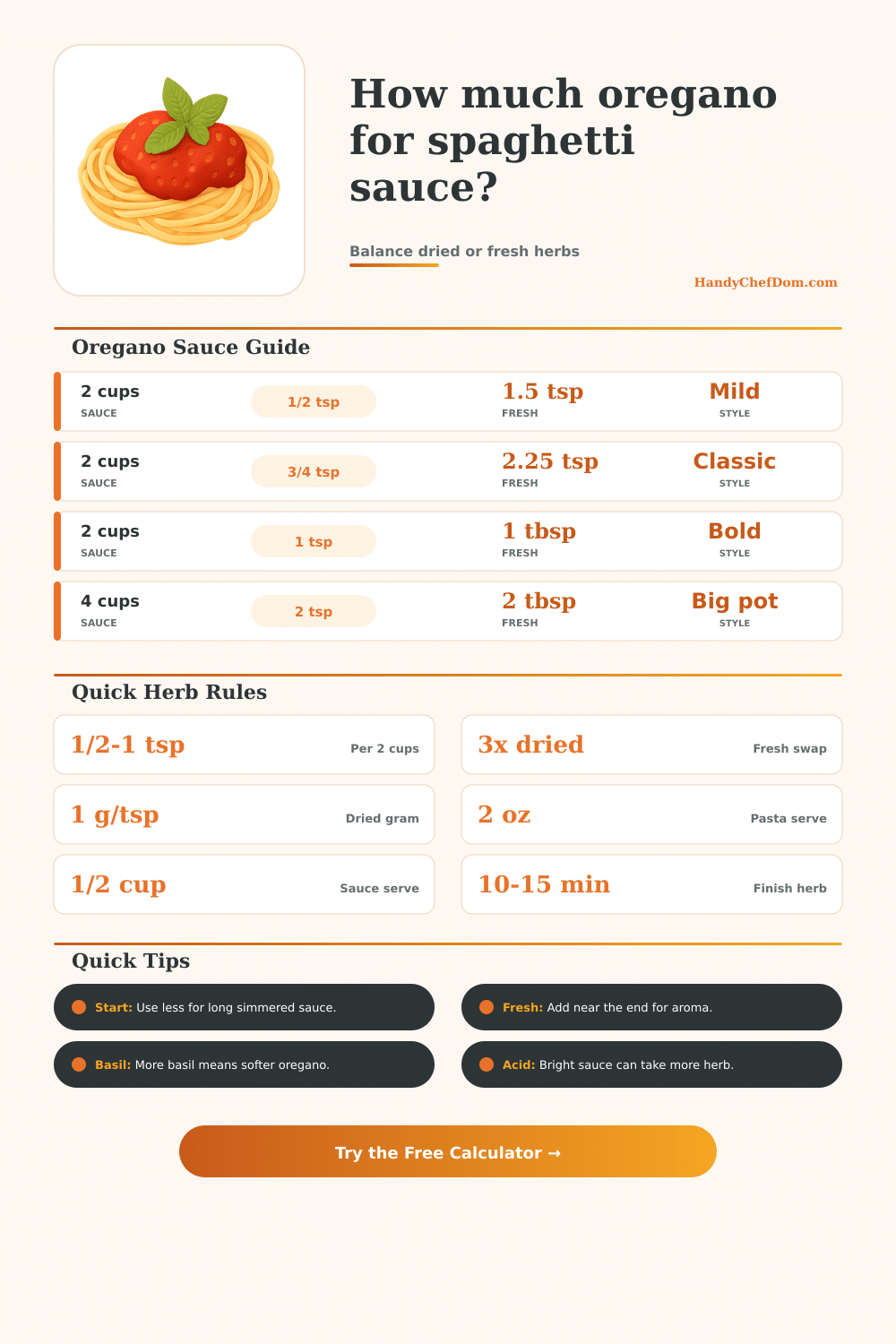
Dried oregano is potent, and a common starting range is about 1/2 to 1 teaspoon per 2 cups of sauce. This calculator adjusts that range for tomato volume, simmer time, fresh-versus-dried form, basil, garlic, meat richness, acidity, and serving coverage.
| Dried Oregano | Fresh Leaves | Fresh Sprigs | Best Timing |
|---|---|---|---|
| 1/4 tsp | 3/4 tsp chopped | 1 small sprig | Last 10 to 15 min |
| 1/2 tsp | 1 1/2 tsp chopped | 2 small sprigs | Last 15 min |
| 3/4 tsp | 2 1/4 tsp chopped | 3 small sprigs | Last 15 to 20 min |
| 1 tsp | 1 tbsp chopped | 3 to 4 sprigs | Last 20 min |
| 2 tsp | 2 tbsp chopped | 6 to 8 sprigs | Split early and late |
| 1 tbsp | 3 tbsp chopped | 9 to 12 sprigs | Large batch finish |
| Tomato Base | Approx Sauce | Classic Oregano | Servings |
|---|---|---|---|
| 2 cups sauce | 2 cups | 3/4 tsp | 4 light plates |
| 1 can, 28 oz | 3 1/2 cups | 1 1/3 tsp | 6 to 7 plates |
| 2 cans, 28 oz | 7 cups | 2 2/3 tsp | 12 to 14 plates |
| 3 cans, 28 oz | 10 1/2 cups | 4 tsp | 20 plates |
| 1 qt sauce | 4 cups | 1 1/2 tsp | 8 plates |
| 1 gal sauce | 16 cups | 2 tbsp | 32 plates |
| Dry Pasta | Plates | Sauce Needed | Oregano Range |
|---|---|---|---|
| 8 oz | 4 | 2 cups | 1/2 to 1 tsp |
| 12 oz | 6 | 3 cups | 3/4 to 1 1/2 tsp |
| 16 oz | 8 | 4 cups | 1 to 2 tsp |
| 24 oz | 12 | 6 cups | 1 1/2 to 3 tsp |
| 32 oz | 16 | 8 cups | 2 to 4 tsp |
| 5 lb | 40 | 20 cups | 5 to 10 tsp |
| Simmer Plan | Dried Oregano Timing | Fresh Oregano Timing | Adjustment |
|---|---|---|---|
| No simmer | Bloom 2 min in oil | Add at finish | Use full amount |
| 15 to 30 min | Add after tomatoes | Last 10 min | Classic amount |
| 45 to 60 min | Add half early | Last 15 min | Add 5% if needed |
| 90 min | Add half early | Last 20 min | Add 8% finish |
| 2 hours plus | Hold some back | Last 20 min | Split the dose |
| Freezer batch | Season lightly | Fresh after thaw | Keep 10% back |
Most spaghetti sauces is centered around oregano, yet few cooks take this herb seriousy. Too much and its piney sharpness makes tomato medicinal; too little and there’s no anchoring agent for the tomatoes. Achieving just-right involves more than a single rule.
Factors include sauce ingredients (does it have meat?); the quantity of tomatoes; the presence or absence of other herbs like basil or garlic; and how long the dish simmer. Plugging in those variables into our calculator will give you the math, but understanding how each factor into the equation helps.
How to Use Oregano in Spaghetti Sauce
The first limitation is amount of tomatoes used. Obviously, the more sauce, the more oregano, but it’s not a linear relationship, since the sauce will concentrate due to evaporation of water. Slow-cooking a big pot destined for the freezer differ from making small one for family dinners, for example. The calculator scales based off real-world cups, not merely servings, so you don’t double the recipe only to realize you got much more herby sauce than you wanted.
The second tweak is simmer time. A pinch of oregano add aroma; a longer simmer tames dried versions’ bright flavor (and makes them softer). So most cooks toss in some at the beginning to deepen the flavor, then a bit more closer to serving for aromatics. With fresh oregano, the reverse is true. Tossing in the fresh stuff right at the start will cause it to lose its scent fast, hence the tool’s advice to add it later. Its makers know that simmer time makes all the difference. They have programmed this into step called “steep time.” This way, the last suggestion accounts for whether your ingredient is fresh sprigs or dried leaves.
Other herbs also work together, such as basil and garlic. Too much basil in a sauce overpowers other flavors; it need less oregano since there’s already plenty of aroma competing. Oregano can be covered up by strong garlic, or made to stand out even more. Instead of guessing what amount of each might make up for the others’ impact, the calculator does it all in one adjustment.
Another wrinkle is meat sauces. Bright marinara tastes better restrained, as the tomato should stay front-and-center; rich ragus can accommodates more oregano. How acidic is it? A sharper-tasting sauce can carry heavier amounts of herb without seeming harsh, while something sweet benefit from lighter touches of oregano. You can indicate this preference in the tool, and it’ll reflect in final result.
Those relationships become apparent in the reference tables. There’s one comparing fresh and dried forms at various volumes, and another showing how many servings each total yield. Use the tables as a quick check when you’re adjusting by eye, then run the calculator for more precise starting point. You won’t ever have exactly the right answer. You’ll be somewhere within a range where you can taste-test and adjust to your liking.
Little things add up, especially with whole batch. A quarter teaspoon too much oregano early in the simmer could of require an extra pinch of sugar or splash of cream at the end to bring the sauce back into balance. Get off on the right foot, and save yourself a step, by starting out as close to correct as possible.