🧁 Powdered Sugar Box to Cups Converter
Turn any box, bag, or partial carton of powdered sugar into usable cups with texture, sifting loss, recipe need, and reserve built in.
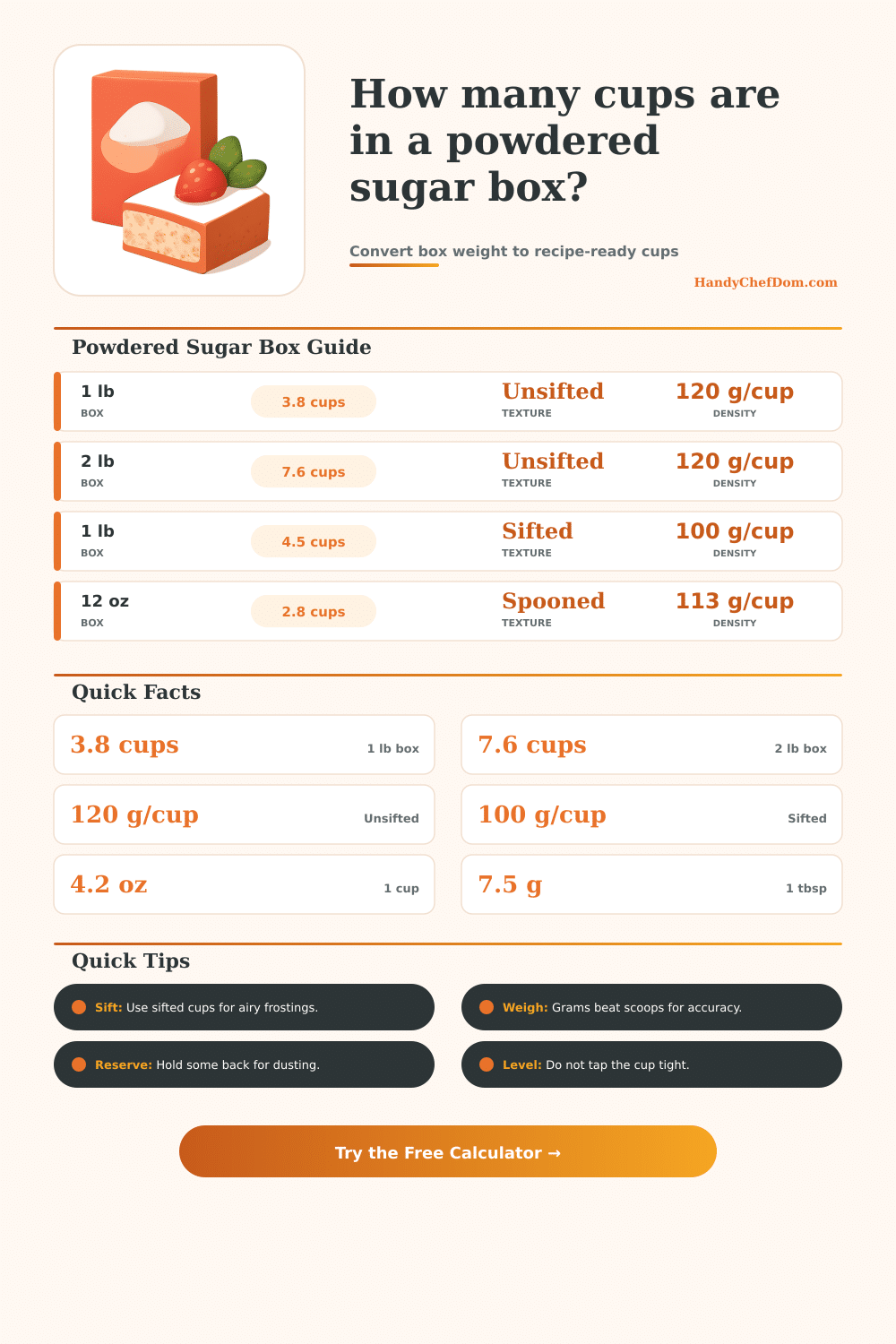
Powdered sugar cups are not fixed because texture changes the grams per cup. Unsifted confectioners sugar is commonly treated as about 120 g per cup, while sifted powdered sugar is closer to 100 g per cup.
| Package Label | Net Weight | Unsifted Cups | Sifted Cups |
|---|---|---|---|
| Small carton | 8 oz / 227 g | 1.89 cups | 2.27 cups |
| Partial box | 12 oz / 340 g | 2.84 cups | 3.40 cups |
| Standard box | 16 oz / 454 g | 3.78 cups | 4.54 cups |
| Large carton | 24 oz / 680 g | 5.67 cups | 6.80 cups |
| Two pound bag | 32 oz / 907 g | 7.56 cups | 9.07 cups |
| Metric carton | 500 g | 4.17 cups | 5.00 cups |
| Measurement Texture | Density Used | Best For | Conversion Note |
|---|---|---|---|
| Unsifted from box | 120 g/cup | Most recipes | Use when recipe says powdered sugar cups without sifting first. |
| Spooned and leveled | 113 g/cup | Careful baking | Spoon into the cup, level, and avoid tapping the cup. |
| Sifted first | 100 g/cup | Macarons and icing | Sifting aerates the sugar, so the same weight fills more cups. |
| Lightly packed | 125 g/cup | Quick frosting | A small tap or scoop from a dense box increases grams per cup. |
| Firm packed | 135 g/cup | Dense scoops | Useful when sugar has compacted during storage. |
| Humid or clumpy | 128 g/cup | Pantry checks | Break lumps first, then use a slightly heavier cup density. |
| Commercial icing sugar | 115 g/cup | Bakery formulas | Good middle value for very fine anti-caking blends. |
| Recipe Use | Common Cup Need | Approx Weight | 1 lb Box Share |
|---|---|---|---|
| Buttercream frosting | 3.75 to 4 cups | 450 to 480 g | About 1 box |
| Cream cheese frosting | 2 to 3 cups | 240 to 360 g | About 1/2 to 3/4 box |
| Glaze or drizzle | 1 to 2 cups | 120 to 240 g | About 1/4 to 1/2 box |
| Royal icing | 4 to 4.5 cups | 480 to 540 g | Just over 1 box |
| Cookie dusting | 0.25 to 0.5 cup | 30 to 60 g | Small portion |
| Donut coating | 2 to 4 cups | 240 to 480 g | Half to 1 box |
| Kitchen Unit | Unsifted Weight | Sifted Weight | Useful When |
|---|---|---|---|
| 1 tablespoon | 7.5 g | 6.25 g | Small glaze adjustments |
| 1/4 cup | 30 g | 25 g | Dusting and finishing |
| 1/3 cup | 40 g | 33 g | Small icing batches |
| 1/2 cup | 60 g | 50 g | Glazes and fillings |
| 1 cup | 120 g | 100 g | Recipe scaling |
| 1 pound | 3.78 cups | 4.54 cups | Box conversion |
It’s the classic volume vs. WEIGHT cooking puzzle: You have a recipe calling for three cups and a one pound box of powdered sugar sitting before you in the pantry. Sixteen ounces, according to the label, but no dice; there’s nothing left in your measuring cup except doubts. Powdered sugar is anything but watery. Depending on how it’s handled, it shift around, settling into lumps and aerating as it goes. Scoop it out of the bag and you’ll have a dense cupful. Sift it first and you’ve got a different story. It is the same amount of stuff, but there is much more volume because you’ve added air to its structure.
Plug in what type of texture you want (stiff versus runny) and package size and the converter above take care of the rest. No guesswork here, you’re getting just the right amount for your frosting.
How to Measure Powdered Sugar Correctly
Why does it matter? Powdered sugar has roughly one hundred twenty grams per cup (unsifted). After sifting, it’s more like a hundred grams per cup, since it traps air and breaks up clumps. Twenty grams doesn’t sound like much…until you realize we’re talking about measuring four cups of sugar for a single batch of buttercream. If you don’t think about the impact on texture, you might be off by a full eight ounces of sugar at that volume.
This is a mistake most home bakers make: they think a cup is a cup no matter what form it takes. You must know exactly what you are measuring in your specific situation. Before you do this with sugar, consider: where does the sugar live? Has it been in that box for months on the shelf? Then it’s probably settled. What happens when you scoop from the bottom of the box? The cup is heavier. What happens when you scoop from the top? It is fluffy.
So the tool lets you adjust for something called texture settings (like firm packed, lightly packed). And these options allow you to match the way things actualy are in your real life, instead of trying to meet some idealized standard. You’re not just translating units: you’re calibrating based off how your sugar is stored.
Humidity matters here as well. Sugar will pull water out of the air. Powdered sugar can get clumpy and a little sticky in a humid environment, making it heavier again by volume in each cup.
And speaking of waste: There’s also the issue of loss. Sifted sugar will stick to a mesh screen or turn into fine dust. For home bakers, this hardly ever represents more than a couple percentage points. But if you’re baking professionally, those margins are precious. Recipe reserve and sifting loss can be entered into the calculator’s fields.
If you’re doing big batches and would like a little wiggle room (i.e., five percent of your sugar supply in reserve, in case you has to thicken a glaze last-minute), here’s where you’d put that number. This provides just enough of a buffer so you don’t go mad with three minutes remaining on the clock and you’ve got no sugar left in the box.
While you’ll see static numbers on reference tables, cooking is dynamic. Unsifted, a standard one pound box equals about three and three quarter cups. Sifted, it’s slightly less than four and a half cups. And that makes all of the difference visually in the bowl. The amount of sugar you choose depends on whether you want the frosting to have structure (so it isn’t grainy) and how easy you want it to spread. An icing that is too sugary may be hard to work with, but one that is too loose won’t hold its peaks. Match your measurements to the kind of texture you like and it works.
There is a reason for this. If precision counts when you’re measuring things, don’t just go by volume. Because the weight of an ingredient never varies different than its level of fluffiness or aeration, weighing everything out in grams leaves no guessing at all. Fluffy is as good as packed; 120 grams is always 120 grams.
But most recipes you’ll come across will still be written in cups. You should of known where you’re starting from to close this gap. Once you know your baseline, use the converter, and adjust accordingly if needed. Have some set aside for finishing touches on your cookies or cakes. Better to have a bit leftover than to run short trying to get just the right swirl. Weight first, honor the air, and let the tool take care of the rest while you concentrate on the mix.