Bacon Sodium Calculator
Estimate bacon sodium by strips, slices, grams, regular bacon, thick-cut bacon, turkey bacon, low-sodium bacon, cooked yield, crispy shrink factor, serving count, and recipe use.
1Bacon Sodium Presets
2Bacon Amount, Type, Yield, and Serving Inputs
Choose whether you are counting strips, slices, raw grams, or cooked grams. The calculator estimates raw bacon sodium, cooked yield, sodium per serving, daily limit percent, and how crispy shrink changes the cooked portion.
Bacon sodium result
Choose bacon details, then calculate.
3Live Bacon Sodium Snapshot
4Bacon Type, Slice, and Sodium Grid
| Bacon type | Typical slice weight | Sodium per slice | Sodium per raw 100 g | Standard cooked yield |
|---|---|---|---|---|
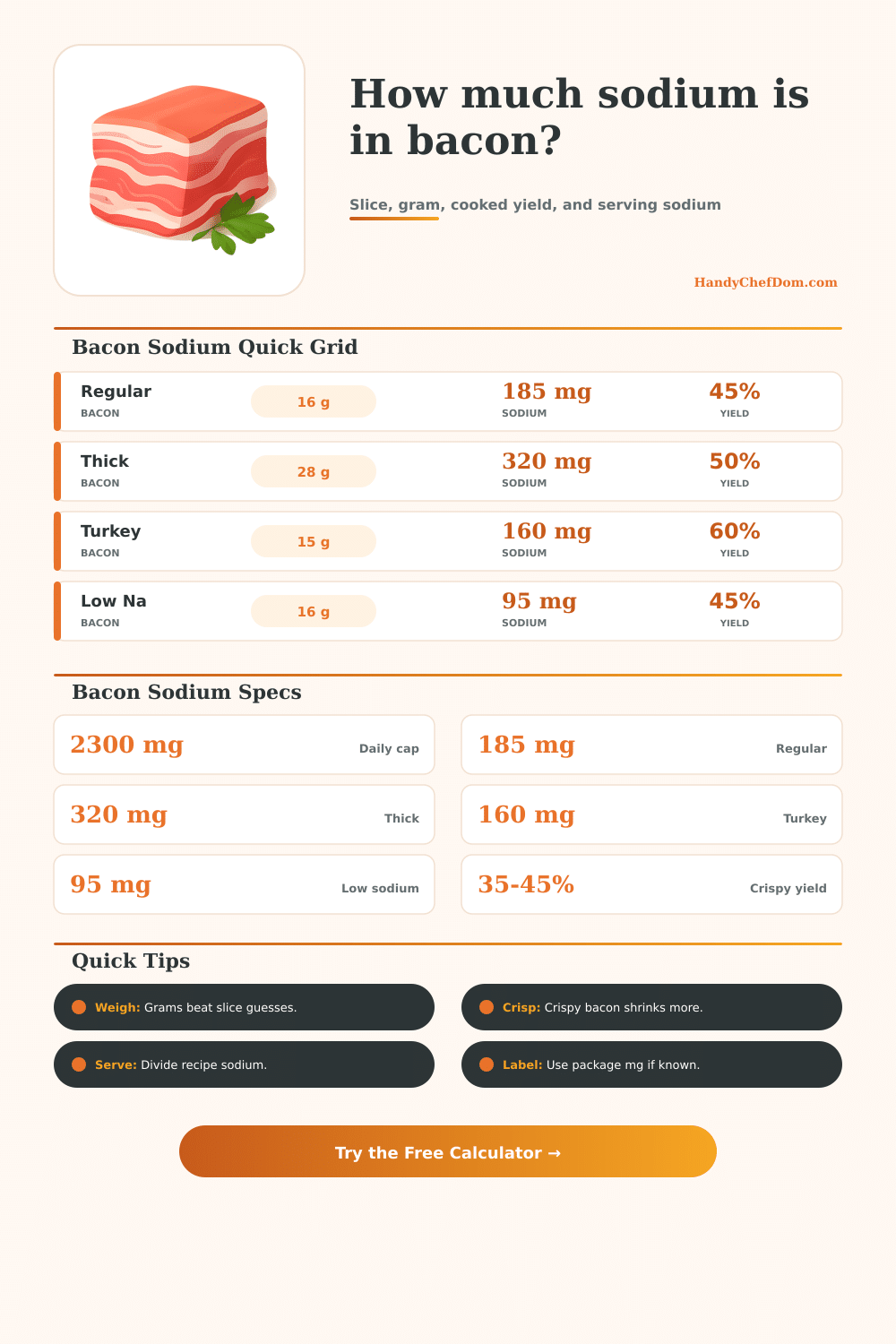
| Regular pork bacon | 16 g raw strip | About 185 mg | About 1156 mg | About 45% |
| Thick-cut pork bacon | 28 g raw strip | About 320 mg | About 1143 mg | About 50% |
| Center-cut bacon | 14 g raw strip | About 160 mg | About 1143 mg | About 48% |
| Turkey bacon | 15 g slice | About 160 mg | About 1067 mg | About 60% |
| Low-sodium pork bacon | 16 g raw strip | About 95 mg | About 594 mg | About 45% |
| Uncured-style bacon | 16 g raw strip | About 180 mg | About 1125 mg | About 45% |
| Canadian bacon rounds | 20 g round | About 240 mg | About 1200 mg | About 85% |
| Cooked bacon bits | 7 g tablespoon | About 125 mg | About 1786 mg | Already cooked |
5Crispy Shrink and Cooked Yield Table
| Crisp level | Cooked yield from raw | Cooked grams from 100 g raw | Sodium reading | Best calculator use |
|---|---|---|---|---|
| Soft-chewy bacon | 55% | 55 g cooked | Sodium is less concentrated per cooked gram | Sandwich strips with bend. |
| Standard crisp bacon | 45% | 45 g cooked | Default for breakfast strips | Most skillet or oven bacon. |
| Very crispy bacon | 38% | 38 g cooked | Sodium is more concentrated by cooked weight | BLT slices and crumbles. |
| Extra-crispy crumble | 32% | 32 g cooked | Small weight can carry high sodium | Salad, soup, and topping bits. |
| Turkey bacon standard | 60% | 60 g cooked | Less rendering than pork bacon | Meal prep and breakfast plates. |
| Canadian bacon | 85% | 85 g cooked | Little shrink compared with streaky bacon | Rounds, muffins, and diced recipes. |
6Serving Count and Recipe Use Table
| Use case | Typical bacon amount | Serving count | Capture factor | Why it matters |
|---|---|---|---|---|
| Breakfast side | 2 strips per person | 1 to 6 servings | 100% | Every strip is assigned to a plate. |
| BLT sandwiches | 3 strips per sandwich | 2 to 8 servings | 90% | Some fat and crumbs stay behind. |
| Crumbled salad | 4 to 8 strips total | 4 to 12 servings | 80% | Rendered bits distribute unevenly. |
| Soup garnish | 2 to 6 strips total | 4 to 10 servings | 70% | Small garnish amount is spread thin. |
| Casserole or bake | 6 to 12 strips total | 6 to 16 servings | 60% | Recipe yield and portions dilute bacon. |
| Party bacon bits | 12 to 24 strips total | 12 to 30 servings | 80% | Topping bowls often have leftover bits. |
7Common Bacon Sodium Scenarios
| Scenario | Bacon selection | Total sodium | Per serving sodium | Daily limit share |
|---|---|---|---|---|
| Two regular strips | Regular bacon, 2 slices | About 370 mg | 370 mg for one serving | About 16% of 2300 mg |
| Three-strip BLT | Regular bacon, 3 slices | About 555 mg | 500 mg with 90% capture | About 22% of 2300 mg |
| Thick-cut brunch plate | Thick-cut bacon, 2 slices | About 640 mg | 640 mg for one serving | About 28% of 2300 mg |
| Turkey bacon meal prep | Turkey bacon, 8 slices | About 1280 mg | 320 mg across four servings | About 14% of 2300 mg |
| Low-sodium breakfast | Low-sodium bacon, 2 slices | About 190 mg | 190 mg for one serving | About 8% of 2300 mg |
| Salad crumble batch | Regular bacon, 6 slices | About 1110 mg | 148 mg across six servings | About 6% of 2300 mg |
8Bacon Sodium Mode Comparison
Best when counting strips or sandwich slices from a package. Label override improves accuracy.
Best before cooking because raw weight connects directly to sodium per raw gram.
Best after cooking. The calculator reverses cooked weight through the shrink factor.
Best when a recipe, package, or nutrition panel already gives the sodium total.
9Two Practical Bacon Sodium Tips
When you fry bacon, odds is good you simply do so until it seems ready, a chewy center, maybe some crispy edges. As the grease bubbles in the skillet, I doubt anyone ever thinks of the sodium content. Bacon’s an indulgence; why bother with math? For most of us, sure, no worries. But for someone watching their blood pressure (or just wanting to hit specific nutrition targets) those sneaky milligrams can add up quick.
Unfortunately, bacon varies in ways that trick you. A thick slab of maple-cured meat may contain different levels of salt than a thin slice of center-cut pork. Eyeballing each slice doesn’t cut it. This is a recipe for guesswork, and guesswork is how you end up blowing your day’s allowance before noon.
How to Count Salt in Bacon
Once you know what you’re cooking, the tool above will do all the math for you. More importantly, it goes beyond just counting slices; it accounts for weight, cure type, and the pesky little factor known as shrinkage. Start with the bacon variety. Why? Because each kind of bacon contains wildly different amounts of sodium per gram: low-sodium varieties, turkey bacon, and regular pork bacon. These become the bases on which the calculator work out the final salt load. Override with label data if you’ve got the package handy. Labels vary by brand more than by cut thickness. Use numbers from the label. It is better to have manufacturer’s data then some general average. You’ll be way ahead of the game when every hundred milligrams brings you closer to your max.
And that’s before the act of cooking itself. Bacon shrivels. Seriously. Like, a ton. The calculator consider how water leaves and fat is reduced when you cook something (hence the term “shrink factor”). It also accounts for effect of salt remaining in the meat. So as the bacon crisps up, its weight goes down, while the salt stays behind, becoming even more concentrated on a per-gram basis. In other words: When you fry up some bacon and then weigh it, you’re working with a denser product different than what came out of the package raw. It doesn’t take a PhD in chemistry to grasp this concept, but you do have to think about it. Underestimating salt level is easy enough to do if you’re thinking “raw weight” when you should of being thinking “cooked weight.”
The equation is also affected by the context of recipe. Is it two strips straight out of the pan? Is it eight strips crumbled over a big salad for a party of six? The calculator take into account the serving size. It also considers how the strips is being used in a recipe. That way, it avoids mistake many of us make. We often credit one little piece with all the sodium found in whole pound of bacon. When you’re using a pound of bacon to build BLT sandwiches, for instance, you may be getting only about 90 percent of the bacon’s sodium into every bite, the rest will remain stuck to the pan (or on your plate). By dividing up total load based off how many servings of it you ate, this tool helps you get a more realistic guess of what the sodium is on a per-plate basis. It can also help you add additional sources of sodium to the mix, such as cheese or bread, so that you know full picture instead of just the meat part.
The slice count is where most people end their analysis. Three slices = three servings of salt. Not so much! Thickness of a given cut of bacon can vary widely from brand to brand. A thick cut may contain as much or more sodium than regular cut. However, it requires more grams per serving to take up that same amount of space on your plate. The best way to get the most accurate answer is with a scale and weighing raw grams pre-cooking. This eliminates all ambiguity around slice size. Not everyone has access to a scale though. In that case, choosing the right slice size multiplier will help close gap between what you see and what really exists.
And I don’t want you to fear bacon. I want you to know bacon. You won’t see the sodium until it shows up on a nutrition label. Or your health metrics. From vague estimates like “a slice” or “some,” you’ll track the serving size, the cut, and the shrink. And you may discover that by switching to a low-sodium version, you can have three rather then two and still stay within your limit. Or you might realize that crumb toppings are cheaper on the sodium budget than whole strip.
With the calculator, you’re not just holding back; you’re adjusting, empowered by knowledge. Reach into packet next time, scan the label, choose your preset, let the numbers do the guiding: Your hand, your choice. Then enjoy knowing just how much you put on that plate (and eat better).