Ground Beef Sodium Calculator
Estimate natural ground beef sodium, added table salt, seasoning blend sodium, cooked yield, per-serving sodium, daily limit percentage, and practical burger, taco, or bolognese scaling.
1Ground Beef Sodium Presets
2Raw Weight, Lean Ratio, Seasoning, and Salt Inputs
Ground beef is naturally modest in sodium; most recipe sodium comes from table salt, salty seasoning blends, broths, sauces, or packets. This tool keeps natural beef sodium separate from added sodium so serving math stays clear.
Ground beef sodium result
Enter beef, seasoning, salt, yield, and serving details, then calculate.
3Live Ground Beef Sodium Snapshot
4Beef Style, Seasoning, and Sodium Grid
Approximate sodium per 100 g raw beef before salt or seasoning blends are added.
Butcher blends and formed patties can carry added salt before home seasoning.
Regular packets can add hundreds of milligrams per listed packet serving.
Leaner beef usually loses less weight, so cooked portions scale differently.
5Lean Ratio and Yield Table
| Lean ratio | Typical cooked yield | Cooked from 1 lb raw | Natural sodium in 1 lb plain |
|---|---|---|---|
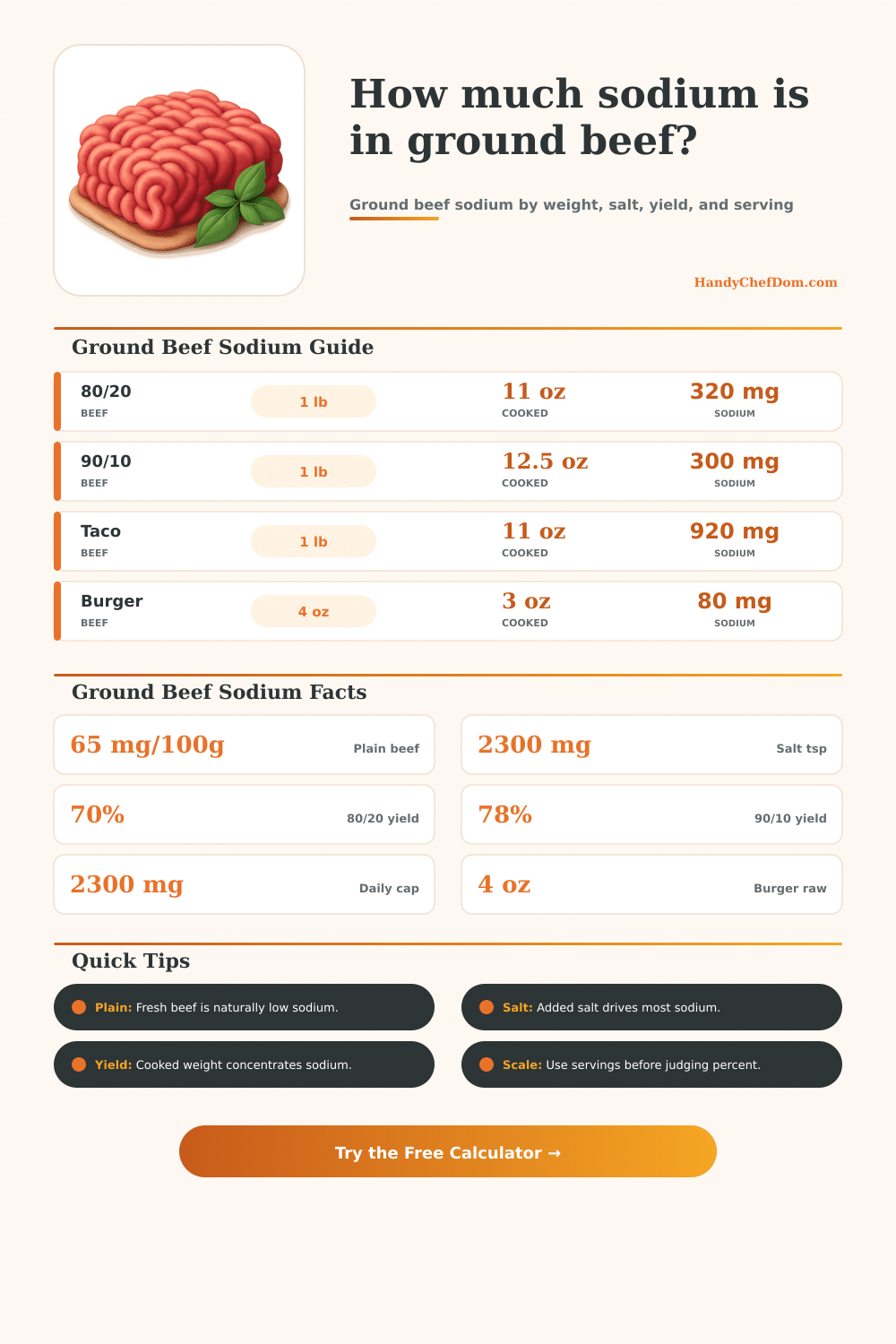
| 70/30 ground beef | About 62% | 9.9 oz cooked | About 295 mg |
| 73/27 ground beef | About 65% | 10.4 oz cooked | About 295 mg |
| 80/20 ground beef | About 70% | 11.2 oz cooked | About 295 mg |
| 85/15 ground beef | About 74% | 11.8 oz cooked | About 300 mg |
| 90/10 ground beef | About 78% | 12.5 oz cooked | About 300 mg |
| 93/7 ground beef | About 82% | 13.1 oz cooked | About 305 mg |
| 96/4 ground beef | About 86% | 13.8 oz cooked | About 305 mg |
6Seasoning Sodium Table
| Seasoning choice | Calculator unit | Sodium estimate | Best use |
|---|---|---|---|
| Plain, no salty seasoning | None | 0 mg added | Use when only beef sodium should count. |
| Pepper and herbs | Per teaspoon | 5 mg per tsp | Salt-free or almost salt-free dry herbs. |
| Burger seasoning blend | Per teaspoon | 320 mg per tsp | Steakhouse-style blends with salt. |
| Reduced-sodium taco seasoning | Per packet | 1400 mg per packet | Lower sodium taco night estimate. |
| Regular taco seasoning packet | Per packet | 2580 mg per packet | Typical packet sodium spread over beef. |
| Italian sauce seasoning | Per teaspoon | 180 mg per tsp | Bolognese, meat sauce, and pasta sauce. |
| Chili seasoning blend | Per teaspoon | 260 mg per tsp | Chili base before canned ingredients. |
7Burger, Taco, and Bolognese Scaling Table
| Serving style | Raw beef guide | Cooked beef guide | Sodium reading |
|---|---|---|---|
| Burger patty | 4 oz raw per patty | 2.8 to 3.4 oz cooked | Natural beef sodium is low unless salted. |
| Slider | 2 oz raw per slider | 1.4 to 1.7 oz cooked | Added seasoning divides across many pieces. |
| Tacos | 2 oz raw per taco | 1.4 to 1.6 oz cooked | Packet seasoning often dominates sodium. |
| Bolognese | 2.5 oz raw per portion | 1.7 to 2.1 oz cooked | Sauce, cheese, and pasta are separate add-ins. |
| Meal prep bowl | 4 to 5 oz raw per bowl | 3 to 4 oz cooked | Use serving count for sodium per container. |
| Chili serving | 2 to 3 oz raw per bowl | 1.5 to 2.3 oz cooked | Canned beans and tomatoes can add more sodium. |
8Common Batch Sodium Table
| Batch scenario | Beef and seasoning | Total sodium estimate | Per serving estimate |
|---|---|---|---|
| Plain burgers for 4 | 1 lb 80/20, no salt | About 295 mg | About 74 mg |
| Salted burgers for 4 | 1 lb 80/20, 1/2 tsp salt | About 1445 mg | About 361 mg |
| Taco meat for 8 tacos | 1 lb 80/20, 1 regular packet | About 2875 mg | About 359 mg |
| Bolognese for 6 | 1.5 lb 85/15, 2 tsp Italian blend | About 805 mg | About 134 mg |
| Meal prep for 5 | 2 lb 93/7, 1 tsp salt | About 2910 mg | About 582 mg |
| Sliders for 16 | 2 lb 80/20, 2 tsp burger blend | About 1230 mg | About 77 mg |
9Two Practical Ground Beef Sodium Tips
Make lean burgers. Make light tacos. Buy a pound of ground beef. Season it lightly with salt and pepper. It taste good. But there is likely a lot more sodium on that plate then you think.
Why? Because fresh beef contain little sodium, most of it comes from whatever you add. And cooking it change its weight. Let’s let the calculator do the math. Put in the uncooked weight. Select your preferred lean ratio. Pick your seasonings. And there you go, here is how to break down your servings.
How to Track Sodium in Your Food
So what? Here’s the kicker: Cooking cause shrinkage. That’s why we don’t weigh beef on an empty stomach, and why fat renders and moisture evaporate from the grill. What doesn’t change? Salt. It stay behind in the reduced amount of cooked meat. As the patty decreases in size, so does its sodium content per ounce. A 93/7 grind retain more than a 70/30 blend. Shrinkage make whatever else is left behind stronger.
Did you know that salt you add might be underestimated? Table salt contain approximately 2300 milligrams of sodium per level teaspoon. That exceed the recommended maximum for most people in one day. Half a teaspoon added to a pound of meat adds well more than 1000 milligrams. And this is all salt on top of what was in the beef (about 65 milligrams of sodium per 100 grams raw). Compared to seasoning packet, that’s little. Regular taco mixes contains almost 2600 milligrams of sodium. Chances are, you’re consuming more salt out of the packet than off the meat.
Sodium from natural beef vs. Sodium from added beef help distinguish those values. You know which is contributing to the total. Hundreds of milligram are lost by swapping to reduced-sodium seasoning. Thousands of calories is saved (and thousands more lost) by replacing 80/20 with 90/10 beef. Less fat mean less cooked-off weight. That decrease the concentration per serving a little bit. But that’s a little something that add up over time.
What do YOU cook? Will it be cheese and canned tomatoes on top of bolognese? You should of consider that sodium when using the calculator, there’s sodium already in those items. If you’re just having a plain patty on a bun, that may appear to be low-sodium. But add American cheese and a salty bun, and suddenly you’ve doubled the sodium. Knowing what’s going into base beef means you have control over any extras.
Managing this doesn’t require you to become a nutritionist. Just understand that it’s all about salt. Chili, tacos, and sliders is typical examples; you can find a table of them here. Treat those as benchmarks. If your burger has only half the sodium of what you’d expect, then maybe you’re buying less-salty meat or you use less salt in your seasoning. Or if your taco have three times the sodium of the benchmark, then maybe re-check how much salt went into it.
That’s not about banning salt. It’s about making it deliberate. If you know that one teaspoon equals your entire daily limit, then suddenly you measure rather than pour; herbs and spices also brings flavor without a sodium punch. Moving to a slightly leaner grind are healthier and more consistent in yield. Ground beef is easy to cook. But then again, so is keeping track of what you eat.
Table salt, shrinkage and those seasoning packets works silently behind the scenes. Until you break down the variables, the mystery remain. You no longer guess at each meal as to whether it fits your daily limit. You simply know. And knowing allow for cooking confidentally. Calculating before you serve the food is the beauty of using math.