🍖 Ham Curing Calculator
Calculate ham salt, sugar, Cure #1 ppm, wet brine, injection pickup, dry cure, cure time, rest time, and safety checks by weight.
Choose a cure method, enter ham weight and thickness, then set salt, sugar, Cure #1 target ppm, injection rate, and brine strength. The calculator sizes ingredients by weight first.
| Cure method | Cure #1 target | Salt range | Typical use |
|---|---|---|---|
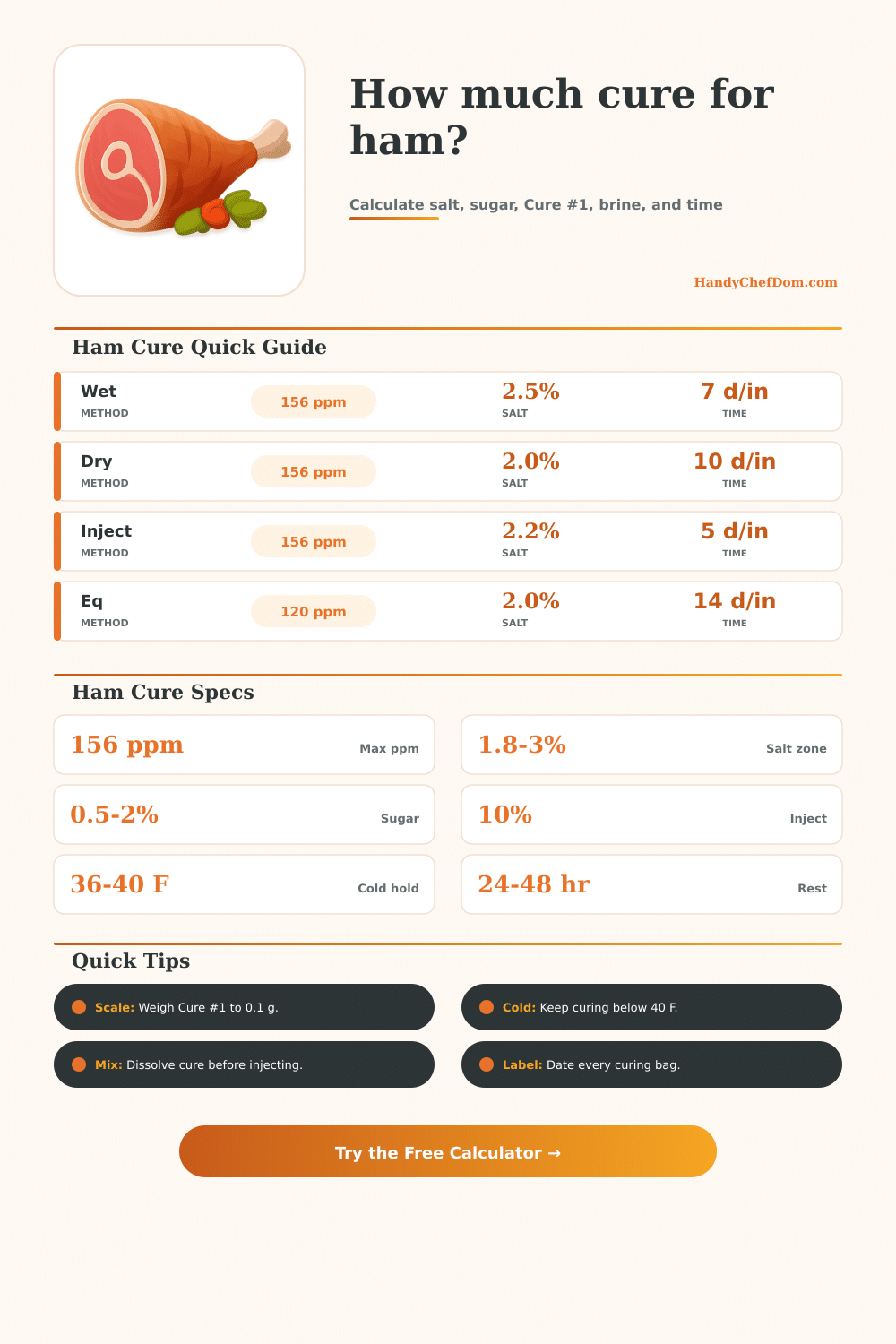
| Wet brine soak | 120 to 156 ppm | 2.0% to 3.0% | Whole legs, halves, picnic cuts |
| Pump and cover | 156 ppm | 2.0% to 2.6% | Large hams needing even curing |
| Dry rub cure | 120 to 156 ppm | 2.2% to 3.5% | Dense or traditional hams |
| Equilibrium bag | 100 to 156 ppm | 1.8% to 2.5% | Boneless or trimmed roasts |
| Low-salt style | 100 to 120 ppm | 1.5% to 2.0% | Small roasts with tested recipes |
| No Cure #1 | 0 ppm | Recipe driven | Use only when no curing salt is intended |
| Ham size | Wet cure time | Injected time | Equalizing rest |
|---|---|---|---|
| 2 to 4 lb hock | 4 to 7 days | 3 to 5 days | 12 to 24 hr |
| 4 to 7 lb boneless | 7 to 10 days | 5 to 7 days | 24 to 36 hr |
| 7 to 12 lb half ham | 10 to 14 days | 7 to 10 days | 36 to 48 hr |
| 12 to 18 lb whole leg | 14 to 21 days | 10 to 14 days | 48 to 72 hr |
| Dry cured large ham | 20 to 45 days | Not typical | 3 to 7 days |
| Country style ham | Recipe specific | Not typical | Long equalize |
| Cure #1 amount | Ham weight | Approx ppm | Plain salt note |
|---|---|---|---|
| 1.13 g | 1 lb | 156 ppm | Counts as salty ingredient |
| 5.67 g | 5 lb | 156 ppm | Subtract Cure #1 salt from total |
| 11.34 g | 10 lb | 156 ppm | About 1 level tbsp by volume |
| 17.01 g | 15 lb | 156 ppm | Weigh instead of scooping |
| 22.68 g | 20 lb | 156 ppm | Mix fully before pumping |
| 28.35 g | 25 lb | 156 ppm | Split batches need separate math |
| Safety check | Preferred range | Why it matters | Calculator cue |
|---|---|---|---|
| Cold holding | 34 to 40 F | Slows spoilage while cure diffuses | Cold or warm check |
| Cure #1 ppm | 0 to 156 ppm | Keeps nitrite plan within common ham limits | PPM warning |
| Salt target | 1.8% to 3.0% | Balances flavor and water activity | Low, ready, or salty |
| Injection pickup | 8% to 12% | Moves cure into thick muscles | Pump rate cue |
| Rest after cure | 24 to 72 hr | Lets cure equalize before cooking | Rest plan |
| Scale accuracy | 0.1 g cure | Small Cure #1 errors matter | Weight-first output |
Ham curing is a method that was used to preserve the meat. Ham curing is the application of some of the ancient methods of preserving meat with moddern methods of ensuring that those preserved meats is safe to eat. To make ham you must begin with raw leg and raw shoulder meat.
To make ham you must add a measured amount of salt to the meat, you must add a small amount of sugar to the meat, and you must add a precise amount of curing salt to the meat. Finally, you must allow time for the cure to move into the muscle of the meat. The goal of ham curing is to produce ham that is flavored, colored, and safe to eat, but the process can be difficult to manage.
How to Plan and Make Cured Ham
A planning tool for ham curing allows a person to enter different parameters of the curing process and automaticly calculates the amount of each ingredient that will be required for the curing process. Each of the inputs into the plan tool have an effect upon the curing process. For instance, the percentage of salt that is used will impact the water activity of the ham, the flavor of the ham, and the safety of the ham; too little salt can permit the growth of spoilage organisms yet too much salt can create a flavor that is harsh to the palate.
The amount of sugar that is used will impact the flavor of the ham; it will mellow the harshness of the salt and provide food for beneficial bacteria, yet it will reduce the amount of salt that is active in the meat. Cure #1 is a pink curing salt that contains nitrite; Cure #1 is a non-negotiable ingredient for most hams. The limit of 156 part per million of nitrite is necessary to inhibit the growth of Clostridium botulinum while minimizing the amount of nitrite that is introduced into the meat; too much nitrite will kill the beneficial bacteria while too little can allow the growth of deadly bacteria.
The thickness of the ham will impact the rate at which the cure reaches the center of the meat; a thick ham will require more days to cure than a thin cut of ham of the same weight. The method in which the person cures the ham, whether by dry curing, injection curing, brining, or equilibrium curing will also impact the time necessary for curing. The time at which the ham is cured will impact every other decision in the ham curing process.
For instance, if the temperature of the ham is ever allowed to fall below 34°F during the curing process, the rate at which nitrite and salt diffuse into the ham will slow to a near halt. Any temperature above 40°F will encourage the development of slime on the surface of the ham prior to the cure can protect the ham from bacterial growth. Thus, a planning tool that estimates the cure time allows a person to ensure that the temperature is maintained throughout the curing process; however, the planning tool cannot replace a meat thermometer that is placed in the cooler where the ham will be cured.
Cure #1 contains salt; the 93% of Cure #1 is plain salt. Thus, if a person were to ignore the salt content of Cure #1 and added salt to reach the target percentage of salt, the end product will be saltier then desired. The planning tool can calculate the amount of plain salt that must be used by automatically subtracting the salt content of Cure #1; thus, the person making the ham will not introduce errors into the curing process by ignoring the salt content of Cure #1.
The pickup and buffer percentages for ham curing are two percentages that remain at their default settings in the planning tool. The pickup percentage represents the amount of liquid brine that the ham will absorb; a higher percentage results in a ham that is saltier but has less brine remaining after the curing process. The buffer percentage is added to ensure that there is an amount of liquid to be used in the curing process; if a person used the amount of brine calculated in the planning tool, they may run out of liquid in the mixing bowl.
Thus, the buffer percentage is simply an estimate of the amount of additional liquid that may be required during the process to ensure that all the ham receives the calculated amount of cure. The reference tables included on the planning tool are a means of managing the expectations of the individuals that prepare the ham; however, the tables are not a replacement for the individual’s knowledge of ham curing. One reference table displays the salt percentages and nitrite targets that is appropriate for different methods of curing the ham.
A second reference table indicates the amount of time that it will take for a ham of a particular size to cure. A third table can be used to ensure that the weight of Cure #1 is accurately measured to the parts per million of Cure #1 that is indicated for a particular weight of ham. Thus, these tables prevent the individual from making errors in the preparation of the ham; they are simply a means of ensuring that the prep occurs within normal parameters.
Finally, the preparation of the ham begins after the person decides upon the ingredients and amounts of ingredients that is necessary for the curing process. The brine must be chilled to the proper temperature, the curing salt must be weighed to the nearest tenth of a gram, and the bag labeled with the date and the date that the ham should be finished curing. During this stage the temperature of the ham must be maintained and it will be up to the individual to decide whether the ham is ready on day twelve or if it will require forty-eight additional hours to reach the desired level of cure.
Thus, the planning tool allows the person preparing the ham to eliminate the need to perform the mathematics that are necessary to prepare each component of the ham; their decision is based off observation rather than arithmetic.