🍷 Wine Bottles per Guest Calculator
Estimate total wine bottles, bottles per guest, pour count, hourly pace, and red, white, and sparkling bottle split for gatherings and meals.
Enter the guest count, event length, pour size, drinking pace, non-drinker share, buffer, bottle size, pours per bottle, and wine split. Red, white, and sparkling percentages are normalized if they do not add to 100.
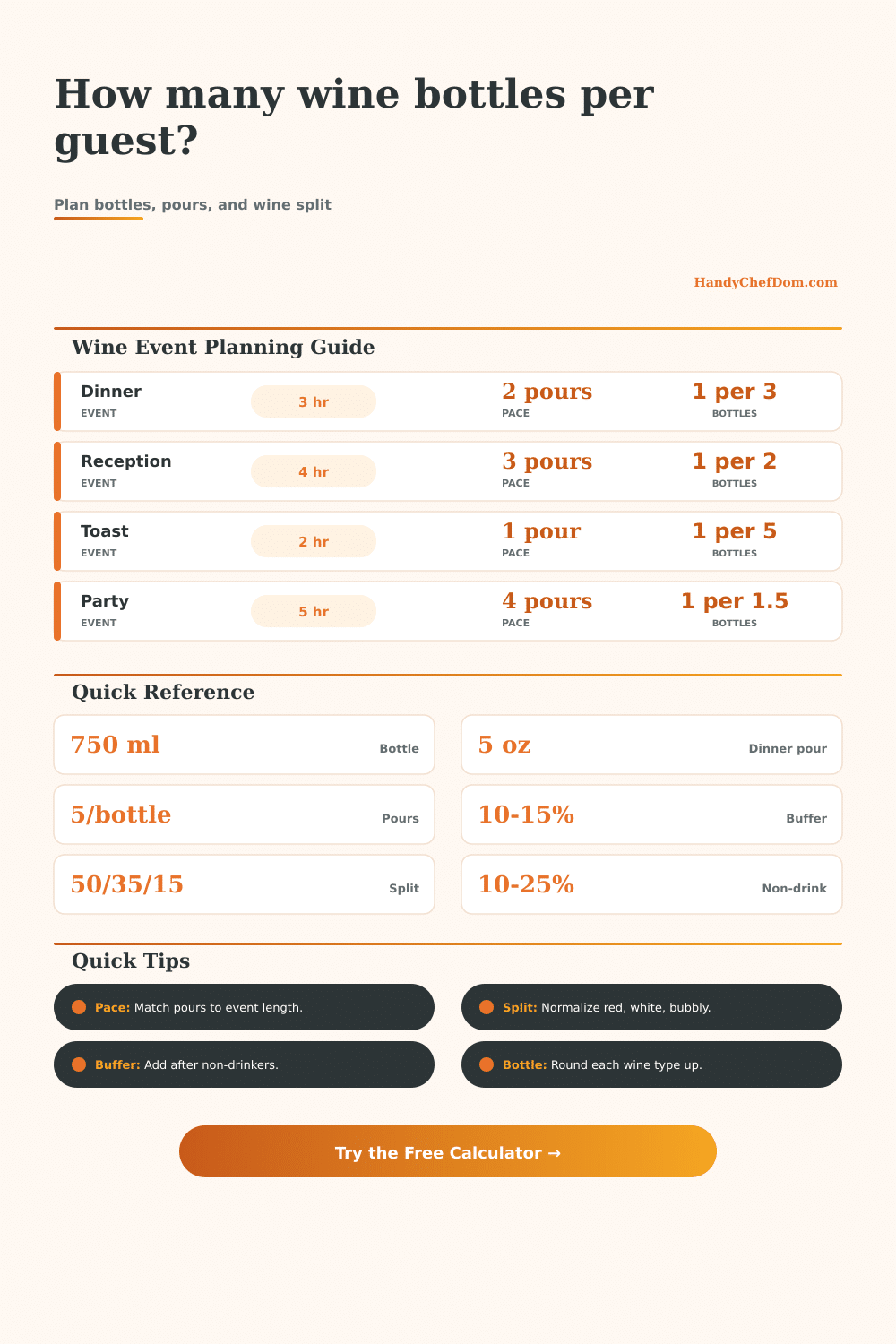
| Pace Setting | Calculator Rate | Best Event Use | Example for 4 Hours |
|---|---|---|---|
| Light pace | 0.5 pour per hour | Lunch, brunch, mixed beverages | 2 pours per drinker |
| Steady pace | 0.75 pour per hour | Dinner party or reception | 3 pours per drinker |
| Social pace | 1 pour per hour | Wine-forward gathering | 4 pours per drinker |
| Lively pace | 1.25 pours per hour | Long party with refills | 5 pours per drinker |
| Toast focused | 1 fixed pour base | Short toast or ceremony | Use fixed pours to override |
| Dinner table | 2.5 pour base | Meal service with refills | Adjusted by event length |
| Bottle Size | Volume | 5 oz Pours | 4 oz Pours |
|---|---|---|---|
| Half bottle | 375 ml / 12.7 fl oz | 2.5 pours | 3.2 pours |
| Standard bottle | 750 ml / 25.4 fl oz | 5.1 pours | 6.3 pours |
| One liter bottle | 1000 ml / 33.8 fl oz | 6.8 pours | 8.5 pours |
| Magnum | 1500 ml / 50.7 fl oz | 10.1 pours | 12.7 pours |
| Event Style | Red | White | Sparkling |
|---|---|---|---|
| Dinner with red meat | 60% | 30% | 10% |
| Mixed dinner menu | 45% | 40% | 15% |
| Brunch or daytime | 20% | 50% | 30% |
| Reception bar | 40% | 45% | 15% |
| Toast heavy event | 25% | 25% | 50% |
| Warm weather patio | 25% | 60% | 15% |
| Guests | Drinkers at 15% Non-Drinkers | Steady 3-Hour Pours | 750 ml Bottles at 5 Pours |
|---|---|---|---|
| 8 guests | 7 drinkers | 16 pours plus buffer | 4 bottles |
| 16 guests | 14 drinkers | 31 pours plus buffer | 7 bottles |
| 40 guests | 34 drinkers | 77 pours plus buffer | 16 bottles |
| 75 guests | 64 drinkers | 143 pours plus buffer | 29 bottles |
| 120 guests | 102 drinkers | 230 pours plus buffer | 46 bottles |
| 200 guests | 170 drinkers | 383 pours plus buffer | 77 bottles |
The silence that descends at the end of the meal when a guest asks for a refill signal the loss of the host’s grip on the dinner party. Because nobody want the food to be cold before they run out. It’s nerve-racking, we know.
But here’s the math: Stop your guessing, pick up some measurements, and you’ve got it. How much wine will each guest consume? What size are his or her glasses? Will anyone stick to water? Those is the variables, and they’re slippery. You need a system.
How to Use the Wine Calculator
Most people overestimate how much wine they’ll need for their party. Everyone imagines their guests chugging down every drop like it’s going out of style. That doesn’t happen very often. Most people don’t drink as frequent. When people sit down and have a meal, they tend to sip their wine with food.
Each glass is about 5 ounces. That’s a standard pour size. How many can you get from a 750 milliliter bottle? Well, about 5. So it sounds like plenty, right? Then throw in some big glasses. It could also be the generous instinct of the host. The calculator do all this for you.
Once you select your drinking speed and event duration, the calculator does the rest. No need to maintain that Excel sheet while reading this article. Buy volume, buy time. It is not just about bottles. The other input I find so helpful is the drinking pace.
You can select whether your event is a lively party or a light lunch. Why does that matter? A three-hour cocktail hour is very different than a three-hour dinner party. When people are standing up, they tend to drink faster. At the table, they’re sipping along with their food.
Based off that choice, the tool will adjust the number of pours per guest. For a social pace, it figures one pour per hour. Steady drops that to three-quarters. That small change affects total number of bottles, especially for larger events.
Finally, there’s the matter of the wine split. Unless your event is relying on one variety (which is very rare), most hosts will require a blend of whites, reds, and potentially some sparkling wine. You can designate the percentage of each in the calculator. If total isn’t one hundred, it will adjust the percentages for you. This comes in handy if you’re unsure of the exact breakdown.
Forty percent white and forty-five percent red is usually a good guess for a diverse dinner party. Depending on the focus of the menu, you may wish to adjust those proportions: if there’s going to be a lot of red meat, you’d probably want more of the big boys. The calculator provides a breakdown by type so you know exactly how many bottles of each you’ll need.
Account for those that don’t drink. In every group, there are some guests who do not drink. Don’t count them, because it will overestimate how many bottles you’ll need. You can enter a % of no drinkers into the calculator (usually between 10-25% depending on the crowd). Once you’ve subtracted those out, you now have an estimate for how many are actualy going to be drinking.
Add a buffer. Account for spills, generous pours, and the enthusiastic guest who wants another glass. Ten to fifteen percent is usually plenty of buffer. It is better to have a few extra bottles left over than to call a neighbour at 8 in the evening. You should of planned ahead.
On the page, there are reference tables that outline the situation for everything from a small dinner party to a big wedding. How the numbers play out: if you’re having forty people over for a four-hour event, you may need as many as sixteen bottles. Sounds like a lot, right? But it’s less than half a bottle per person.
A little context goes a long way, and in general you’ll go through more wine at a wedding reception then you would during a quieter brunch toast. The tool accounts for that. And then it allows you to round up by type, so you don’t wind up with a fraction of a bottle of something that you can’t buy.
Wine planning isn’t rocket science. It’s not precision engineering. It’s about comfortable abundance. You need enough so you can keep the conversation going, but not so much that anyone wakes up with a hangover or a budget crisis.
You want to look like you’ve got it all figured out. And how do you get there? By taking away the guesswork.
Start with the number of guests. You should also account for non-drinkers. Select a pace based on the energy in the room. And let the tool take care of the rest.
If you end the night with a smile on your last guest’s face and one (or two) bottles leftover, congratulations: you nailed it.