🥬 Spinach Potassium Calculator
Estimate potassium milligrams, per-serving daily value, raw-to-cooked shrinkage, drained yield, and smoothie, salad, or cooked-dish scaling from fresh, frozen, baby, or mature spinach.
🥬Spinach Potassium Presets
🧮Spinach Potassium Inputs
Use raw cups for salad and smoothie planning, grams for precise potassium tracking, cooked cups for wilted spinach, and drained yield for frozen or boiled spinach.
📊Quick Spinach Potassium Cards
🥬Spinach Form, Prep, And Potassium Grid
| Spinach form | Typical measure | Weight used | Potassium estimate | Best calculator mode |
|---|---|---|---|---|
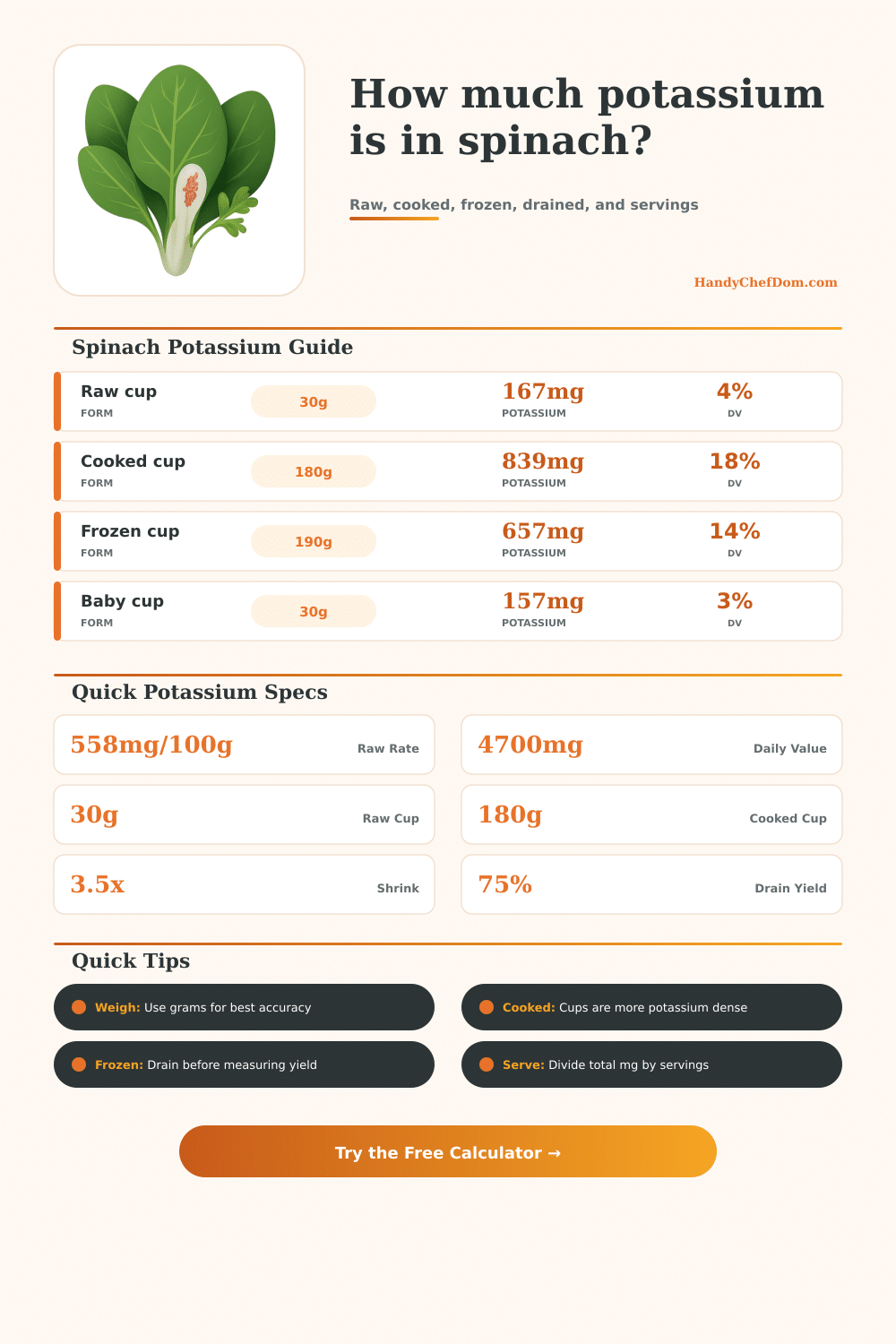
| Fresh baby spinach | 1 raw cup | 30 g | 157 mg | Raw cups or grams |
| Fresh mature spinach | 1 raw cup | 30 g | 167 mg | Raw cups or grams |
| Stemmed mature spinach | 1 raw cup | 28 g | 156 mg | Raw grams |
| Boiled cooked spinach | 1 cooked cup | 180 g | 839 mg | Cooked cups |
| Frozen chopped drained | 1 drained cup | 190 g | 657 mg | Cooked grams |
| Frozen leaf drained | 1 drained cup | 185 g | 666 mg | Cooked grams |
| Concentrated spinach puree | 1 puree cup | 240 g | 1226 mg | Cooked grams |
| Spinach salad blend | 1 raw cup | 28 g | 145 mg | Raw cups |
🍳Raw-To-Cooked Shrinkage And Drained Yield Table
| Prep state | Raw cups needed | Cooked cup yield | Drain yield | Potassium note |
|---|---|---|---|---|
| Lightly wilted spinach | 2.5 cups | 1 cup | 90% | Potassium mostly retained by batch |
| Typical cooked spinach | 3.5 cups | 1 cup | 82% | Cooked cups look more potassium dense |
| Firmly packed cooked spinach | 4.5 cups | 1 cup | 75% | Use cooked grams if squeezed |
| Very reduced spinach | 5.5 cups | 1 cup | 68% | More raw spinach fits each cooked cup |
| Frozen chopped, thawed | Package based | 1 cup | 70% | Drained weight controls potassium estimate |
| Boiled and drained | 3.5 cups | 1 cup | 75% | Cooking liquid loss lowers retained batch mg |
🥣Smoothie, Salad, And Cooked Spinach Scaling Table
| Target use | Target spinach | Potassium at target | Typical servings | Scaling rule |
|---|---|---|---|---|
| Side salad portion | 2 raw cups | 335 mg | 1 salad | Raw cups divided by 2 |
| Green smoothie pack | 60 raw g | 335 mg | 1 smoothie | Raw grams divided by 60 |
| Cooked side portion | 0.5 cooked cup | 419 mg | 1 side | Cooked cups divided by 0.5 |
| Frozen block equivalent | 255 drained g | 882 mg | 3 sides | Drained grams divided by 255 |
| Cooked-dish mix-in | 120 cooked g | 559 mg | 4 portions | Cooked grams divided by 120 |
| Meal prep half-cup | 90 cooked g | 419 mg | 1 container | Cooked grams divided by 90 |
🎯Potassium Daily Value Reference Table
| Reference target | Daily potassium | Raw spinach cups to match | Cooked spinach cups to match | Calculator setting |
|---|---|---|---|---|
| FDA Daily Value | 4700 mg | About 28 cups | About 5.6 cups | Default label comparison |
| WHO-style target | 3500 mg | About 21 cups | About 4.2 cups | General nutrition comparison |
| Lower adult reference | 2600 mg | About 16 cups | About 3.1 cups | Lower target comparison |
| Higher adult reference | 3400 mg | About 20 cups | About 4.1 cups | Higher target comparison |
💡Spinach Potassium Tips
You’ve got a bag of spinach in the crisper drawer, some of it’s going a little soft but you want it to contribute to your healthy eating efforts. The issue: Spinach is deceptive. A big cup of it look like a lot, but when heated, all those fluffy raw leaves dissapears into nothingness. Need to meet some potassium goal? Visual estimates aren’t going to get you there. What’s in the bag doesn’t necessarily end up in the bowl. Time to learn the difference.
Potassium is an electrolyte that regulate muscle function and maintains your blood pressure. (The recommended daily amount is set by the FDA at 4700 milligrams.) That’s fine as long as we’re talking mountains of produce … unless you learn something new, like this: Spinach has plenty of potassium in it. Turns out it’s relatively concentrated.
How Cooking Changes Spinach Nutrition
Here’s how much goes into one cup of cooked spinach: A cooked cup contain about six times more potassium than its raw counterpart, even though they look alike. Why? Because cooking causes the leaves to compress, reducing the volume. And also releases their water which evaporates. The nutrients are intact; the empty space isn’t. It makes sense why they do that.
It’s also nice to know that all calculation was done by the calculator (above) for you: Just input how you’re preparing it, and the rest is guesswork-free… No more wondering if what you get is half or three-quarters of your daily intake.
Many people wrongly believe that cooked measures up with raw ones; they think that two cups of spinach in the recipe mean two cups of spinach out of bag, onto their plates. Not even close. When you cook spinach down, the leaves collapse dramatically. How much? It typically reduces by about 3.5 times. This is built into the calculator’s “shrinkage” factor, allowing you to convert huge bag into real-life nutrients. And also form.
Per gram, baby spinach is mild and tender compared to more fibrous, slightly differently nutritious mature leaf. If you’re cooking with frozen chopped spinach, there’s another wrinkle: Water dynamics. The frozen blocks may hold extra liquid or they will release their water as they thaw. Squeeze it out and the concentration becomes greater. This also increase the concentration of whatever else was in the block which shifts amount of potassium per bite. It’s the drained-yield variable that nobody thinks about.
Are you boiling spinach and sending it down the drain? You’re not just discarding water; you’re losing some of the leached-out nutrients along with it. Keeping a correct yield percent in your calculations help prevent a mistaken overestimate of what landed in the colander.
How do you like your greens? If you’re making a smoothie, it’s in its raw state, and so it counts by raw weight (even though blender broke down its structure). If you’re sautéing it as a side dish, it cooks down into less mass, so it counts by cooked weight. Because the calculator gives you the option of flipping back and forth between these modes, you can get an answer that represent what happens in your own kitchen.
Maybe your one tiny handful of cooked spinach has almost as much potassium as a huge mountain of raw salad. This is why. Despite being easy to picture in our heads when we’re at the store, cups aren’t always the most accurate way to go for precision. In fact, sometimes grams make more sense.
How do you like your spinach? There’s no one correct answer. But do not count it wrong. Accounting for serving size, prep method, and form makes the guesswork go away. It enables you to know just how many milligrams of potassium you’re consuming at any given time, and whether all that effort spent on chopping was worth it. The numbers will paint the picture.
So next time you’re gazing at a sagging bag of spinach leaves, know this: Size is deceptive. Truth lies in weight and preparation. Know what’s actualy in that cup, and decide whether to blend it into tomorrow’s smoothie or wilt it tonight for a weeknight supper. You’ll go from mindlessly munching to mindfully fueling. It’s the same spinach, but you should of understood it a lot better now.