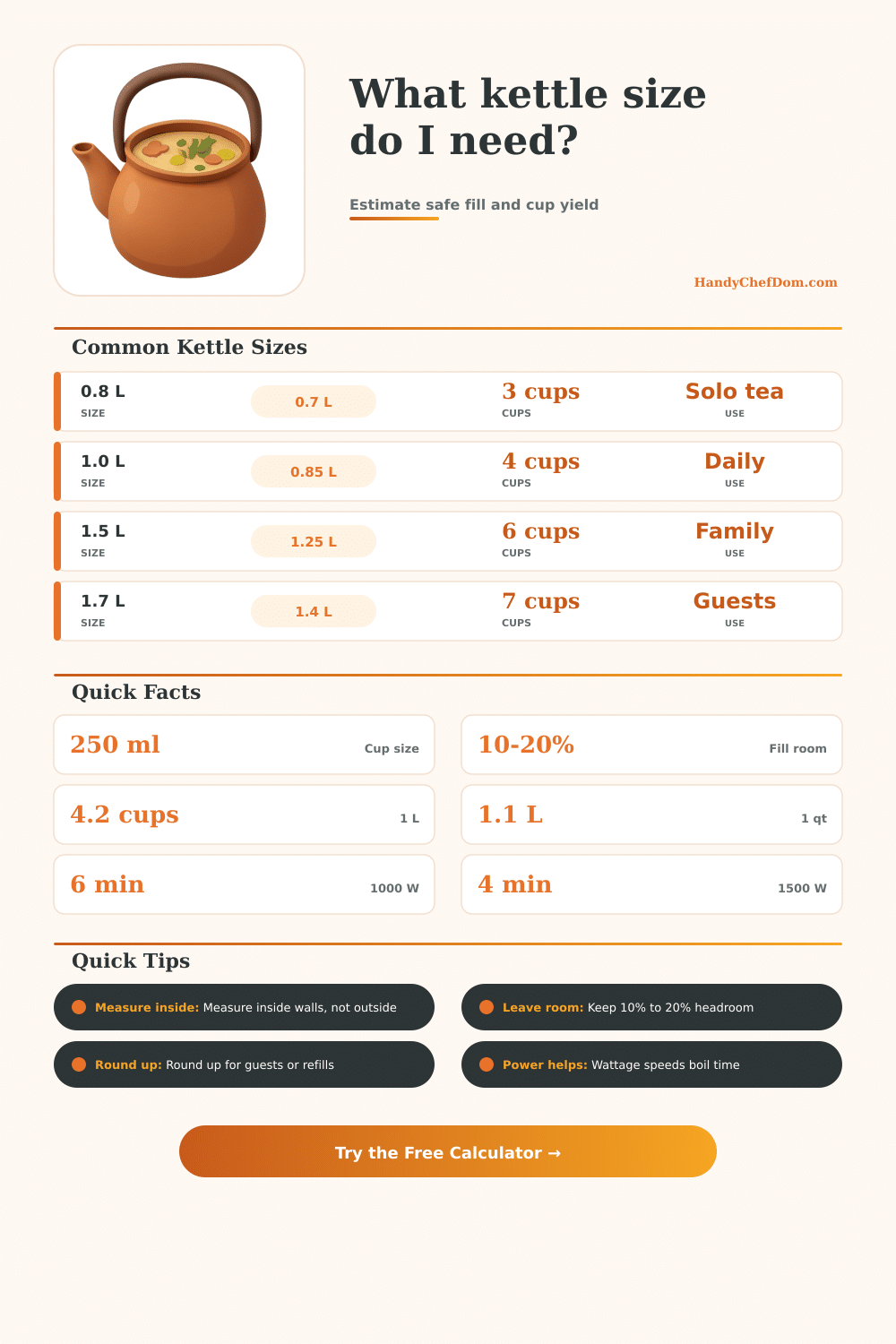
Kettle Volume Calculator
Measure kettle capacity, safe fill, cup yield, and boil batch size without overfilling.
| Size | Fill | Cups | Use |
|---|---|---|---|
| 0.8 L | 0.7 L | 3 cups | Solo tea |
| 1.0 L | 0.85 L | 4 cups | Daily |
| 1.5 L | 1.25 L | 6 cups | Family |
| 1.7 L | 1.4 L | 7 cups | Guests |
| Unit | Liters | Cups | Note |
|---|---|---|---|
| 1 cup | 0.24 L | 1 cup | Small pour |
| 1 qt | 0.95 L | 4 cups | Big mug set |
| 1 L | 1 L | 4.2 cups | Metric base |
| 1 gal | 3.8 L | 16 cups | Batch fill |
| Fill | Headroom | Best For | Note |
|---|---|---|---|
| 70% | 30% | Loose boil | Most room |
| 80% | 20% | Daily use | Safe |
| 85% | 15% | Tea rounds | Common cap |
| 90% | 10% | Electric | Tight fill |
| Power | Time | Profile | Note |
|---|---|---|---|
| 800 W | 5-7 min | Compact | Slow |
| 1200 W | 4-5 min | Standard | Balanced |
| 1500 W | 3-4 min | Fast | Common |
| 1800 W | 2-3 min | High | Quick |
Selecting a kettle require an understanding of the difference between the total capacity of a kettle and the usable volume of a kettle. The total capacity of a kettle is the total amount of water that the kettle can hold when the water reach the very top of the kettle. However, the usable volume of a kettle is the amount of water that can be boiled in the kettle without the water overflowing from the kettle.
Because water expand when it reaches boiling temperatures, it is possible for the boiling water to spill over the top of the kettle if too much water is loaded into the kettle. Thus, it is important to consider these factors when determining the total amount of water that a kettle can safely hold. The shape of a kettle may impact the total amount of water that a kettle can hold.
How Much Water to Put in a Kettle
Many kettle has a tapered shape, where the kettle is wider at its base than it is near its top. To determine the total amount of water that a kettle can hold, you must measure the interior width of the top of the kettle, the interior width of the base of the kettle, and the height of the kettle. Additionally, if the kettle has a gooseneck spout, the spout will reduce the total amount of water that can be held within the kettle.
The material from which a kettle is made and the heating elements that is within the kettle can impact how long it takes for the water to reach boiling temperatures. For instance, stainless steel kettles are very durable, but the glass or ceramic kettles may conduct heat different than stainless steel kettles. Furthermore, the wattage of the heating element within the kettle will impact the rate at which the heating element heats the water.
For instance, an eighteen hundred watt heating element will heat the water faster than a fifteen hundred watt heating element. The starting temperature of the water can also impact the time that is required to boil the water. Cold water will require longer boiling times than water that starts at a warmer temperature.
The size of the kettle that you select will depend upon the number of servings of water that you need to prepare throughout the day. An eight hundred milliliter kettle is a good size for an individual who only needs to prepare one or two serving of beverages. However, a one point five liter kettle may be better for an individual who needs to prepare a familys servings.
For instance, if four individual are to be served, and each individual requires two hundred fifty milliliters of water, one liter of water is required to prepare each individual. In this case, an individual will purchase a kettle that is larger in size than the total amount of water that is required to provide headroom for the water. Headroom is the space within the kettle that is left empty between the water and the top of the kettle; this headroom is provided to prevent the water from splashing out of the kettle during the boiling process.
To prevent any messes from occurring in the kitchen or another area of the house in which the kettle is used, there are specific rules to follow when filling the kettle with water. One rule is to limit the amount of water that is loaded into the kettle to eighty-five percent of the total capacity of that kettle. If you fill the water to eighty-five percent of the total capacity of the kettle, there is enough space for the water to expand during the boiling process.
If the water is filled to ninety percent of the total capacity of the kettle, it is possible for the water to spill out of the kettle if the lid of the kettle is tight and the water is boiling violent. If the amount of water is limited to seventy percent of the total capacity of the kettle, there is more maximum headroom for the water to boil, but there is less water to prepare beverages. When using a kettle, it is necessary to avoid the mistake of filling the kettle to the spout.
If a kettle is filled to the spout, the water will spill from the kettle as the water begins to boil. Many individuals may make this mistake if they rely upon the printed labels that are printed on the side of the kettle. These printed labels are often inaccurate in depicting the total amount of water that should be loaded into the kettle.
Instead, you should measure the dimensions of the kettle and a calculator that considers the wattage of the heating element of the kettle can be used to determine the amount of water that should be loaded into the kettle. Thus, by measuring the dimensions of the kettle and considering the wattage of the heating element, you can ensure that the kettle that is purchased will meet the individuals or kitchens need, and that the water will not overflow from the kettle. You should of checked the dimensions first to avoid a mess.
Its important to be careful with teh amount of water you use. One could of avoided this if they used a more moddern kettle. You’ll want to make sure youre not filling it too high.
One should check their measurements based off teh labels.