Coconut Water Potassium Calculator
Estimate potassium in coconut water by cups, milliliters, fluid ounces, bottles, coconut water type, concentrate level, serving count, workout or smoothie use, daily value percent, and sugar-to-potassium ratio.
1Coconut Water Potassium Presets
2Volume, Type, Serving, Use, and Sugar Context Inputs
Choose the way you measured coconut water, then set the type and use. The calculator keeps potassium first, while sugar is included only for the sugar-to-potassium ratio and smoothie context.
Coconut water potassium estimate
Choose a preset or enter your own coconut water details.
3Live Coconut Water Potassium Snapshot
4Coconut Water Size, Type, and Potassium Grid
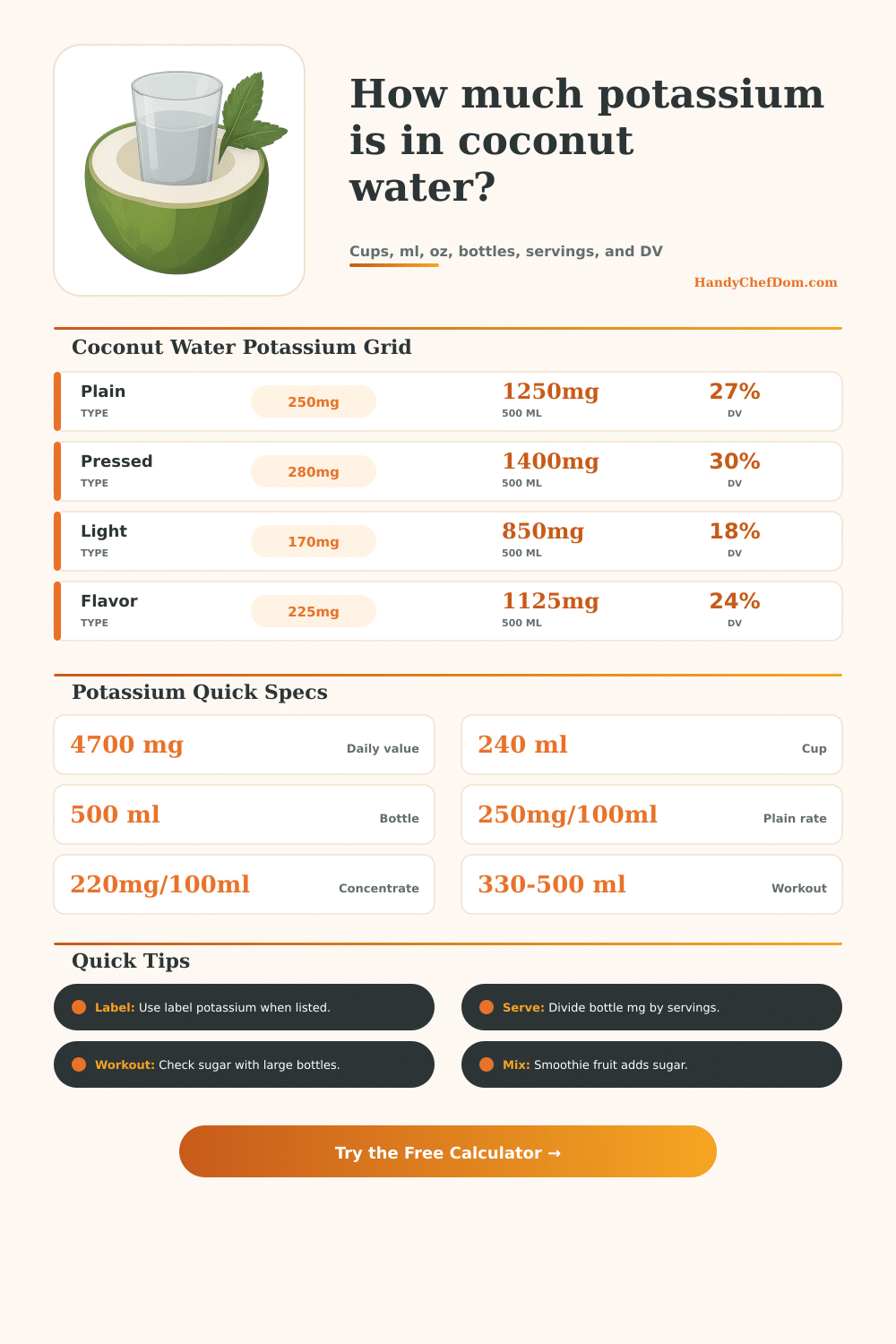
| Coconut water type | Potassium per 100 ml | Sugar per 100 ml | 500 ml potassium | Best calculator use |
|---|---|---|---|---|
| Plain unsweetened coconut water | 250 mg | 5.1 g | 1250 mg | Everyday bottle, cup, and hydration estimates. |
| Pressed coconut water | 280 mg | 5.8 g | 1400 mg | Creamier smoothies and post-workout bottles. |
| Young Thai style coconut water | 260 mg | 5.6 g | 1300 mg | Fresh-tasting servings and chilled cartons. |
| From concentrate coconut water | 220 mg | 6.2 g | 1100 mg | Shelf-stable cartons and pantry bottles. |
| Light or diluted coconut water | 170 mg | 3.6 g | 850 mg | Kid portions, spritzers, and long sipping. |
| Flavored coconut water blend | 225 mg | 7.8 g | 1125 mg | Tropical flavors where sugar rises faster. |
| Electrolyte sport coconut water | 300 mg | 5.5 g | 1500 mg | Workout labels with added electrolytes. |
| Reconstituted coconut water powder | 210 mg | 5.4 g | 1050 mg | Powder packets mixed into measured water. |
5Bottle, Cup, Milliliter, and Ounce Reference Table
| Package or pour | Volume | Plain potassium | Pressed potassium | Serving note |
|---|---|---|---|---|
| Small tasting pour | 120 ml / 4.1 fl oz | 300 mg | 336 mg | Useful for mocktails or kid cups. |
| One kitchen cup | 240 ml / 8.1 fl oz | 600 mg | 672 mg | Common smoothie and recipe measure. |
| Mini carton | 250 ml / 8.5 fl oz | 625 mg | 700 mg | Usually a single small serving. |
| Small carton | 330 ml / 11.2 fl oz | 825 mg | 924 mg | Can be one workout serving or two light pours. |
| Can | 414 ml / 14 fl oz | 1035 mg | 1159 mg | Check if the label uses multiple servings. |
| Standard bottle | 500 ml / 16.9 fl oz | 1250 mg | 1400 mg | Often treated as one grab-and-go bottle. |
| Carton | 1000 ml / 33.8 fl oz | 2500 mg | 2800 mg | Batch smoothies or fridge servings. |
6Workout, Hydration, and Smoothie Use Table
| Use case | Typical coconut water | Potassium focus | Sugar ratio watch | Calculator setting |
|---|---|---|---|---|
| Casual sipping | 180 to 250 ml | Moderate potassium comparison. | Lower if serving is small. | Casual sipping |
| Post-workout bottle | 330 to 500 ml | Often 825 to 1500 mg potassium. | Count the full bottle sugar. | Post-workout bottle |
| Hot day hydration | 250 to 500 ml | Potassium can stack across refills. | Alternate with water when repeating. | Hot day hydration |
| Smoothie base | 180 to 355 ml | Potassium from coconut water plus fruit. | Fruit often drives sugar higher. | Smoothie base |
| Mocktail or mixer | 90 to 180 ml | Smaller potassium contribution. | Syrups and juice change ratio. | Mocktail or mixer |
| Kid-sized split | 90 to 150 ml | Per-serving potassium stays modest. | Split cartons into small cups. | Kid-sized split servings |
7Potassium Daily Value and Sugar Ratio Table
| Scenario | Total potassium | Serving count | Per-serving DV | Sugar-to-potassium context |
|---|---|---|---|---|
| One cup plain coconut water | 600 mg | 1 serving | About 13% | About 20 mg potassium per sugar gram. |
| 500 ml plain bottle | 1250 mg | 1 serving | About 27% | Good potassium, but also about 26 g sugar. |
| 500 ml pressed bottle | 1400 mg | 1 serving | About 30% | Higher potassium and slightly higher sugar. |
| 500 ml flavored bottle | 1125 mg | 2 servings | About 12% | Flavors usually lower mg per sugar gram. |
| 1 liter carton split four ways | 2500 mg | 4 servings | About 13% | Per-serving sugar depends on pour size. |
| Smoothie with banana | 900 mg plus fruit | 2 servings | About 10% | Fruit sugar changes the ratio more than potassium. |
8Potassium Planning Cards
If a carton lists potassium, enter mg per 100 ml to replace the built-in type estimate.
Large bottles can be one serving or several pours, so per-serving DV depends on your count.
Dilution and rich pressed styles scale potassium and sugar together in the estimate.
Smoothie fruit adds sugar, so the sugar-to-potassium ratio can shift even when volume is fixed.
9Two Practical Coconut Water Potassium Tips
You grab a bottle of coconut water. You heard it helps you stay hydrated and maintain electrolytes. And that’s true, but what’s in the bottle will actualy determine how much it benefits you. Most people believe all coconut waters is created equal, like assuming all tap water tastes the same regardless of municipality. But it’s not so simple. Is the coconut water fresh-pressed? Is it diluted with more water? Is it made using powder and then mixed with water? Those thing matter, since you’re not shelling out for a sweet drink in cool packaging; you’re buying hydration.
If your diet restricts certain nutrients, this prevents you from accidently going over or missing the mark with other ingredient. Because it shows how much potassium (or whatever goal nutrient you enter) is already present in that bottle at a glance. You can also use it to create custom ratios and amounts of each ingredient, just put them all in to see how profile changes.
Why Coconut Water Is Not All The Same
Volume is another confusing factor. That’s because many times when we see a bottle listed on the ingredient label, we think “one serving,” when really it may have double the nutritional value. For example, a large 500 ml bottle contains around 1250 mg of potassium. This is based off an average plain one. That accounts for approximately a quarter of an adult’s recommended daily value.
However, if you split that same bottle throughout the day, your body will process the minerals different, even though you are still getting the same total amount of nutrients. You can choose how many servings is in each item and change that count using the tool, important for those who track their macronutrients or anyone trying to meal prep. It makes you ask yourself whether you’re having just half a bottle or full thing.
In coconut water, potassium is almost always accompanied by sugar, and here’s the kicker: watch their ratio. Sugars can gives us energy, but they also spike our blood glucose. Combine coconut water with something else like banana or mango in your smoothies and you’re looking at a serious increase in sugar load. Even if you’re only measuring coconut water, its potassium content will be added to whatever’s on top of it, including additional potassium from fruits. And there lies the point: Context completely alters the nutritional picture.
One cup may have 20 mg of potassium per gram of sugar. Now add some berries and all bets are off. This is not simply about the coconut water anymore, it’s now about the whole drink.
One of the most popular uses for the drink is workout recovery. People want to replenish lost electrolytes (sodium, potassium) from sweating in workouts. Coconut water has those, but perhaps not enough for hardcore workouts different than purpose-built sports drinks. It is fine for mild to moderate exercise and it is also good for staying hydrated when exercising on hot days. The trick is to match consumption with exertion. Having a sip or two won’t help much when you’ve worked up a serious sweat; having a liter will probably cause over-consumption.
If you’re on any diet that calls for managing potassium, it should of been best to read labels rather than guess at how much to drink. This is clearly laid out in the table at the bottom of page. You can compare different kinds of bottles and sizes, and see how their mineral density compares. For example, you can compare a large jug to a mini carton. When you’re standing there in the aisles trying to figure out what’s going to be best value per bottle this kind of visual aid comes in handy.
The higher potassium, relative to sugar content, the better. Sure, drinking light or diluted stuff may feel good because it tastes refreshing, but that stuff won’t have the minerals you’re after. Better to have less of something with lots of oomph than more of something wimpy.
In short: it helps make smarter decisions. It removes the need to believe marketing words such as “superfood” and lets you see for yourself. If you’re drinking something (smoothie or just water), you know what’s in there, and that makes it an intentional decision. What happens when you know your inputs? The math is easy after that. But the thought that went into those inputs is where you gain true value. When you read the nutrition label again, you’ll have fewer surprises and more clear-cut expectations.