🍪 Vanilla Extract Sugar Calculator
Convert vanilla extract to vanilla sugar, scale homemade vanilla sugar, adjust recipe liquid, and estimate aroma strength from beans, sugar weight, and infusion age.
Use swap mode when a recipe lists vanilla extract and you want to use vanilla sugar. Use make mode when you are filling a jar and want to estimate extract-equivalent strength.
| Vanilla Form | Approx Extract Match | Typical Amount | Best Kitchen Use |
|---|---|---|---|
| Pure vanilla extract | 1 teaspoon | 5 ml | General batters, custards, buttercream, and fillings |
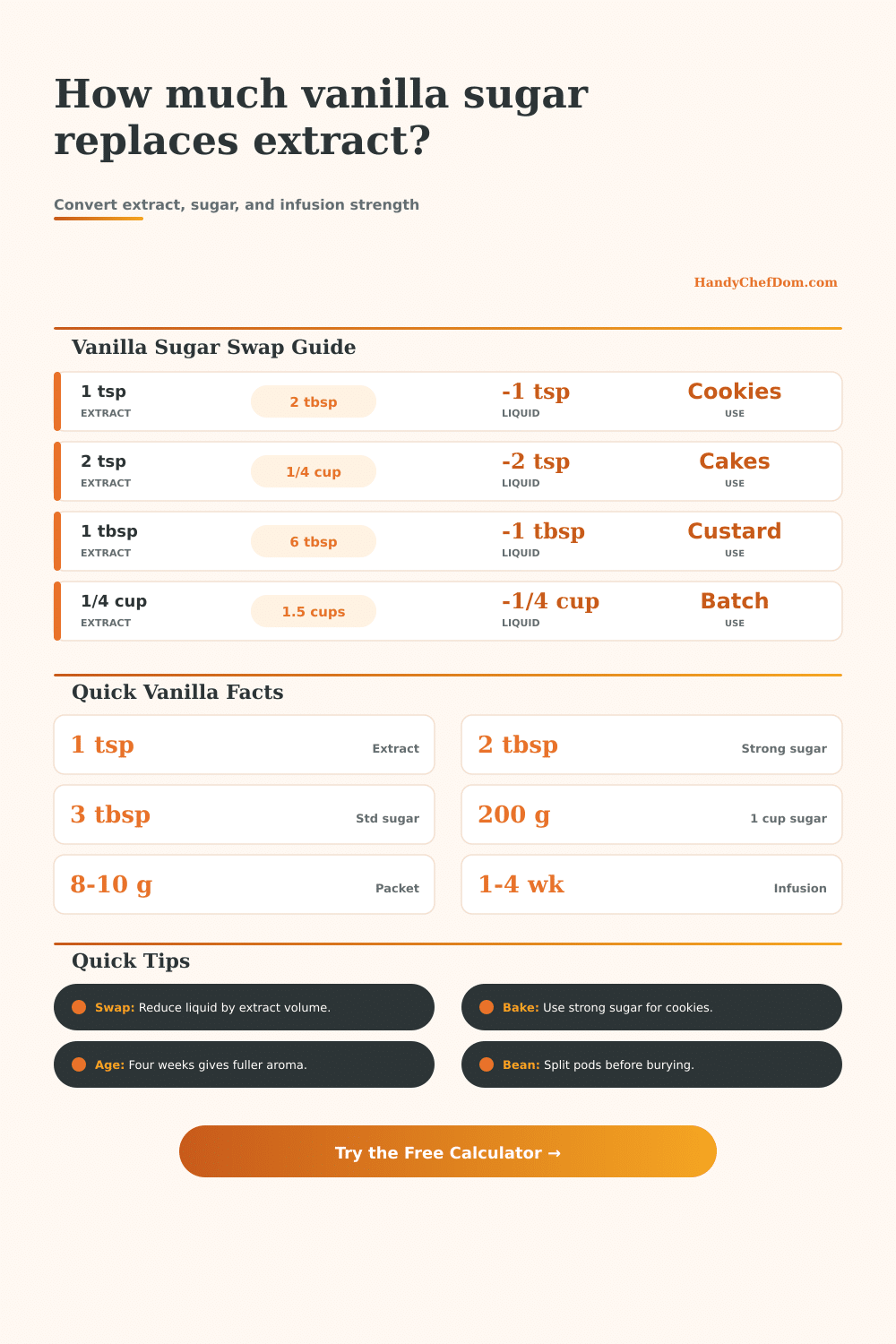
| Standard homemade vanilla sugar | 1 teaspoon | 3 tablespoons | Cakes, muffins, soft cookies, and quick breads |
| Strong homemade vanilla sugar | 1 teaspoon | 2 tablespoons | Shortbread, sugar cookies, streusel, and dry toppings |
| Mild homemade vanilla sugar | 1 teaspoon | 4 tablespoons | Tea sugar, whipped cream, fruit, and light desserts |
| Vanilla sugar packet | 1 to 2 teaspoons | 8 to 10 grams | Small cake batter, pancake batter, or pudding |
| Ground vanilla sugar | 1 teaspoon | 1 to 2 tablespoons | Dry mixes where bean specks are welcome |
| Extract Called For | Standard Vanilla Sugar | Strong Vanilla Sugar | Liquid To Remove |
|---|---|---|---|
| 1/2 teaspoon extract | 1 1/2 tablespoons | 1 tablespoon | 1/2 teaspoon or 2.5 ml |
| 1 teaspoon extract | 3 tablespoons | 2 tablespoons | 1 teaspoon or 5 ml |
| 2 teaspoons extract | 6 tablespoons | 1/4 cup | 2 teaspoons or 10 ml |
| 1 tablespoon extract | 9 tablespoons | 6 tablespoons | 1 tablespoon or 15 ml |
| 2 tablespoons extract | 1 1/8 cups | 3/4 cup | 2 tablespoons or 30 ml |
| 1/4 cup extract | 2 1/4 cups | 1 1/2 cups | 1/4 cup or 60 ml |
| Sugar Type | 1 Tablespoon | 1/4 Cup | 1 Cup Kitchen Weight |
|---|---|---|---|
| Granulated white sugar | 12.5 g | 50 g | 200 g |
| Caster or superfine sugar | 10 g | 40 g | 190 g |
| Powdered sugar | 7.5 g | 30 g | 120 g |
| Light brown sugar | 13 g | 55 g | 220 g packed |
| Demerara sugar | 13.5 g | 54 g | 215 g |
| Turbinado sugar | 12 g | 48 g | 192 g |
| Jar Formula | Bean Loading | Infusion Age | Estimated Flavor Level |
|---|---|---|---|
| Mild table sugar | 1 bean per 2 cups | 1 to 2 weeks | Light aroma for drinks and fruit |
| Standard baking sugar | 2 beans per 2 cups | 3 to 4 weeks | Balanced cake and cookie strength |
| Strong baking sugar | 3 beans per 2 cups | 4 to 8 weeks | Full aroma for dry doughs |
| Spent bean refresh | 3 spent beans per cup | 4 to 6 weeks | Mild, rounded vanilla aroma |
| Ground vanilla blend | 1 teaspoon powder per cup | Same day | Immediate speckled flavor |
| Paste sugar blend | 1 tablespoon paste per cup | Same day | Moist, very aromatic sugar |
Now, don’t mistake vanilla sugar and vanilla extract as being interchangeable at 1:1 ratio; they aren’t. They’re not even remotely similar in terms of their physical characteristic. One’s a scent carried by a slowly-released substance (vanilla sugar) and the other’s a highly-concentrated solution of that same scent in liquid solvent (vanilla extract).
This alters how your dough hydrate. Removing extra liquid means removing moisture, that requires adjusting for the loss of volume. No worries, the calculator will take care of this for you after inputting your recipe information. You won’t have to wing it when trying to determine what amount of liquid to offset.
Why Vanilla Sugar Is Different From Vanilla Extract
To understand how swap affects the physics, consider that vanilla extract is about two-thirds water and one-third alcohol (around 35 percent). So each two-teaspoon serving as directed in a typical recipe contribute almost ten milliliters of fluid to whatever you’re mixing it into. Swapping that out with three tablespoons of vanilla sugar replaces that liquid with dry mass; adding bulk without adding moisture. That means your batter get thicker, which can lead to denser cakes or cookies that don’t spread as much.
Depending on the structure of what you’re cooking this may or may not matter. In general, if you want to get realy exact with your bake, you should of subtracted from total recipe-liquid ingredients the volume equivalent to extract you take out. Custards and loose batters probably won’t care; anything that relies more on structure may.
Vanilla sugar can be quite potent as well. If you’re using homemade jars the flavor can range from mild to intense, depending on how many bean you use and how long you let it sit. We’ve found that packets in Europe are standardized to contain just enough flavor to hint at the spice without overpowering it. So when you make your own it will depend on how strong your vanilla sugar was.
You’ll get asked about strength of your homemade sugar, so you can plug it into calculator. A jar that’s been sitting for four weeks with two whole beans per cup of sugar will probably be more potent than a jar freshly made. Depending on how loaded with beans and how old your infused sugar is the ratio will change. That way, if you think your homemade jar is strong but it turns out to be weak, you won’t end up under-seasoning things.
The type of sugar used also makes a difference. Vanilla doesn’t behave the same way with granulated white sugar as it does with brown sugar or caster sugar. Because caster sugar’s crystals is finer, there is more surface area for the vanilla compounds to cling to. And brown sugar introduces molasses flavors that further complicate the vanilla flavor.
With this app, you can specify what kind of sugar to use. This subtly alters weight conversions. That little bit of detail becomes important if you’re trying to match a bakery standard or scale a recipe up for a party. There’s an easy-to-read lookup table on the page, but calculator allows you to go into detail when dealing with a particular batch.
Want to double your recipe? Scale that multiplier up. Prefer a more subtle note in the background or a bolder aroma in the foreground? Adjust sweetness intensity. It makes it easier to work with a system of textures and flavors different than a list of ingredients.
Vanilla sugar’s on your agenda? Make it now. You need at least one week, which is barely long enough for the vanillin and other aromatic compounds in the vanilla bean to dissapears into the sugar crystals. Four weeks is better, but eight weeks is best. Don’t hurry things along.
Before hiding beans beneath the sugar, split each one. That way, the seeds will touch the sugar instead of being hidden inside the pod, allowing them to make a big difference in final taste.
The calculator is science. But baking is both art and chemistry. Baking requires intuition and also require that you taste-test the batter. You watch for the way the dough spreads. Know that the calculator will get you there, but rely on your senses to complete the task.