Salmon Iron Calculator
Estimate salmon iron by fillet weight, wild, farmed, canned, or smoked type, cooked yield, serving count, daily value percent, protein, omega-3 context, and meal prep scaling.
1Salmon Iron Presets
Pick a real kitchen scenario, then adjust the salmon type, fillet weight, cooked yield, serving count, daily value reference, and meal prep buffer as needed.
2Fillet Weight, Type, Yield, and Serving Inputs
Enter the edible salmon amount. Raw and cooked modes use the cooked yield setting, while canned and smoked styles can be treated as ready-to-eat edible weight.
Salmon iron estimate
Your salmon iron, cooked yield, protein, omega-3, and meal prep split will appear here.
3Salmon Type, Prep, and Iron Snapshot
4Salmon Type Iron Grid
| Salmon type | Best calculator form | Iron per 100 g | Protein per 100 g | Omega-3 per 100 g |
|---|---|---|---|---|
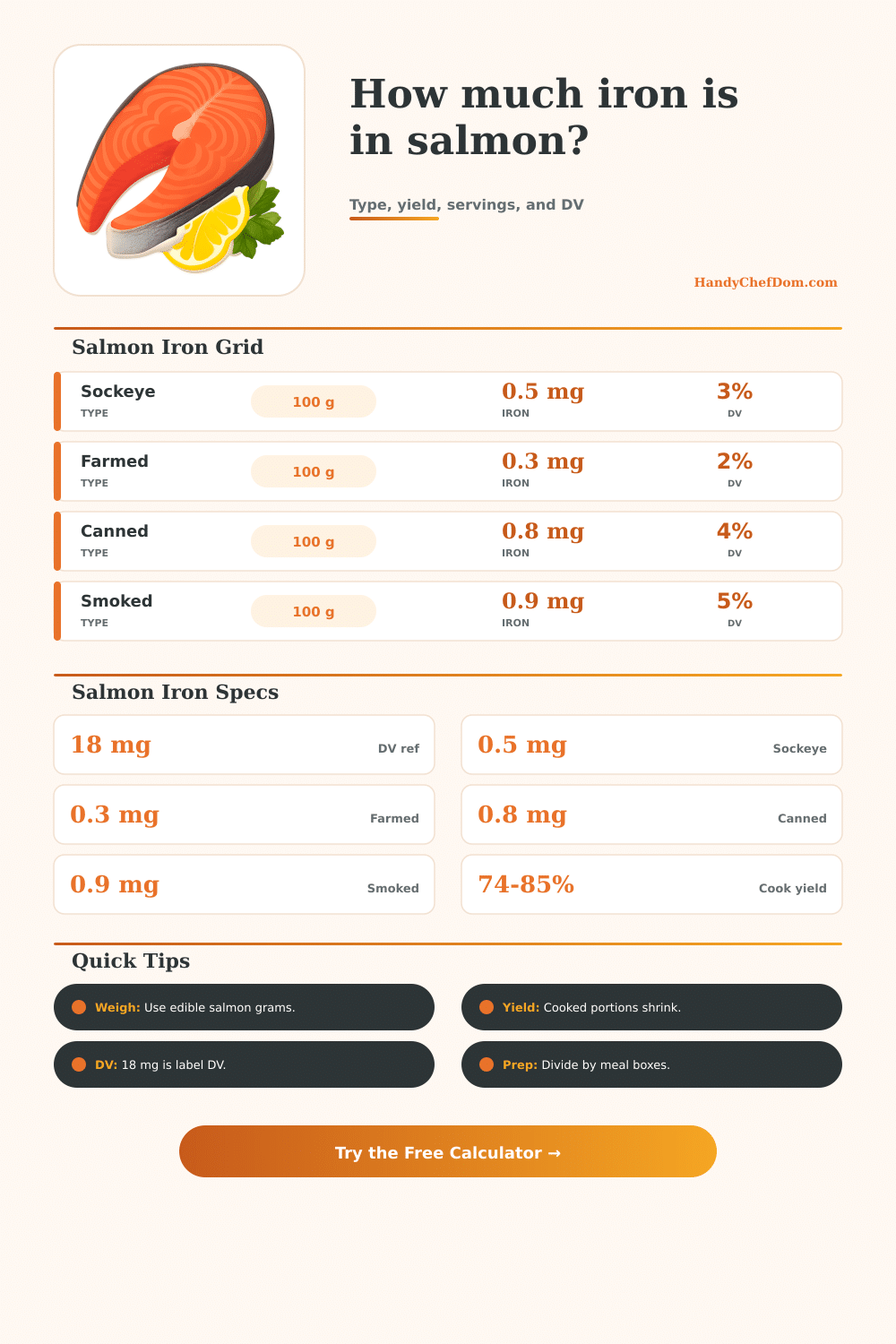
| Wild sockeye salmon | Raw fillet or cooked portion | 0.50 mg | 25.4 g | About 1200 mg |
| Wild chinook salmon | Thicker raw fillet | 0.70 mg | 24.0 g | About 1700 mg |
| Wild coho salmon | Meal prep fillet | 0.45 mg | 24.0 g | About 1000 mg |
| Farmed Atlantic salmon | Raw fillet or cooked portion | 0.34 mg | 22.0 g | About 2000 mg |
| Wild pink salmon | Fillet or flaked prep | 0.35 mg | 25.0 g | About 900 mg |
| Canned pink salmon, drained | Can count or cooked weight | 0.77 mg | 23.6 g | About 1000 mg |
| Canned sockeye salmon, drained | Can count or cooked weight | 0.89 mg | 24.0 g | About 1100 mg |
| Smoked salmon | Ready-to-eat weight | 0.85 mg | 18.0 g | About 1300 mg |
5Prep Style and Cooked Yield Table
| Prep or form | Default yield | Cooked grams from 100 g raw | Iron math note | Best use |
|---|---|---|---|---|
| Baked or roasted fillet | 78% | 78 g cooked | Default balanced fillet shrink | Dinner portions and pans |
| Grilled fillet | 74% | 74 g cooked | More moisture loss and flaking | Party trays and outdoor meals |
| Pan-seared fillet | 76% | 76 g cooked | Moderate moisture loss | Weeknight skillet portions |
| Poached or steamed fillet | 85% | 85 g cooked | Gentler yield, less shrink | Soft flakes and bowls |
| Air-fried fillet | 75% | 75 g cooked | Similar to roasted with crisp edges | Meal prep pieces |
| Canned, drained salmon | 100% | Use drained weight | No cooking shrink in calculator | Salads, cakes, and lunches |
| Smoked salmon | 100% | Use package edible weight | Ready-to-eat weight is direct | Brunch boards and bagels |
6Serving and Meal Prep Scaling Table
| Scenario | Raw fillet plan | Cooked yield at 78% | Iron with sockeye | Meal prep note |
|---|---|---|---|---|
| Dinner for 2 | 12 oz / 340 g | 265 g cooked | 1.33 mg total | Two generous fillets |
| Family for 4 | 24 oz / 680 g | 531 g cooked | 2.65 mg total | Four dinner plates |
| Meal prep 5 boxes | 40 oz / 1134 g | 884 g cooked | 4.42 mg total | About 177 g each |
| Party tray 12 | 72 oz / 2041 g | 1592 g cooked | 7.96 mg total | Small buffet portions |
| Canned lunches 6 | Six 5 oz cans | 663 g drained | 5.11 mg total | One lunch scoop each |
| Smoked brunch 8 | 24 oz ready-to-eat | 680 g edible | 5.78 mg total | Thin board portions |
7Daily Value and Portion Context Table
| Reference choice | Daily iron reference | 0.5 mg salmon iron equals | Calculator use |
|---|---|---|---|
| FDA Daily Value | 18 mg | About 3% DV | Nutrition label style comparison |
| 8 mg reference | 8 mg | About 6% of target | Smaller daily reference comparison |
| 15 mg reference | 15 mg | About 3% of target | Teen-style planning comparison |
| 27 mg reference | 27 mg | About 2% of target | Higher daily reference comparison |
| Custom reference | User entered | Auto calculated | Use your own nutrition target |
8Salmon Iron Mode Comparison
Best before cooking because it converts raw weight into expected edible cooked portions.
Best after cooking when you can weigh the flaked or plated salmon directly.
Best for canned salmon lunches because package liquid changes edible grams.
Best for meal prep when each box needs the same raw fillet starting amount.
9Two Practical Salmon Iron Tips
When you purchase fish like salmon, you’re buying it for that high quality protein and all those healthy omega-3 fats. Chances are iron isn’t one of the nutrient category you consider when choosing a piece from the counter at the market. And there’s a good reason for this: Most people get their iron from other red meats, so it’s not generally assumed to be an important component of “typical” diet.
Yes, salmon contain some iron, but how much? If you’re following certain dietary restrictions, such as keeping your diet heme-free, or aiming to reach particular levels of any given mineral, you need to understand the iron content. This will help you plan meals to match.
How to Count Iron in Salmon
Above is a converter that calculates nutrition values for you based on raw weight, eliminating guesswork regarding density and moisture content changes. So how do you measure iron in salmon? How do you know exactly how much is on your plate compared to what was on the scale prior to cooking?
Here’s the tricky part: the water inside raw fish evaporate when it heats up. So if you’ve got a raw fillet in your hand, you’re weighing the entire contents (water included). Then, when it’s time for the grill/baking pan, its weight plummets. What happened? All the water were left behind. The calculator accounts for this decrease in size with its yield percentage option.
Ignore this factor and use raw weight to calculate your meal and guess what happens? You’ll get more than you bargained for, the iron remains in the meat; the water escapes. This is not good for portion control.
Not all salmon are created equal. Farmed Atlantic salmon tend to be lower in iron per hundred-gram serving compared to their wild sockeye cousins. Canned and smoked versions of salmon tends to pack in even more since processing will concentrate the meat or remove some moisture from the product. In other words, if you’re making a salmon salad using canned pink salmon, the drained weight of product is what counts. You can toggle this feature on the calculator and adjust it to match the way you got hold of fish (less memorization, more matching your own kitchen counter).
So, why would I care about this level of accuracy for such a minor contributor to my day’s worth of nutrients? Salmon isn’t typically a major source of iron for most healthy adult. But if you’re keeping close track of micronutrients, dealing with anemia, preparing meals for pregnant women (who require more minerals), etc., then those fractions accumulate. By default, the tool displays as a % of daily value compared to established standards. It may seem like a tiny amount. After all, one serving has three percent, but consider it as a bonus that accompanies the fats and protein.
The second wrinkle is meal prepping. If you’re cooking multiple fillet simultaneously (and they aren’t all arranged identically in the air fryer/oven), some will shrink different than others. To account for this, I include a buffer percentage in my calculations so that if I divide the cooked servings across several containers, I won’t come up short. This makes sense for how people actualy cook and it’s the kind of thing most cooking apps don’t factor into their formulas. With the calculator, even when I’m cooking in batches or feeding more than myself, I never lose track of how much iron is actually in each serving.
How much iron your body will absorb from a specific amount of salmon also depends on everything else you consume. For example, tannins in teas could blocks absorption. Consuming vitamin C-rich foods such as bell peppers or asparagus alongside salmon increases uptake. This calculator takes into account the amount of iron present in the fish itself. You control for that before eating, but all other factors is related to meal makeup and personal biology. This helps us have more realistic expectations.
You shouldn’t obsess over tracking salmon iron. It’s a form of mindfulness. But it helps to have a method for estimating how much you get so you can eliminate guessing when trying to eat right. Once you know how weight changes during cooking, the calculation becomes easy, whether you’re cooking up a big portion for the week or searing up a fat cut for yourself. It clarifies exactly what you’re putting into your body, making each dinner a more mindful decision, one in which each bite of fish doesn’t simply take up room on your plate but contributes to your health.