Orange Vitamin C Calculator
Estimate vitamin C from orange variety, edible grams, fruit count, cups of sections, or juice and compare it with daily intake targets
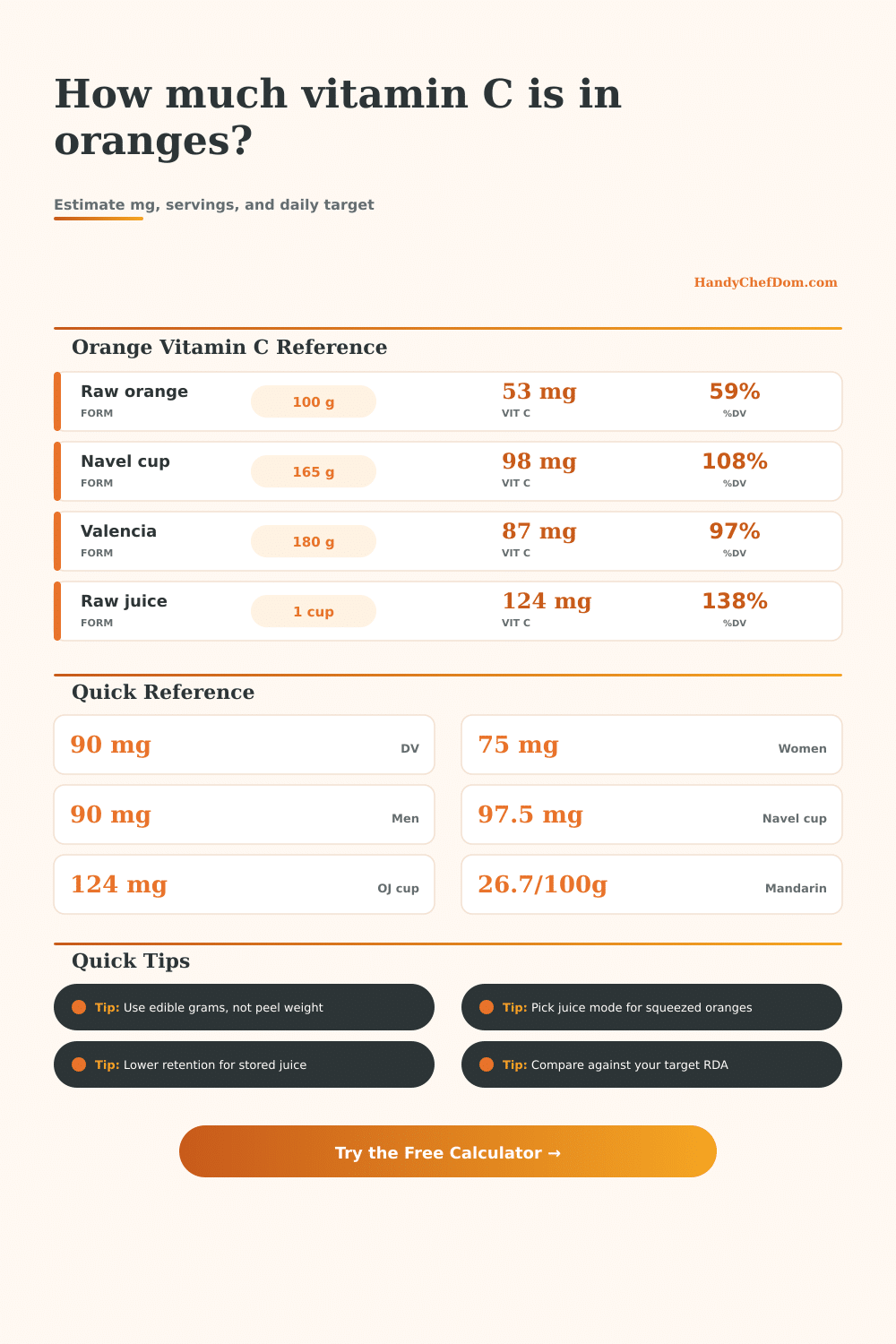
| Orange Variety / Form | Reference Portion | Vitamin C | Working Value |
|---|---|---|---|
| Raw orange, all commercial | 100 g edible fruit | 53.2 mg | 53.2 mg/100 g |
| Navel orange sections | 1 cup, 165 g | 97.5 mg | 59.1 mg/100 g |
| California Valencia sections | 1 cup, 180 g | 87.3 mg | 48.5 mg/100 g |
| Cara Cara orange estimate | 100 g edible fruit | 53.2 mg | commercial orange base |
| Blood orange estimate | 100 g edible fruit | 50.0 mg | culinary citrus average |
| Mandarin / tangerine | 100 g edible fruit | 26.7 mg | 26.7 mg/100 g |
| Fresh raw orange juice | 1 cup, 248 g | 124 mg | 50.0 mg/100 g |
| Chilled orange juice | 1 cup, 249 g | 83.7 mg | 33.6 mg/100 g |
| Input Form | Common Measure | Metric Weight | Imperial Weight |
|---|---|---|---|
| Small orange | 1 fruit, 2-3/8 in | 96 g whole | 3.4 oz |
| Medium orange | 1 fruit, 2-5/8 in | 131 g whole | 4.6 oz |
| Large orange | 1 fruit, 3-1/16 in | 184 g whole | 6.5 oz |
| Navel sections | 1 cup | 165 g edible | 5.8 oz |
| Valencia sections | 1 cup | 180 g edible | 6.3 oz |
| Generic sections | 1 cup | 180 g edible | 6.3 oz |
| Orange juice | 1 cup | 248 g | 8.75 oz |
| Mandarin sections | 1 cup | 195 g edible | 6.9 oz |
| Target Profile | Vitamin C Target | Orange Equivalent | Calculator Use |
|---|---|---|---|
| FDA Daily Value | 90 mg | about 169 g raw orange | Label-style %DV |
| Adult men | 90 mg | about 169 g raw orange | RDA comparison |
| Adult women | 75 mg | about 141 g raw orange | RDA comparison |
| Pregnancy | 85 mg | about 160 g raw orange | RDA comparison |
| Breastfeeding | 120 mg | about 226 g raw orange | RDA comparison |
| Men who smoke | 125 mg | about 235 g raw orange | RDA plus 35 mg |
| Women who smoke | 110 mg | about 207 g raw orange | RDA plus 35 mg |
| Children 9 to 13 | 45 mg | about 85 g raw orange | Child RDA comparison |
| Handling Choice | Calculator Factor | Best For | Effect on Result |
|---|---|---|---|
| Fresh, eaten soon | 1.00x | whole oranges, fresh sections | No reduction |
| Peeled same day | 0.95x | packed lunches | Small reduction |
| Cut and refrigerated | 0.90x | fruit bowls | Moderate reduction |
| Fresh juice same day | 0.85x | home-squeezed juice | Juicing adjustment |
| Juice held overnight | 0.78x | stored juice portions | Storage adjustment |
| Older cut fruit | 0.70x | long-held sections | Conservative estimate |
| Scenario | Amount | Edible Weight | Vitamin C | % of 90 mg DV | Useful For |
|---|---|---|---|---|---|
| Small raw orange | 1 fruit | 71 g edible | 38 mg | 42% | Snack check |
| Medium raw orange | 1 fruit | 97 g edible | 52 mg | 57% | Lunchbox |
| Large raw orange | 1 fruit | 136 g edible | 72 mg | 80% | Single fruit |
| Navel sections | 1 cup | 165 g | 98 mg | 108% | High-C bowl |
| Valencia sections | 1 cup | 180 g | 87 mg | 97% | Juicing fruit |
| Mandarin sections | 1 cup | 195 g | 52 mg | 58% | Kid portions |
| Fresh raw juice | 1 cup | 248 g | 124 mg | 138% | Breakfast |
| Chilled juice | 1 cup | 249 g | 84 mg | 93% | Carton juice |
In the a.m., you stare down the bare juice glass and find yourself questioning whether you’ve reached the day’s nutrition goal. Or maybe you had some fruit or yogurt for breakfast, though you don’t really remember. By 10, who knows? An orange is healthy, sure, but what exactly are its nutrients?
What matter isnt so much eating the fruit itself. It is learning to recognize what makes those nutrients vary from one type of orange to another. You also has to consider where and how they were stored, and how they are prepared. Are all oranges equal in nutrients? Wrong! You can input exactly what kind of orange and how many (the calculator figure out the math for you).
Why Not All Oranges Are Equal
A cup of OJ made from Valencias isn’t the same as half a pound of clementines or one whole navel orange. What you pick will affect your vitamin C intake. Why? Because the sugar-to-acid ratio varies by variety, the flesh density change. This means you get more or less vitamin C per gram eaten.
Pick the generic raw orange option, and you’re getting an average value that might or might not match blood orange sitting on your countertop. That’s where most people fail. They lump citrus into a category rather than recognize it as a diverse group of fruits each with its own nutrition.
How they measure is just as important as what they measure: It seems natural to count full-sized fruits, until you see that oranges vary greatly in size depending on the supplier and time of year; some may be less than half the size of another. Cups of cut-up sections or other edible weight eliminate such guesswork about seedless vs. Pithy peel, and the ability to switch between fruit counts, peeled-fruit weights, or juice volume make this one handy tool. (Juicing alters everything, making your results different.)
Freshly squeezed orange juice has more vitamin C than chilled versions from the store, whether you leave the pulp behind or blend it all in. But once that fresh juice is exposed to light and air, it deteriorates quickely. Vitamin C is another nutrient that decreases significanly during storage. Because it’s water soluble and susceptible to degrading quickly with exposure to heat and oxygen, there’s a retention adjustment built into the calculator.
For example, if you peeled an orange in the morning and ate it at lunchtime without putting it in the fridge, you’re losing out on more nutrients compared to eating it right away. Depending on how you handle the food, it will be assigned a multiplier ranging from one hundred percent (for fresh) down to lower numbers as the produce ages or sits in storage. It may seem like a minor thing, but when you have a goal of hitting certain amounts each day, every percentage point counts.
You could assume that you’ve met your recommended intake for the day, but then realize that since the fruit was sitting on the counter for four hours, you probably only ate about eighty-five percent of that amount. This is great because, compared to blindly eating whatever fruit, the numbers give you something to compare these total adjusted numbers too.
There’s a drop down where you choose what kind of profile you want your food for (from normal adults to those who need more, like pregnant people and smokers). So instead of just knowing that it was healthy-ish, this places your diet in context of what YOU need. How many cups of juice or servings of each section make up the amount of your nutritional base? Exactly. It makes nutrients feel concrete when planning meals.
The trick with food precision isn’t so much in the strict numbers as it’s in the educated know-how: When you understand how different foods retain their nutrients (peeled fruits lose vitamin C over time), or when you juice, you strip out fiber and concentrate sugar, or when fruit loses potency after being exposed to air and light, you’re making smarter decisions based off an informed place… Without getting overwhelmed by tracking them all down.
That same orange can be a strong nutritional powerhouse, but only if you treat its composition with respect. Adjust for how it was grown (variety), handled (storage), and prepared (method) and stop guessing, and start knowing, what your body’s getting. Make that morning routine feel like a deliberate act of fueling instead of mere habit. You should of tried this sooner to see the diffrence.