🍎 Daily Cider Vinegar Calculator
Convert cider vinegar portions into tablespoons, teaspoons, milliliters, dilution water, acidity load, daily servings, recipe timing, cap checks, and tonic sugar or sodium estimates.
Use the bottle acidity when it is listed. The calculator treats acidity percent as grams of acetic acid per 100 ml of vinegar, then keeps food planning separate from any health claim.
Cider vinegar results will appear here.
Equivalent spoons and ml.
Vinegar plus dilution liquid.
Compared with your entered cap.
Approx acid strength in the mixed serving.
Small splash reference for drinks or sauces.
Exact US tablespoon conversion.
Useful when comparing nutrition labels.
Daily vinegar compared with your cap.
| Kitchen measure | Exact US milliliters | Teaspoon equivalent | Rounded label use | Planning note |
|---|---|---|---|---|
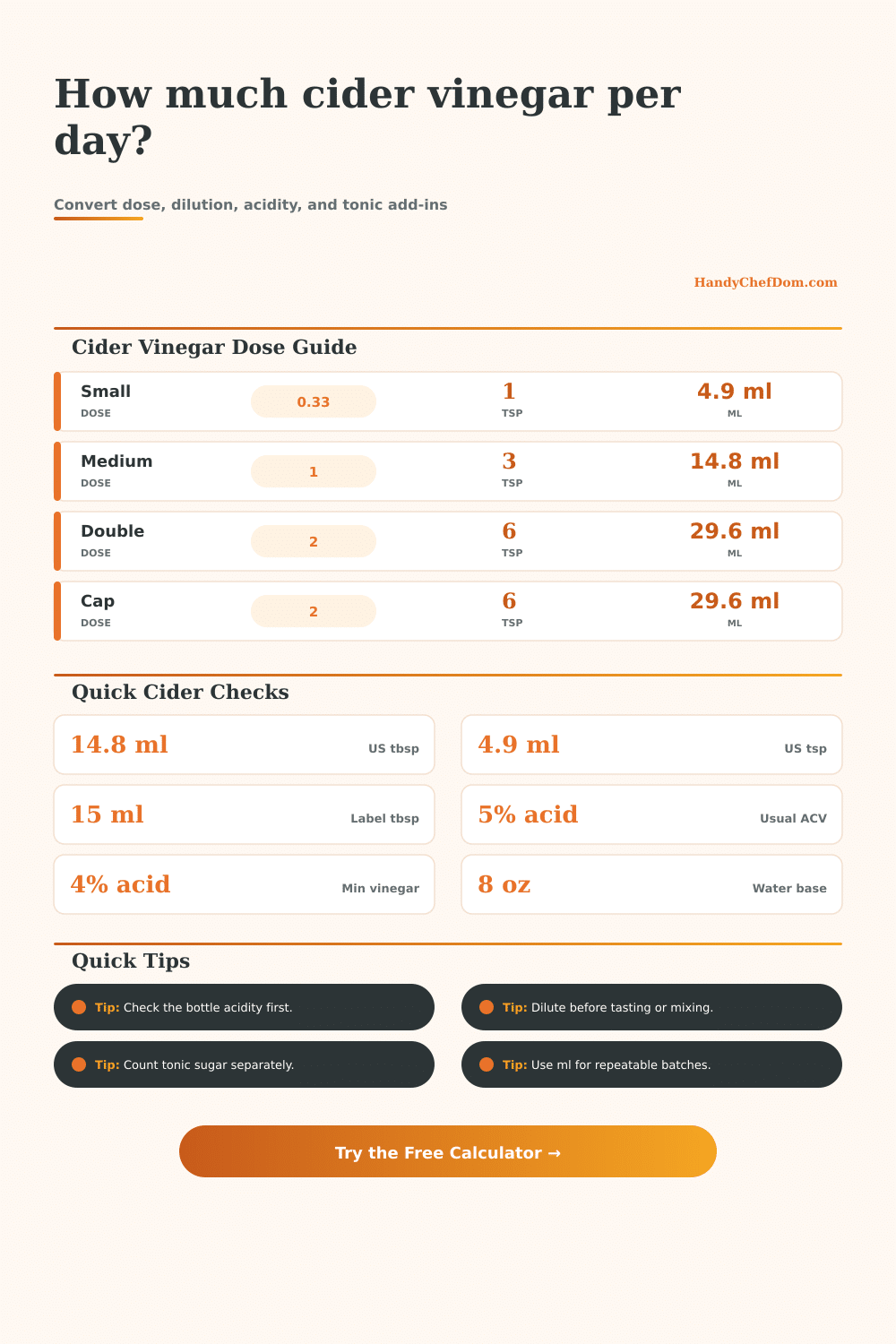
| 1 teaspoon cider vinegar | 4.9289 ml | 1 tsp | 5 ml | Small splash for a glass, dressing, sauce, or taste adjustment. |
| 1 tablespoon cider vinegar | 14.7868 ml | 3 tsp | 15 ml | Common serving-sized kitchen measure for daily or recipe math. |
| 2 tablespoons cider vinegar | 29.5735 ml | 6 tsp | 30 ml | Useful cap comparison because it equals 1 US fluid ounce. |
| 1/4 cup cider vinegar | 59.1471 ml | 12 tsp | 60 ml | Recipe batch amount for dressings, sauces, and quick pickles. |
| 1/2 cup cider vinegar | 118.2941 ml | 24 tsp | 120 ml | Batch amount that should be divided by servings before logging daily totals. |
| Vinegar acidity | Acetic acid meaning | Acid in 1 tbsp | Acid in 2 tbsp | Best calculator use |
|---|---|---|---|---|
| 4% acidity | 4 g acetic acid per 100 ml vinegar | 0.59 g | 1.18 g | Minimum vinegar strength reference for culinary planning. |
| 5% acidity | 5 g acetic acid per 100 ml vinegar | 0.74 g | 1.48 g | Common apple cider vinegar and general kitchen default. |
| 6% acidity | 6 g acetic acid per 100 ml vinegar | 0.89 g | 1.77 g | Stronger culinary bottle; reduce dose if matching a 5% recipe. |
| 7% acidity | 7 g acetic acid per 100 ml vinegar | 1.04 g | 2.07 g | High-acid cooking vinegar; verify bottle label before use. |
| Custom acidity | Label percent drives the math | Percent x 0.1479 | Percent x 0.2957 | Use when the bottle states another acid strength. |
| Vinegar dose | Common dilution liquid | Water to vinegar ratio | Mixed serving volume | Practical use |
|---|---|---|---|---|
| 1 tsp | 4 oz water | About 24:1 | About 4.2 fl oz | Lightly flavored drink or tasting portion. |
| 1 tbsp | 8 oz water | About 16:1 | About 8.5 fl oz | Default diluted glass in this calculator. |
| 2 tbsp | 12 oz water | About 12:1 | About 13 fl oz | Larger glass when keeping flavor less sharp. |
| 1 tbsp | 2 tbsp oil or juice | About 2:1 | About 3 tbsp | Dressing or sauce portion, not a water drink. |
| 1/4 cup | 1 cup liquid | About 4:1 | About 1.25 cups | Batch recipe that gets divided into servings. |
| Recipe mode | Sugar per serving | Sodium per serving | Default pairing | Calculator note |
|---|---|---|---|---|
| Diluted cider vinegar drink | 0 g | 0 mg | Vinegar and water | Only vinegar acidity and dilution water are counted. |
| Honey tonic | 6 g | 5 mg | Honey and lemon style glass | Adds sweetener sugar to the daily extra card. |
| Low-sugar tonic | 2 g | 20 mg | Light sweetener or splash of juice | Uses a small sugar estimate without a health claim. |
| Switchel style tonic | 8 g | 95 mg | Sweetener plus pinch of salt | Tracks sodium when a tonic includes salty add-ins. |
| Salad dressing or marinade | 0 g | 120 mg | Seasoned savory recipe | Counts a modest sodium estimate from seasoning. |
There you are, in your kitchen, standing with a bottle of apple cider vinegar. You want to use it, maybe for blood sugar control? Maybe you want it for digestion? Some sources say to drink a tablespoon before breakfast, while others says two teaspoons. A third source caution not to go over six ounces per day. Not only can’t you tell which would taste good, you can’t even get started telling which is most likely to be better for you…or bad.
Why not check the label first, then reach for the spoon? No need. This calculator converts your chosen dose (based off the strength of the bottle you bought) into milliliters. It also estimate how much acetic acid you are consuming so you can stay below any limit you set for the day.
How to Use the Apple Cider Vinegar Calculator
Acidity levels differs between brands. Knowing your vinegar’s percentage is important if you’re looking to stay super on top of ACV intake. A 6 percent vinegar will have more oomph then its 5 percent counterpart (five grams of acetic acid per 100 milliliters of solution). When using different types without altering your dosage, you could end up taking extra acid each day, oops! That’s why the tool require your vinegar’s percentage. It’ll automatically convert it into grams for you. Then you can input it and know exactly how much acid you’ve had.
In other words: Don’t assume that just because two vinegars appear alike in the bottle, they’re necessarily chemically the same. For one thing, dilution also protects tooth enamel; and tastes good. Most guides suggests that you mix vinegar with water before drinking because straight vinegar will be rough on your teeth and esophagus. To account for this, the calculator allow you to specify quantity of vinegar you use (in teaspoons or tablespoons) and it matches this to a corresponding amount of water. So now you know exactly how much water you’re putting in each glass, and you’ll be able to see final acidity after dilution.
More isn’t always better; even if two glasses contain the same amount of vinegar, it matters greatly whether you use a big splash in a giant glass or a heavy dose in a tiny cup. The calculator shows both, the ratio as well as the volume you end up with after mixing everything together.
But there’s more: frequency and timing. Do you take it all at once or split it into two doses? You can enter how many times per day you want to take the vinegar. The interface will immediately calculate your total acid and vinegar load for each day, so you’ll know when you’re getting close to your limit before reaching for the spoon. That’s great, since it helps plan ahead. It’s like a built-in rail for safety in your routine. It keeps moderation in check without you having to see a doctor.
For people interested in flavoring their water beyond a straight mix, there’s also recipe mode. If you add salt, or honey, this will alter the nutrition of your drink. Even though the dose of vinegar stay the same. These additions are broken out separately by the calculator, which estimates how much sodium or sugar is being added to your drink without muddying that number with the vinegar amount. That makes it easier to see what you’re drinking: maybe you can handle the acidity, but not the sugar from a sweetened tonic. Breaking things out like this make it easier to make an informed decision about what you want to put into the drink (as opposed to simply mixing up liquids).
If you like your information presented in a more static way different than an interactive input, there are reference tables on the page that give you a quick lookup. The exact conversion between teaspoons, tablespoons, and milliliters makes sense when scaling recipes or comparing nutrition labels, it’s nice to know the precise amount you need for accuracy. Or you might want to double check the serving sizes listed on your nutrition label. They often round up or down to the nearest whole number. Knowing the exact conversion will help. There is also information on various acidity strengths and dilution ratios. This makes a useful cheat sheet to keep on hand while planning ahead. No more guessing at how much to measure with a spoon or teaspoon!
In the end, however, it’s all about creating a sustainible cider vinegar habit. One teaspoon in the AM? Two tablespoons, spread out during the day? Your goal isn’t to discover some magic number, but simply to figure out how much makes sense, to stick to something healthy that fits your kitchen habits and your personal limits. That’s where the calculator comes in: it gives you a visual picture of those limits so you can make a coherent plan from what might otherwise be an overwealming stream of vague internet tips. You begin with a bottle and a question; you finish with a glass of cider vinegar and a firm grasp on exactly what’s inside.