Yogurt Calcium Calculator
Estimate calcium from yogurt style, portion size, serving frequency, and label adjustment using USDA-style nutrition baselines.
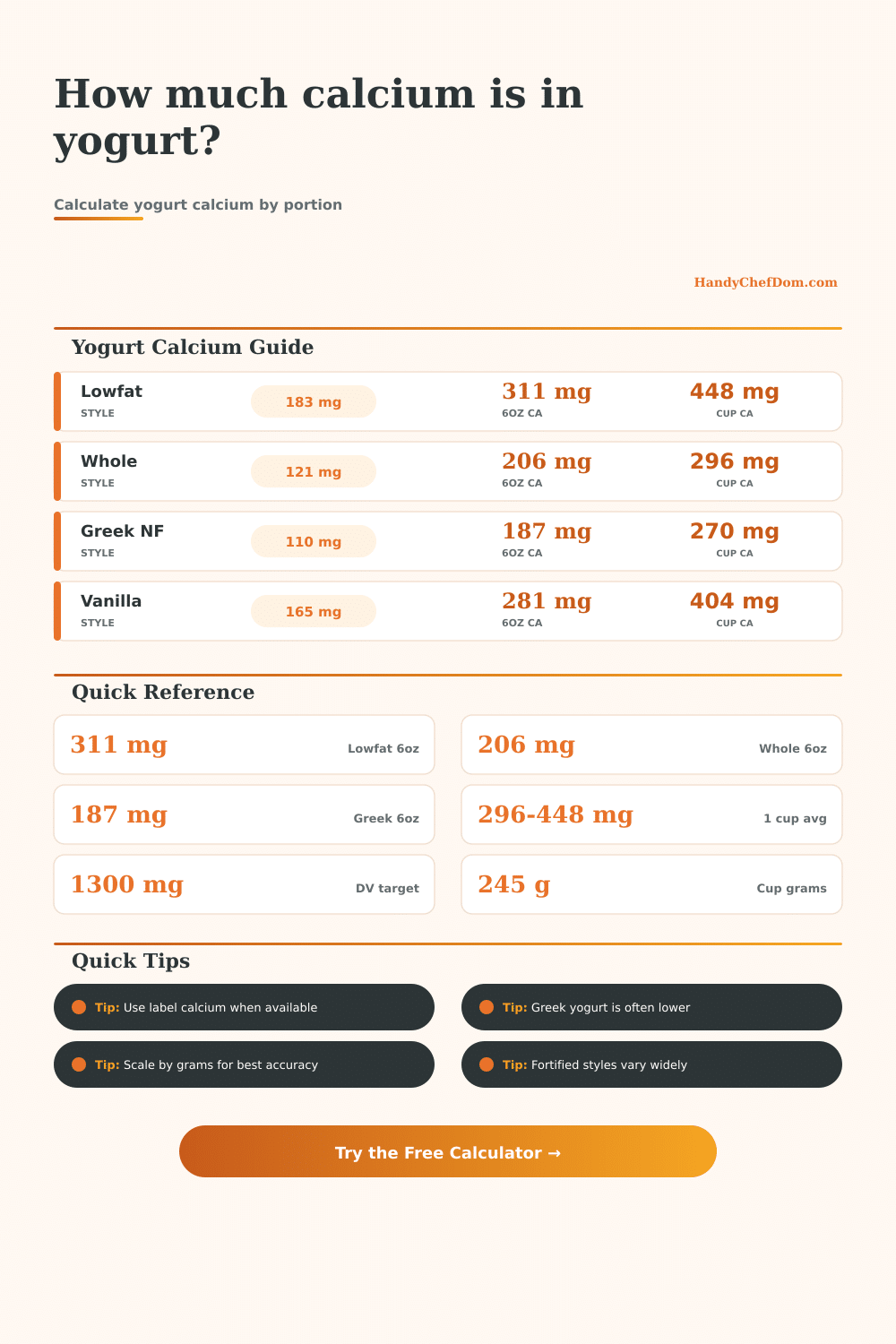
| Yogurt Style | Calcium / 100 g | 6 oz Calcium | 1 Cup Calcium | Protein / 6 oz | Calories / 6 oz |
|---|---|---|---|---|---|
| Plain Lowfat Yogurt | 183 mg | 311 mg | 448 mg | 8.9 g | 107 |
| Plain Whole Milk Yogurt | 121 mg | 206 mg | 296 mg | 5.9 g | 104 |
| Plain Nonfat Yogurt | 199 mg | 338 mg | 488 mg | 9.0 g | 95 |
| Greek Plain Nonfat | 110 mg | 187 mg | 270 mg | 17.3 g | 100 |
| Greek Plain Whole Milk | 100 mg | 170 mg | 245 mg | 15.3 g | 165 |
| Vanilla Lowfat Yogurt | 165 mg | 281 mg | 404 mg | 8.3 g | 162 |
| Fruit Lowfat Yogurt | 169 mg | 287 mg | 414 mg | 7.5 g | 168 |
| Skyr Plain Nonfat | 120 mg | 204 mg | 294 mg | 18.7 g | 107 |
| Drinkable Yogurt or Kefir | 120 mg | 204 mg | 284 mg | 6.5 g | 109 |
| Portion | Approx Grams | Lowfat Plain | Whole Plain | Greek Nonfat |
|---|---|---|---|---|
| Half cup | 123 g | 225 mg | 149 mg | 135 mg |
| 6 oz container | 170 g | 311 mg | 206 mg | 187 mg |
| 3/4 cup | 184 g | 337 mg | 223 mg | 202 mg |
| 1 cup | 245 g | 448 mg | 296 mg | 270 mg |
| 200 g bowl | 200 g | 366 mg | 242 mg | 220 mg |
| 8 oz cup | 227 g | 415 mg | 275 mg | 250 mg |
| Measure | Plain Yogurt | Greek Yogurt | Drinkable Yogurt | Best Calculator Mode |
|---|---|---|---|---|
| 1 tablespoon | 15 g | 16 g | 15 ml | Weight |
| 1/4 cup | 61 g | 64 g | 59 ml | Volume |
| 1/2 cup | 123 g | 128 g | 118 ml | Volume |
| 3/4 cup | 184 g | 191 g | 177 ml | Volume |
| 1 cup | 245 g | 255 g | 237 ml | Volume |
| 1 ounce | 28.35 g | 28.35 g | 29.6 ml | Weight |
| Daily Target | Lowfat 6 oz | Greek 6 oz | Whole 6 oz | Plain Lowfat Cups |
|---|---|---|---|---|
| 1000 mg | 31% | 19% | 21% | 2.2 cups |
| 1200 mg | 26% | 16% | 17% | 2.7 cups |
| 1300 mg | 24% | 14% | 16% | 2.9 cups |
| 1500 mg | 21% | 12% | 14% | 3.3 cups |
YOGURT: One kind of food, right? Nope! It is one category containing various ingredient. All bear the same-looking label. So each could be two cups of dairy consumed in a day. And the amount of calcium you take in may be quite different than that of another.
If you choose plain lowfat vs Greek yogurt, for instance, you’ll recieve varying amounts of calcium. Protein counts, and so does texture. For example, how much whey was extracted? Why? Whey contain minerals. Processors remove whey (to thicken), and some calcium goes along for the ride.
Why Different Yogurts Have Different Calcium
What’s in your bowl matters. It matters more than grabbing something on sale. The calculator above figure it out for you. Plug in your desired size and style. See what calcium contribute to your daily total.
Many assume that all yogurts is equal when it comes to supporting bone health. The data proves otherwise. Plain lowfat yogurt contain about 300 milligrams of calcium per six-ounce serving. Nonfat Greek yogurt provides slightly less in the same size portion. It is closer to 187 milligrams.
Why? Because Greek yogurt is strained multiple times. Removing liquid whey concentrates protein while reducing mineral density. Small trade-off. If you’re tracking your intake, hitting your nutritional goals might require a tradeoff with calories or sugar.
Personal experience matter more than general data. You can adjust for brand differences in the tool. Why is this? Brands do not all add the same stuff. Some are just milk with nothing added. Others add calcium carbonate. If it says that on your label, use the enriched one. Then it will match what’s going on. Otherwise you’re using a generic average. That prevents guessing wrong. It goes from a rough estimate to something you can reliably track.
Second is frequency. One high calcium food per week isn’t going to help you much with any minerals. A daily serving of yogurt will account for 25% or more of your required amount. See the chart on that page for details. That tells you how total weekly consumption vary by routine.
Big servings occasionally won’t match consistency. You don’t have to eat huge servings to be getting some benefits. Eating food regularly maintains steady levels of minerals which in turn allows bones and muscles to function best. As you age, your body absorbs nutrients less effective, so a routine becomes even more important.
One other error is portion size. There are lots of one-serving container where the actual weight varies between brands. Different brands have different weights, and you aren’t always getting the right amount from one package. For example, an eight ounce cup is not equivalent to a six-ounce cup. Those tend to get mixed up in people minds.
Instead, input either volume (or better yet, weight). That removes any possibility for confusion and forces you to read grams. Grams give you accurate counts on different foods. This allows you to compare greens to cheese to yogurt. You get a clearer picture of what you eat.
The goal isn’t to stress over every milligram. Get familiar with what you eat. Know that Greek yogurt contains fewer minerals, but more protein. Pair it with something else high in minerals. Skyr? Add some leafy greens or almonds. That offsets the missing minerals. It makes tracking simpler. Your system isn’t dependent on a single food item. You’re creating a system that suits your taste buds and lifestyle.”
The yogurt is good for your diet. It is useful in many ways, too. You can cook with it, snack on it, even have it for breakfast. And understanding what it has will help you do more of that. The tool does the math; you create the plan. Consider frequency, size, and style. That transforms this everyday dairy item into a smart health move.
What was once a habit, like that morning bowl, now becomes a considered decision. You should of looked at the data first.