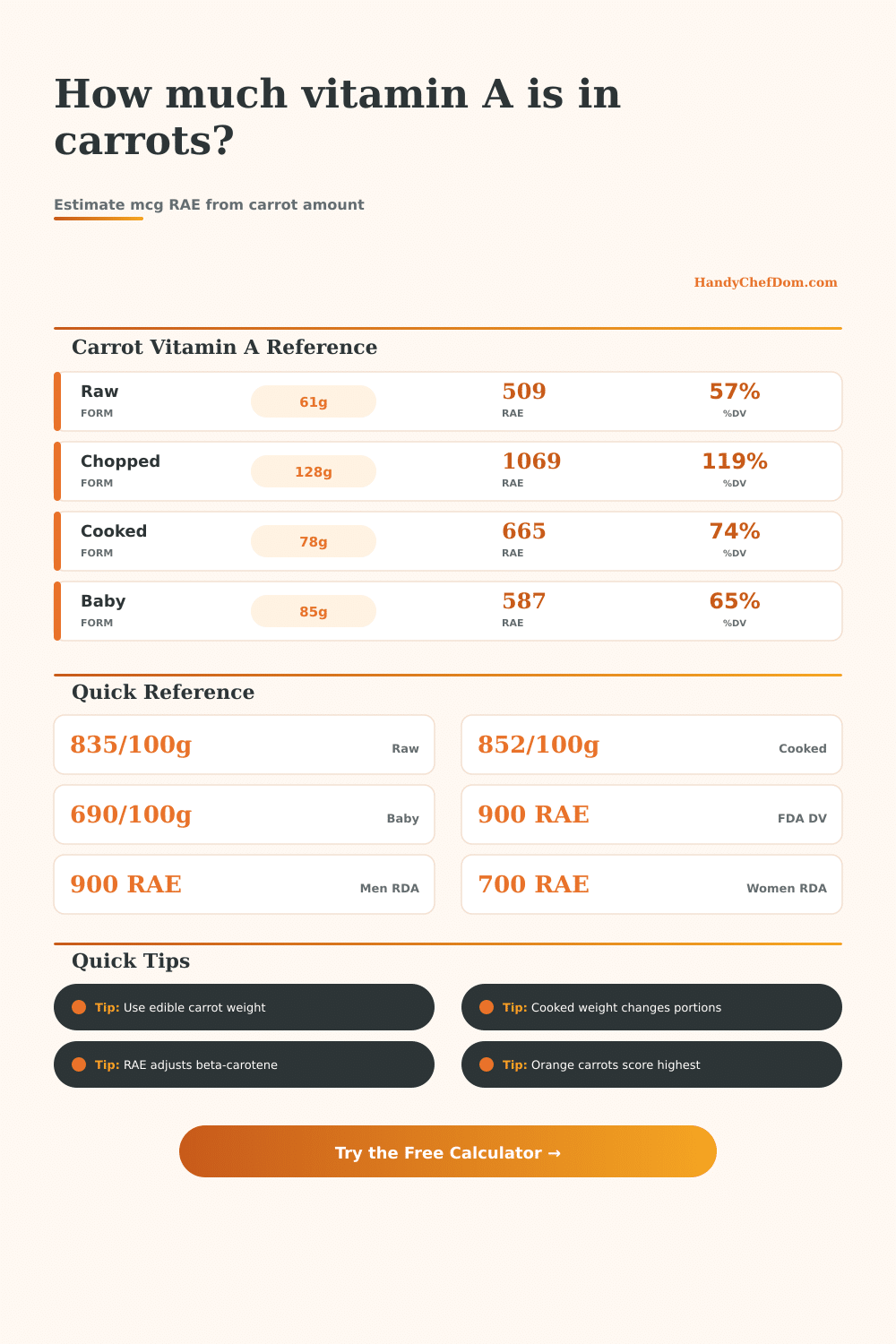
Carrot Vitamin A Calculator
Estimate vitamin A as mcg RAE from carrot form, size, color, beta-carotene conversion, and prep changes.
| Carrot Form | RAE/100g | Beta-Carotene | Alpha-Carotene | Calories | Fiber |
|---|---|---|---|---|---|
| Raw whole orange | 835 mcg | 8,285 mcg | 3,477 mcg | 41 kcal | 2.8 g |
| Raw chopped | 835 mcg | 8,285 mcg | 3,477 mcg | 41 kcal | 2.8 g |
| Raw shredded | 835 mcg | 8,285 mcg | 3,477 mcg | 41 kcal | 2.8 g |
| Baby carrots raw | 690 mcg | 6,390 mcg | 3,770 mcg | 35 kcal | 2.9 g |
| Boiled drained | 852 mcg | 8,330 mcg | 3,776 mcg | 35 kcal | 3.0 g |
| Roasted estimate | 920 mcg | 8,950 mcg | 3,850 mcg | 45 kcal | 3.1 g |
| Input | Conversion | Used For | Example |
|---|---|---|---|
| USDA RAE | FoodData value | Default result | 835 mcg/100g raw |
| Diet beta-carotene | 12 mcg = 1 RAE | NIH method | 8,285 mcg = 690 RAE |
| Diet alpha-carotene | 24 mcg = 1 RAE | Added estimate | 3,477 mcg = 145 RAE |
| Conservative | 18 mcg = 1 RAE | Lower conversion | Meal variability |
| Enhanced meal | 10 mcg = 1 RAE | Fat/puree context | Oil or blended |
| Amount | Weight | RAE | % FDA DV | Beta-Carotene | Common Use |
|---|
| Reference Group | mcg RAE/Day | Medium Raw Carrots | Notes |
|---|---|---|---|
| FDA Daily Value | 900 | About 1.8 | Nutrition label reference |
| Adult male RDA | 900 | About 1.8 | NIH adult male amount |
| Adult female RDA | 700 | About 1.4 | NIH adult female amount |
| Pregnancy RDA | 770 | About 1.5 | Adult pregnancy amount |
| Lactation RDA | 1300 | About 2.6 | Adult lactation amount |
| Child 4-8 RDA | 400 | About 0.8 | Use age-specific guidance |
Carrots is good for your eyes, right? You were told that as a kid, and no doubt said it to yours; but there’s more to the story then that. When you eat carrots, it isn’t like your body sucks up pre-made vitamin A the way it would suck up vitamin A from an egg yolk or liver. You’re eating a pro-vitamin called beta-carotene and then your intestines has to turn it into different compound: retinol. And they do so with different levels of success, depending on certain factors. What color carrot? How did you eat it? What else was in your stomach when you ate it? How much fat was present? The calculator does the math for you based off your specific situation.
It’s designed to help you decide if it really matter how you cook those carrots. Roast versus steam. When you search around in nutritional databases, they’ll give you an average value of cooked carrots, but that muddles the waters of what happens when you boil and roast the vegetables. Cooking break down fibers, which allows your body’s enzymes access to carotenoids. But there’s a catch: If you over-boil your carrots, you start leaching the good stuff out into the cooking water. When you roast the carrots, you concentrate the goodness, but you also lose some through weight loss. The tool takes all of this into account, and doesn’t let you compare raw-weight with roasted-weight without accounting for volume change (i.e., density).
More Than Just Eyes: How Carrots Really Help You
There’s also color, which gets overlooked. We think carrots are all just one basic orange, but pale yellows and whites tend to be far less strong in beta-carotenes than their deeper cousins. And even purple carrot can be off-putting. Inside, they is typically orange, which contributes to their vitamin A action. When you toss various colors into your shopping cart. Say, a bag of rainbow carrots, you’re diluting your average potency versus what might come from a bag of uniformly deeper orange ones. You don’t have to run them through a lab test to know that it makes a difference; it shifts your output numbers by enough to care about if you want to keep track of how much you take in.
Context is everything. Your body absorbs beta-carotene better when there’s fat in your diet. Snacking on raw carrots will give you some usable vitamin A. However, you’ll get more value if you eat the carrot with something fatty, such as a salad with olive oil dressing or a chicken breast. To account for this, the tool allows users to choose an absorption context, anything from a no-fat snack to a fat-filled blended meal.
Why does this matter? If your body doesn’t absorb the nutrient it won’t store it for later. Most people underestimate how much the food matrix affect bioavailability. If you’re planning meals in advance (meal prepping), the reference tables on the page makes it simple to compare various serving sizes. For instance, a typical medium-sized raw carrot provides roughly half the recommended daily allowance for adult men; women who are pregnant or lactating require almost two carrots to reach same level. Building tissue for another human being increases nutrient needs quite significantly, so it’s not surprising to learn that regular RDAs change greatly at those life stages.
Also: Trim loss. A dirty carrot with leaves on is not what you’re eating; only its edible part matter. Peeling carrots, whether lightly or heavily, removes some of that nutritious exterior. Baby carrots (often pre-peeled) that are cut from larger ones might be less dense than whole young carrots. Adjust your calculations to match trim factors. That way, your estimate takes into account what’s actualy going into your mouth.
You don’t have to hit the precise micrograms per day. You’ve got a buffer of stored vitamin A in your liver that’ll absorb any day-to-day swings. Perfect isn’t as important than consistent. It’s meant to be used like a trend-spotting tool, not a solution to one meal. Are you regularly underperforming? Or do you frequently prepare food in a way that destroys its own nutrients?
Think of it this way: How can we make the most of what we’re eating? Eat the orange veggies; get started with the basics. Cook ‘em gently and add some fat to help with absorption. These decisions won’t just improve your vision (they’ll give your skin a boost), too. You should of used this more often.