Cashews Magnesium Calculator
Estimate magnesium from raw cashews, roasted cashews, salted cashews, and cashew butter servings using USDA, NIH, and FDA reference values
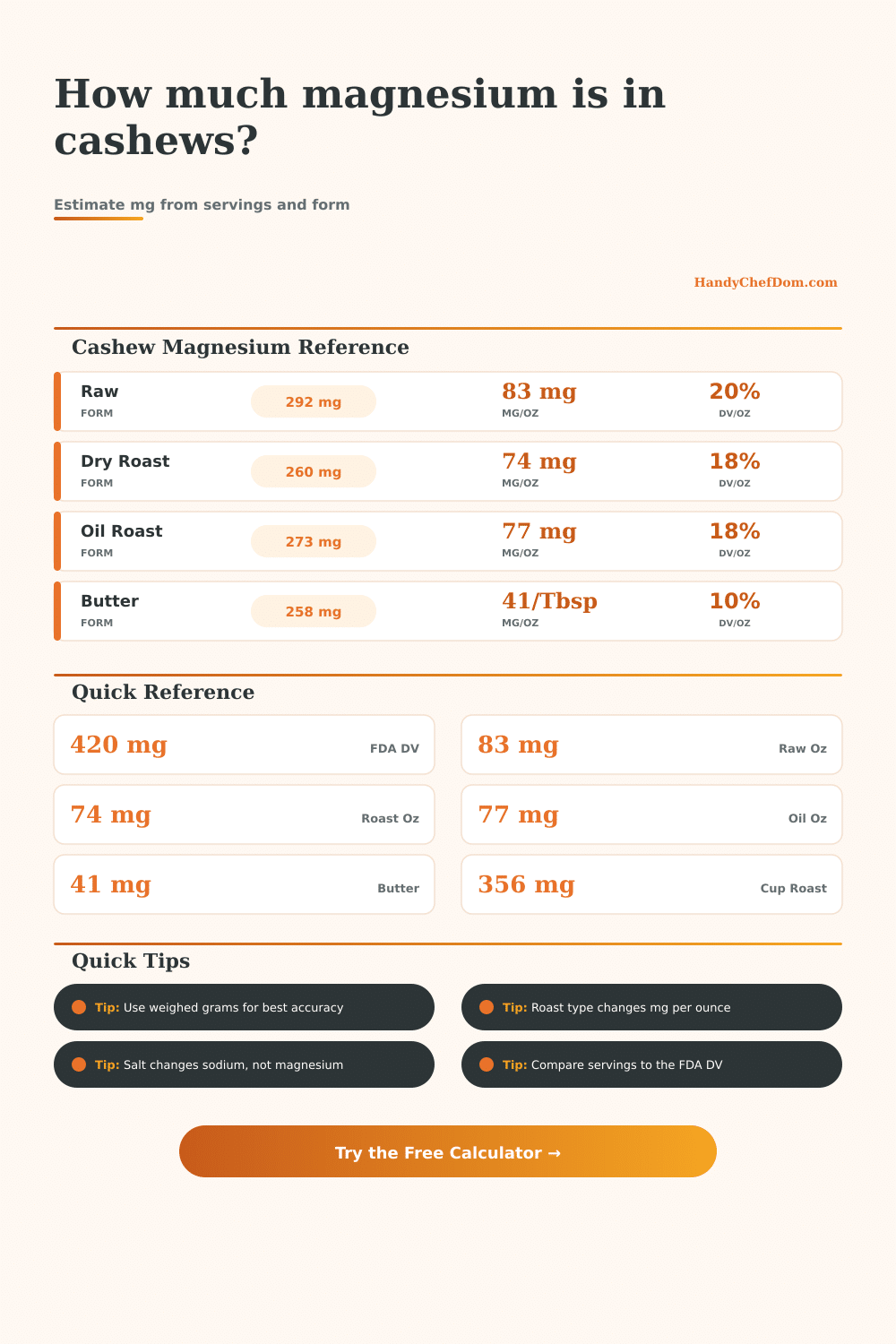
| Form | Mg/100 g | Mg/1 oz | Kitchen Serving |
|---|---|---|---|
| Raw cashew kernels | 292 mg | 82.8 mg | 1 oz or 28 g |
| Dry roasted, unsalted | 260 mg | 73.7 mg | 1 oz or 18 kernels |
| Dry roasted, salted | 260 mg | 73.7 mg | 1 oz or 18 kernels |
| Oil roasted, unsalted | 273 mg | 77.4 mg | 1 oz or 18 kernels |
| Oil roasted, salted | 273 mg | 77.4 mg | 1 oz or 18 kernels |
| Cashew butter, plain | 258 mg | 73.3 mg | 1 tbsp or 16 g |
| Measure | Typical Weight | Raw Mg | Dry Roast Mg |
|---|---|---|---|
| 1 ounce kernels | 28.35 g | 82.8 mg | 73.7 mg |
| 18 roasted kernels | 28.35 g | 82.8 mg | 73.7 mg |
| 1/4 cup whole | 34 g | 99 mg | 88 mg |
| 1/2 cup whole | 68 g | 199 mg | 177 mg |
| 1 cup roasted | 137 g | 400 mg | 356 mg |
| 1 tbsp butter | 16 g | 47 mg | 41 mg butter |
| Reference Group | Mg/Day | 1 Oz Dry Roast | 2 Tbsp Butter |
|---|---|---|---|
| FDA Daily Value | 420 mg | 18% | 20% |
| Men 19-30 | 400 mg | 18% | 21% |
| Men 31+ | 420 mg | 18% | 20% |
| Women 19-30 | 310 mg | 24% | 27% |
| Women 31+ | 320 mg | 23% | 26% |
| Pregnancy 19-30 | 350 mg | 21% | 24% |
| Scenario | Form | Serving | Magnesium | FDA DV | Sodium |
|---|---|---|---|---|---|
| Small topping | Raw | 0.5 oz | 41 mg | 10% | 2 mg |
| Standard snack | Dry roast | 1 oz | 74 mg | 18% | 5 mg |
| Salted snack | Oil salted | 1 oz | 77 mg | 18% | 87 mg |
| Trail mix scoop | Raw | 1/4 cup | 99 mg | 24% | 4 mg |
| Shared bowl | Dry roast | 1/2 cup | 177 mg | 42% | 11 mg |
| Toast spread | Butter | 1 tbsp | 41 mg | 10% | 2 mg |
| Smoothie add-in | Butter | 2 tbsp | 83 mg | 20% | 5 mg |
| Meal prep jar | Dry roast | 1 cup | 356 mg | 85% | 22 mg |
| Reference | Value Used | Calculator Role | Notes |
|---|---|---|---|
| USDA FDC 170162 | 292 mg/100 g | Raw cashew base | Raw kernels |
| NIH ODS table | 74 mg/oz | Dry roasted check | 18% DV rounded |
| USDA roasted data | 260 mg/100 g | Dry roast base | Salt does not raise magnesium |
| USDA butter data | 41 mg/tbsp | Butter conversion | 16 g tablespoon |
| FDA nutrition DV | 420 mg/day | Percent DV math | Adults and ages 4+ |
Sprinkling some salt onto your snack doesn’t alter the nutrient balance. You might imagine sodium pushing out magnesium the way sugar waters down your juice, but that is not what happens. Salt impacts your blood pressure; it doesn’t touch your minerals. While adding salt might seem like it changes your mineral levels, it actualy leaves them alone, so you just have to watch your sodium budget while hitting those nutritional benchmarks.
A handful of cashews provides more of your daily dose then many other foods found at the average grocer. It’s a powerful method for filling up on nutrients.
Why Cashews Are Good for You
Serving sizes gets complicated quickly, such as comparing a half-cup of shelled nuts to slathering butter over a slice of bread. To use it, the calculator does all the conversion math for you (so there is no need to memorize the USDA data points). Most people don’t realize that it also accounts for the form of the nut itself. One-hundred-grams of roasted cashews contain less magnesium than raw cashews. Heating can break down certain nutrients and change the density, changing the figures by just enough to matter if you’re consuming large amounts. All you have to do is indicate whether your nuts were roasted in oil, dry roasted, or raw, then you’ll recieve an appropriate starting point. This helps avoid the mistake of overestimating your consumption from general nutrition labels (which frequently combine various processing styles into one group).
It all comes down to form: What is the difference in weight vs. Volume? Cashew butter will weigh less than whole kernels, but they both contain substantial amounts of magnesium. Because the butter is denser (and spreads farther), a serving contains fewer calories and less nut by weight then if you were eating whole nuts straight from the bowl. In order to account for that, you’re able to toggle between measurement types. Ounces, tablespoons, or even cups, with the tool. When using butter, the output consider the reduced weight of your particular spoonful.
That’s helpful when preparing meals for multiple people across a few days, since you can then calculate totals all at once to match. So not only do you know how much magnesium everyone gets per serving, but also how that compares to his/her individual daily target. On top of this uncomplicated snack planning, one more wrinkle: daily targets differ by gender and age. According to traditional nutritional guidelines, a man aged 30 requires more magnesium than a woman aged 25. Demographic comparisons help put a single ounce into context; how does that much affect your personal health goals? When you see what percentage of your day’s requirement you get from a small handful, that puts things into perspective.
That’s a lot if you’re getting eighteen percent of your recommended value from such a small amount, but not quite enough to sustain an entire diet. To complete your nutrition, round out with legumes and leafy greens.
Accuracy improves drastically when you weigh your food instead of estimating by eye. Whole nuts don’t settle the same way as broken ones, so cups aren’t accurate. The weight of what is inside the same glass cup will differ. Measuring in ounces or grams gives me a clearer idea of how much I’ve got in there. And if I can’t be precise, the tool has variance adjustments to adjust to batch processing and natural variation in nut size. That allows me to use the numbers even if I’m dealing in approximate values rather than having to track every bite. The best of both worlds: snacking casually while still keeping some kind of handle on what’s going into your system.
To ease meal-specific anxiety, try thinking of your magnesium intake on a daily basis instead of a per meal one: don’t strive to reach your goal at each meal (just throughout the entire day). Magnesium is a great nutrient to use this approach with because cashews are so versatile. They can be tossed into a salad, mixed into trail mixes, or served as a sauce base…no need to cook ‘em up special. This convenience makes them a go-to snack and encourages consistent intake. Consistent > Perfect in terms of long term nutrition habits.
So yes, it’s about understanding: What am I really measuring here? In this case, we’re not talking about taste, or about texture, but rather mineral content. When you look past the concern (sodium) and focus on the benefit (magnesium), you realize cashews are an easy choice for healthy eating. Choose your form carefully, watch your portions and consider cashews a trusted source of minerals missing from so many moddern diets.
Yes, those numbers are daunting. Until you break down the portion size into something reasonable. Then they’re just one more good reason to stock the cupboard with a jar of nuts.