🍕 Slices per 14 Inch Pizza Calculator
Calculate how many slices a 14 inch pizza makes from cut style, square or party cut, slice angle, crust width, toppings density, appetite, serving style, and party size.
Start with a common 14 inch pizza cut, then adjust slice count, party size, appetite, crust width, toppings density, and serving style.
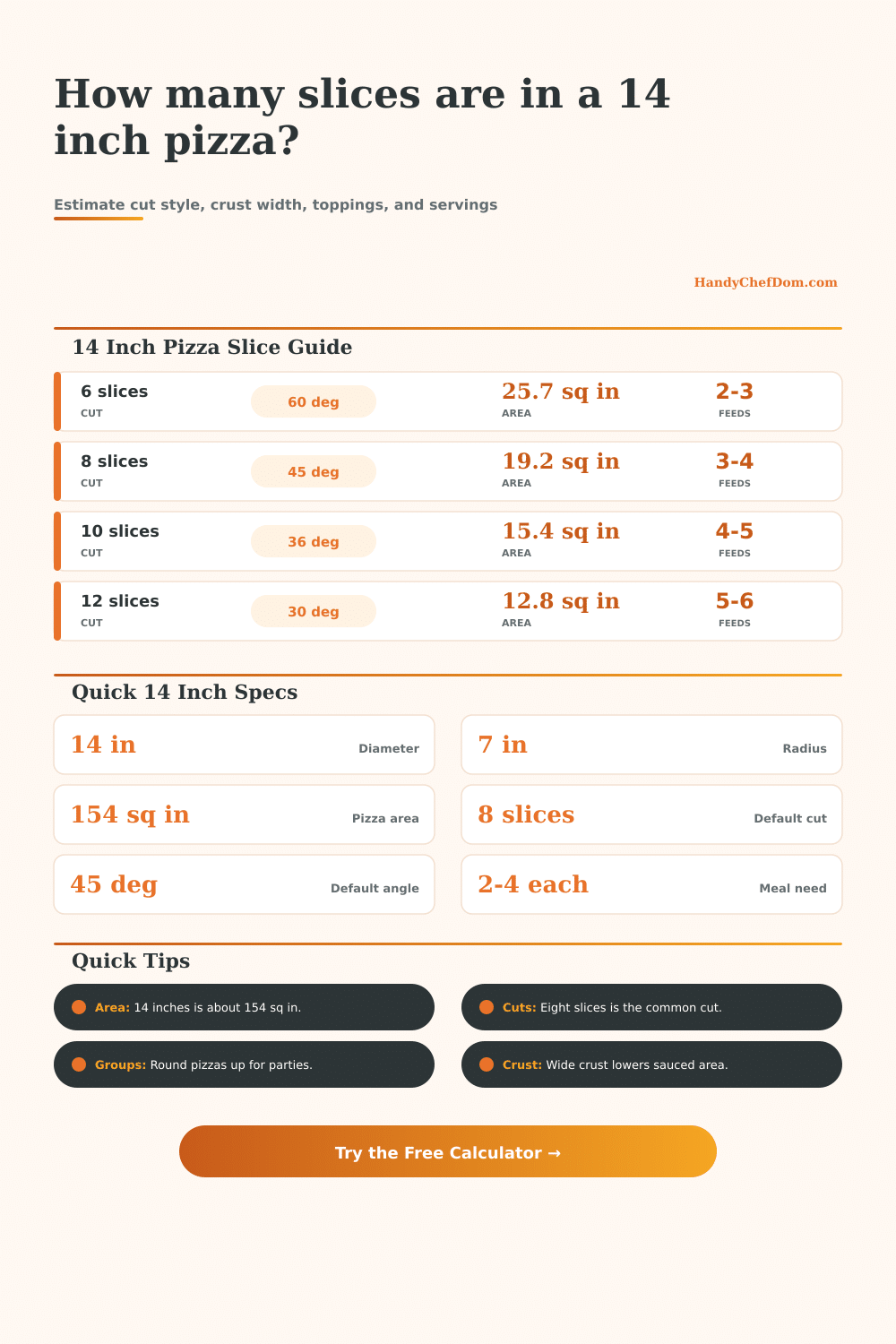
| 14 inch cut | Pieces | Angle per wedge | Area before crust | Area after 0.35 in crust | Best planning use |
|---|---|---|---|---|---|
| Hearty wedge cut | 6 slices | 60° | 25.7 sq in | 23.2 sq in | Thick crust, deep dish, or very hungry eaters. |
| Standard wedge cut | 8 slices | 45° | 19.2 sq in | 17.4 sq in | Most 14 inch delivery-style pizzas. |
| Thin wedge cut | 10 slices | 36° | 15.4 sq in | 13.9 sq in | Thin crust, mixed toppings, easier sharing. |
| Small wedge cut | 12 slices | 30° | 12.8 sq in | 11.6 sq in | Buffets, sampling, or kids with adults. |
| Square / party cut | 16 pieces | 22.5° equivalent | 9.6 sq in | 8.7 sq in | Grazing tables and child-friendly portions. |
| Serving style | Light appetite | Average appetite | Hearty appetite | Extra hungry | Planning note |
|---|---|---|---|---|---|
| Snack or appetizer | 1 slice | 1.5 slices | 1.9 slices | 2.3 slices | Pizza served before another meal. |
| Main meal with sides | 2 slices | 2.7 slices | 3.4 slices | 4 slices | Common family dinner planning. |
| Pizza is the only food | 2.4 slices | 3.2 slices | 4 slices | 4.8 slices | Round up because sides are absent. |
| Mostly kids | 1 slice | 1.4 slices | 1.8 slices | 2.1 slices | Use smaller pieces to reduce waste. |
| Late-night crowd | 2.6 slices | 3.5 slices | 4.4 slices | 5.3 slices | Plan extra pies for uncertain headcount. |
| Crust width | Sauced radius | Edible 14 inch area | 8-slice area | 10-slice area | 16-piece area |
|---|---|---|---|---|---|
| 0.00 in | 7.00 in | 153.9 sq in | 19.2 sq in | 15.4 sq in | 9.6 sq in |
| 0.25 in | 6.75 in | 143.1 sq in | 17.9 sq in | 14.3 sq in | 8.9 sq in |
| 0.35 in | 6.65 in | 138.9 sq in | 17.4 sq in | 13.9 sq in | 8.7 sq in |
| 0.50 in | 6.50 in | 132.7 sq in | 16.6 sq in | 13.3 sq in | 8.3 sq in |
| 0.75 in | 6.25 in | 122.7 sq in | 15.3 sq in | 12.3 sq in | 7.7 sq in |
| Toppings density | Demand factor | Best cut style | Party size cue | Common order note |
|---|---|---|---|---|
| Light toppings | 1.08x | 8 or 10 wedges | Guests may take more slices | Thin cheese or veggie pies disappear fast. |
| Normal toppings | 1.00x | 8 standard wedges | Average meal planning | Use this as the baseline. |
| Loaded toppings | 0.93x | 8 wedges or 12 small wedges | Richer slices slow demand | Good for mixed adult tables. |
| Heavy / deep toppings | 0.86x | 6 hearty wedges | Fewer slices feel filling | Still round up for uncertain headcount. |
| Square / party cut | Variable | 16 pieces | Kids, buffets, grazing | Piece count rises while area per piece falls. |
There’s something odd about a fourteen-inch pizza. It is large enough to feel accomplished by, yet not big enough to ensure a feeling of having fed everyone comfortabley (or even begrudgingly). For this reason, most parties ends up ordering two pizzas when what we all actualy need is one and a half. We leave them in the fridge for several days before eating them.
Slices don’t add up in a straight line. Human hunger are too unpredictable for such simple mathematics. While a normal slice may be enough for a quiet Tuesday evening, on a wild weekend afternoon with no lunch, nobody is satisfied.
How to Calculate the Right Amount of Pizza
First off: You define the fraction of the pie you’d like. Most chains defaults to eight slices, which gives you roughly nineteen square inches of pizza per wedge. Sounds good! Until you remember there’s also crust. And sometimes it’s pretty thick.
What you’re left with isn’t necessarily what the geometry would suggest; the top layer of sauce sit atop a foundation of mostly-empty space. So depending on your crust width, you may be spending money on bread instead of cheese and toppings.
Enter the calculator, which does the math for you after you plug in your desired crust width. That way, you’ll get rid of doughy outer perimeter to see what’s really for eating. Think of crust width as a volume-tax. A half-inch thicker crust may not seem like much but it shaves a huge chunk out of that inner circle. You lose about ten percent of the square footage devoted to real eating.
Topplings: Toppling changes everything. Because a heavily topped pizza (e.g. A heavily topped pizza, like sausage and pepper, has more mass than a lightly topped one. All cheese), people will order less of it. Intuition breaks down here; we think more area = more satisfaction. Nope. Richness and weight also plays into this equation. If most people in your party like thick topping pizzas, expect to get slightly fewer slices per person then if they prefer light vegetable topping. There’s a good way to prevent over-ordering; adjust the demand factor based on how thick the toppings are, which is reflected in the reference table. This might seem like a minor tweak in the model, but it’ll save you cash at the end of the day.
Beyond the taste of the pizza, nearly just as important is how that slice fits into the meal. Is it an appetizer? A main dish? If the only thing being served is pizza, then those slices gets gobbled up faster because there is no other side of the plate to cushion the hunger. But if there’s also garlic bread and salads available, then suddenly each person can take a little less pizza making it part of a full meal.
The same goes with late night crowds. They tend to get hungry around midnight, and that spike in hunger mean things get eaten quickly. In this case, you’re going to have to order extra pizzas and round them up more vigorously then you would at a sit-down dinner party.
Kids complicate things even further. Their attention spans is brief and their hunger is unpredictable. Small slices help curb wastage here, nobody wants to feel bad about not finishing a massive wedge of leftover pizza.
The temptation with big-batch dishes is to cut things into squares; that looks like more food! But it doesn’t make any MORE food. It just subdivides the same amount into bite-sized chunks. That’s nice if everyone will be nibbling at a buffet or grazing table. In fact, it can help to clarify how much you’re eating: three square pieces of something is equivalent to a couple of slices of a different thing… unless you think there are six pieces in this pan, then you’ve got yourself a quarter of the pie.
The math makes sense when you see it visualized, and you can explain the portions better. Twelve little squares suggest “take one,” whereas six big wedges say “this is my share.”
In the end, all this amounts to a pizza math problem that’s a mix of probability and appetite. No one can perfectly guess a person’s level of hunger, though they could of account for known factors such as the density of toppings and serving style. Your quest isn’t perfect precision, it’s preventing the two extremes, leaving half your budget in the fridge or running out of food. If you account for the wasted crust and factor in the context of the meal, everything start to add up.
It transforms order anxiety into easy math. You’re still forced to go with your gut on the last tally, but you’ll be making an educated guess based off something other than blind luck. You know what goes into satisfying someone, not just what you can cram onto a dish.