Green Tea Caffeine Calculator
Estimate caffeine from tea style, leaf grams, water temperature, steep time, infusions, cups, and the time window you drink them in
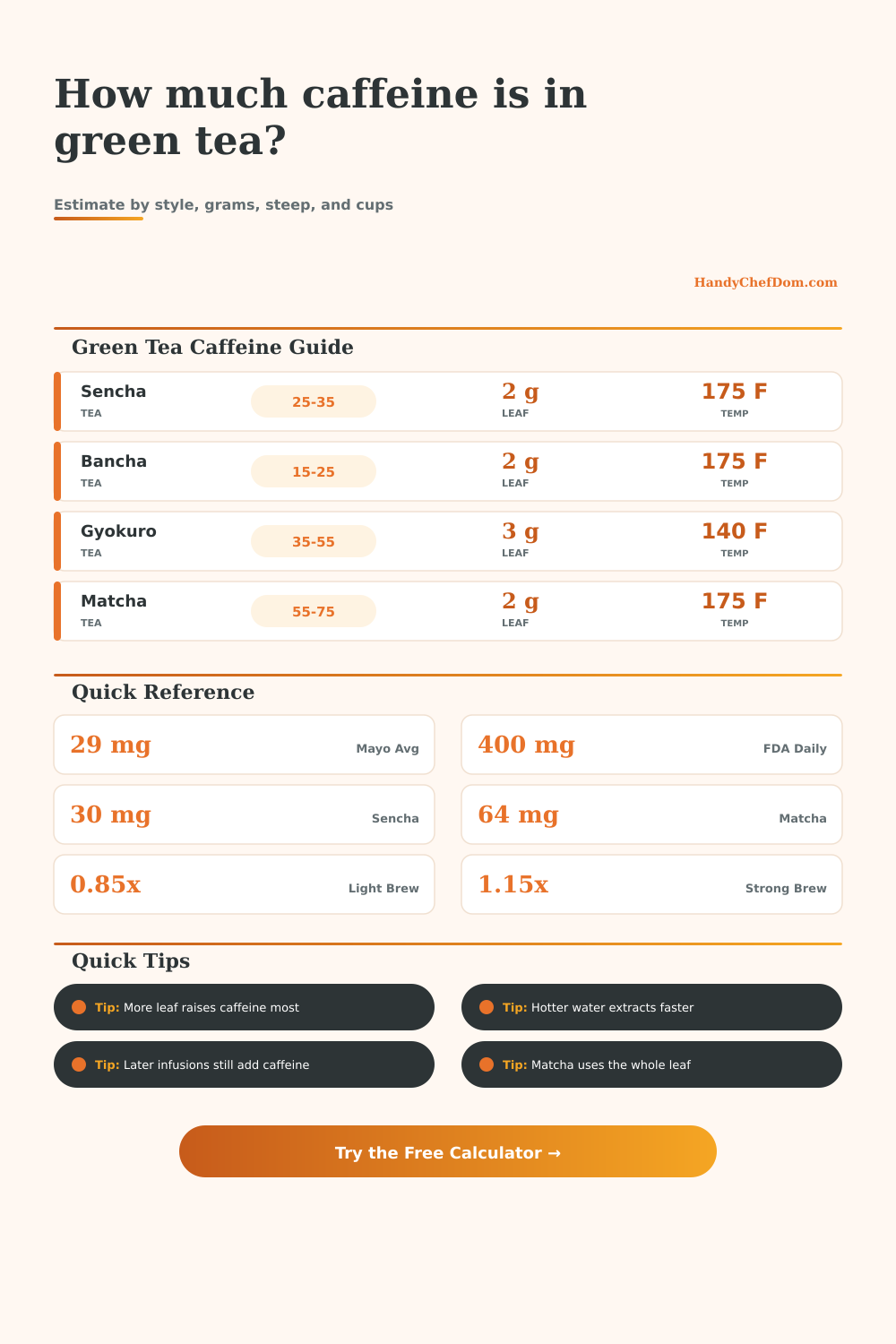
| Tea Style | Typical Cup | Leaf Basis | Best Fit |
|---|---|---|---|
| Sencha | 25 to 35 mg | 14.5 mg/g | Daily mug |
| Bancha | 15 to 25 mg | 9.0 mg/g | Light cup |
| Gyokuro | 35 to 55 mg | 18.0 mg/g | Small pot |
| Matcha | 55 to 75 mg | 32.0 mg/g | Whole leaf |
| Water | Temp | 3 Min Factor | Use Case |
|---|---|---|---|
| Cool green | 150 F / 66 C | 0.76x | Gyokuro |
| Standard | 175 F / 79 C | 1.00x | Sencha |
| Hot green | 190 F / 88 C | 1.10x | Bag tea |
| Boiling | 212 F / 100 C | 1.18x | Strong brew |
| Infusion | Share | Example | Notes |
|---|---|---|---|
| First | 100% | 30 mg | Largest pull |
| Second | 55% | 17 mg | Still active |
| Third | 32% | 10 mg | Lower cup |
| Fourth+ | 18% | 5 mg | Gentle tail |
| Reference | Amount | Cup Equivalent | Source Use |
|---|---|---|---|
| Mayo brewed green | 29 mg | 8 oz cup | Benchmark |
| FDA adult guide | 400 mg | Daily cap | Reference |
| Lower target | 200 mg | Daily cap | Optional |
| Very low target | 100 mg | Daily cap | Optional |
Three hours after you sat down for a work session, your hands start to shake. It is rarely the tea itself that causes this crash. Most likely it’s due to an incorrect understanding of how leaves extract in hot water and how caffeine travels through them.
The mistake most people make is thinking all green tea are equal. They believe they get the exact same amount of energy from each cup, no matter what way they brew it. That misconception will kill your afternoon productivity.
How to Control Caffeine in Your Tea
The truth is you are running a chemistry experiment on yourself every morning. Surprisingly enough, it’s very easy and also the single most important variable. We’re talking about how much actual leaf matter was in your cup or pot.
Water temperature and steeping time is also important factors, but they play a supporting role. While those things matter, they aren’t as impactful as leaf weight. These variables (and others) get people worked up; they think that these are the tools to use to adjust the strength. All of these thing matter.
But here’s the thing: putting twice as many leaves into your cup will have a significantly larger effect on the amount of caffeine you ingest compared to taking 30 seconds longer to steep the leaves or cooling your water down by ten degrees. For instance, if you’d like to limit your overall day’s consumption to something under a certain number, try weighing out your tea first. You can use a standard two-gram scoop as a decent starting point for measuring purposes.
Jumping up to three or four grams without changing any other parameter basically doubles the amount of caffeine in your cup. This is true even if you brew it for a shorter period of time. And then there’s temperature, which acts as a supporting player. The hotter the water, the quicker it pull more complete compounds from leaf structure.
Brew any tea… Even subtle ones such as gyokuro, in boiling water and yes, you’ll get maximum caffeine extraction. But you’re also jarring the leaves’ amino acids, which give them their savory umami quality. That can leave you with a harsh, puckering cup of bitterness that slams straight into your system but doesn’t deliver on the nuanced flavor you sought.
For most bancha and sencha types, water closer to 175 degrees Fahrenheit will do the trick, dissolving the caffeine into the beverage at an appropriate pace while preserving the finer flavors. But then what about all those leaf re-uses? Most conventional tea require more than one steeping. With each infusion, the largest portion of soluble compounds (which includes most of the caffeine) is drawn out by that first cup.
Yes, subsequent cups will have some caffeine left over, but much less so. If you’re careful about limiting yourself to a certain number of cups per day, you’ll have to factor this decline into your math. Perhaps the second cup has only half as much caffeine as the first. And the third even less! This lessening effect is something you can’t ignore if you want to avoid over- or under-counting on a diet of caution.
In contrast, the mental model for matcha is something else entirely: You drink the water but toss out the leaves when you make tea by traditional steeping methods. The wet material containing some fraction of the caffeine goes in the trash. When you make matcha, you’re consuming the entire plant, literally, in powdered form whisked into suspension. There is no waste.
This means each spoonful of matcha powder contains almost as much caffeine as the entire dose you are drinking. Matcha is therefore a far more powerful delivery system per gram different than even a strongly-brewed cup of loose-leaf tea. It’s not just a concentration of flavor; it’s a concentration of energy without the diluting effect of the thrown-away leaves.
Once you know how it works, you go from guessing what to do next to making adjustments on the fly. Want more of a pick-me-up in the afternoon? Drop down a little bit on leaf amount or drop the water temperature so it extracts more slow. Want more oomph first thing in the morning? Go longer with your steep or bump up the dose.
The calculator (above) let you adjust all those variables on their own. It also shows visually just how much those little tweaks add up, gram by gram and minute by minute. So the bottom line isn’t a matter of milligram counting. It’s about matching the energy profile of your tea with that of your daily rhythm.
Even if that evening’s gyokuro tastes great, you’ll be up all night if it’s got lots of caffeine. If your afternoon slump requires a little pick-me-up but you’ve overdone it on a weakly-brewed bancha, well, there goes your afternoon. When you understand what factors drive the level of caffeine, then you can brew with purpose instead of by habit. You should of had the variables under control. The tea will match.