🍯 Maple Syrup Sugar Calculator
Convert maple syrup teaspoons, tablespoons, cups, milliliters, and grams into total sugar, per-serving sugar, sugar teaspoons, daily limit share, and honey-swap sugar.
Choose a real kitchen measure, syrup grade, serving count, and use style. The calculator converts the entered syrup to volume, weight, total sugar, serving sugar, and a same-volume honey comparison.
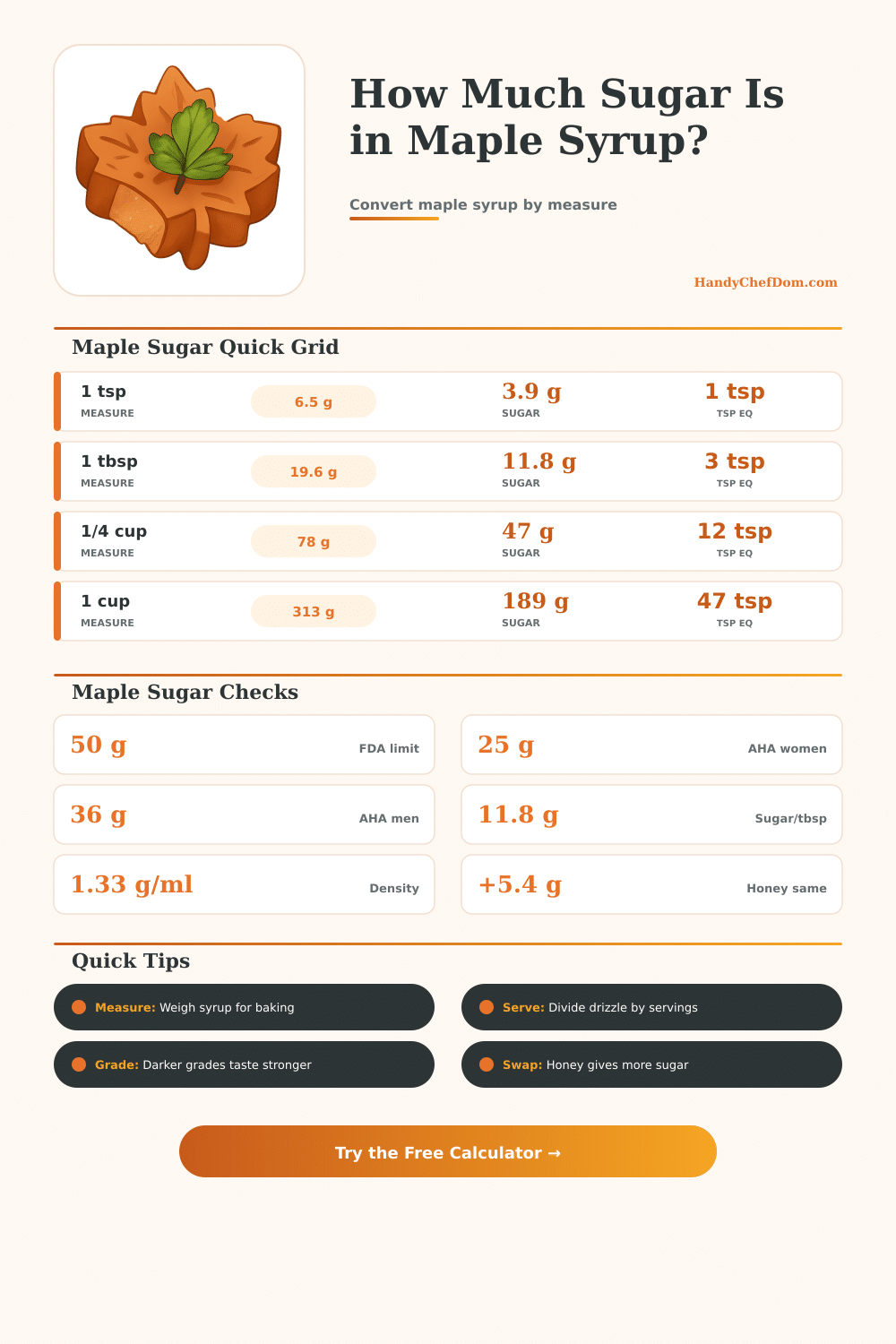
| Maple measure | Approx ml | Amber syrup grams | Approx sugar grams | Granulated tsp equivalent |
|---|---|---|---|---|
| 1 teaspoon maple syrup | 4.9 ml | 6.5 g | 3.9 g | 1.0 tsp sugar |
| 1 tablespoon maple syrup | 14.8 ml | 19.6 g | 11.8 g | 3.0 tsp sugar |
| 2 tablespoons maple syrup | 29.6 ml | 39.2 g | 23.7 g | 5.9 tsp sugar |
| 1/4 cup maple syrup | 59.1 ml | 78.3 g | 47.3 g | 11.8 tsp sugar |
| 1/3 cup maple syrup | 78.9 ml | 104.5 g | 63.1 g | 15.8 tsp sugar |
| 1/2 cup maple syrup | 118.3 ml | 156.7 g | 94.7 g | 23.7 tsp sugar |
| 1 cup maple syrup | 236.6 ml | 313.5 g | 189.4 g | 47.4 tsp sugar |
| Maple use | Typical syrup per serving | Approx sugar | Calculator use factor | Best input unit |
|---|---|---|---|---|
| Pancake or waffle topping | 1 to 2 tbsp | 12 to 24 g | 100% counted | Tablespoons |
| Light bowl drizzle | 1 to 2 tsp | 4 to 8 g | 100% counted | Teaspoons |
| Baking batter sweetener | Recipe amount divided | Depends on slices | 100% retained | Cups or grams |
| Sticky roasted glaze | 1 to 1.5 tbsp | 12 to 18 g | 92% counted | Tablespoons |
| Drink sweetener | 1 to 3 tsp | 4 to 12 g | 100% consumed | Teaspoons or ml |
| Marinade or brushing sauce | Batch amount divided | Partial retention | 70% counted | Milliliters |
| Syrup grade or style | Density used | Sugar percent by weight | Sugar per tbsp | Use note |
|---|---|---|---|---|
| Golden delicate maple syrup | 1.315 g/ml | 60.2% | 11.7 g | Light color, mild maple taste |
| Amber rich maple syrup | 1.325 g/ml | 60.4% | 11.8 g | Common all-purpose table syrup |
| Dark robust maple syrup | 1.335 g/ml | 60.6% | 12.0 g | Stronger flavor for baking |
| Very dark strong maple syrup | 1.345 g/ml | 60.8% | 12.1 g | Bold flavor, similar sugar density |
| Reduced maple glaze | 1.370 g/ml | 61.5% | 12.5 g | Concentrated sauce or glaze |
| Swap question | Maple baseline | Honey estimate | Sugar difference | Calculator meaning |
|---|---|---|---|---|
| Same volume sweetener | 1 tbsp maple | 1 tbsp honey | About +5.4 g sugar | Honey is denser and higher in sugar by weight |
| Same sugar target | 1 tbsp maple sugar | About 10.2 ml honey | 0 g difference | Use less honey to match maple sugar grams |
| Quarter cup baking swap | 59 ml maple | 59 ml honey | About +21 g sugar | Same-volume honey raises total sugar |
| Drizzle comparison | 2 tsp maple | 2 tsp honey | About +3.6 g sugar | Small drizzles still change per-serving sugar |
When you cook pancakes, you might add way too much syrup. Suddenly, it’s all about the sugar. The same thing happens for a lot of us; maple syrup are packed full of sweetness. If you’re guessing as you go along, it’s hard to keep an eye on how much you consume. Use a calculator to turn that guesswork into black-and-white figures, no need to hold back during your pancake feast.
Things get tricky because, unlike water, maple syrup doesn’t follow the rule-of-thumb on volumes versus weights. Because maple syrup is dense and viscous, one tablespoon will weigh heavier than a tablespoon of juice or milk. Once you know which grade of syrup you are measuring (light or dark), the tool takes care of the math behind different densities.
Why You Need a Maple Syrup Sugar Calculator
Whether you’re using light amber syrup for baking or dark robust syrup doesn’t change anything; darker syrups is simply denser, meaning they contains more sugar per weight. Even though the volume might remain unchanged if you swap out maple syrup grades in a recipe, the total amount of sugar may differ. That matter if you are following a strict diet.
Everyone’s concerned about how much syrup goes onto the pancakes in total, but it matters more how much that volume translates to per serving. If it’s just you, pouring maple syrup over your oatmeal, that’s easy math. But if this is a family breakfast, the total amount of all that sugar can add up quickly. The calculator allows you to enter number of servings and clearly shows you exactly how many grams of added sugar each person will consume.
It also takes into account what happens with the syrup. Not all drops end up in your mouth. If you’re using syrup as a marinade for meat, or a glaze on some vegetable, some of the syrup burns off, some drips away, and some adheres to the plate. To avoid overestimating the amount of sugar that ultimately gets consumed, the tool includes a retention factor based off the way you are cooking it.
Yes, Maple Syrup is Less Bad: Many people think maple syrup is a “healthier” sweetener choice compared to refined white sugar because of its trace minerals and lower glycemic index. True! But that doesn’t make it a carb- or calorie-free food. Each tablespoon of amber maple syrup has about 12 grams of sugar (about 3 teaspoons of granulated white sugar).
If you compare this against honey, the difference is even greater: honey’s sweetness and density means you’ll get far higher sugar content per the exact same volume if you used it instead of maple in a recipe. To help make the case for leaving the maple bottle out on the table, our sugar calculator features a “swap comparison,” allowing you to see just how many extra grams of sugar you’d be adding if you replaced maple with honey.
For the most part, the sticky stuff will leave residue on spoons and measuring cups, so we should of weigh our syrup to get the most accurate result. Small mistakes adds up. If you’re lucky enough to own a kitchen scale, you can bypass all of this and just use grams. There is no more guesswork.
But most home cooks sticks with tablespoons and teaspoons because they’re fast and convenient. Here are all those common conversions laid out simply on the page’s reference tables. They’ll tell you exactly how many milliliters each standard holds, allowing you to cross check your guesses. Knowing these benchmarks helps you visualize what a moderate portion look like before you even start cooking.
Enjoying sugar at breakfast is fine. Tracking doesn’t mean taking the fun out of eating your favorite foods, it’s about being informed and choosing wisely based off the information. If you know how much of that sugar you’re getting, then you can plan around that for the rest of the day. Want to go ahead and have one more pour? Know exactly how much of your sugar limit it uses.
After all, we’re here to make math easy. Let the calculator do its job and enjoy your food without having to crunch numbers. No matter what you choose, moderation is always tastier than regret. Unless you’re talking about bacon…