🍝 Meatballs Calorie Calculator
Estimate calories per meatball, per serving, and by portion goal using meat blend, raw size, cooked yield, add-ins, and sauce.
Enter raw meatball size and batch add-ins. The calculator estimates total calories, calories per meatball, calories per serving, cooked portion weight, and the number of meatballs that fit your portion goal.
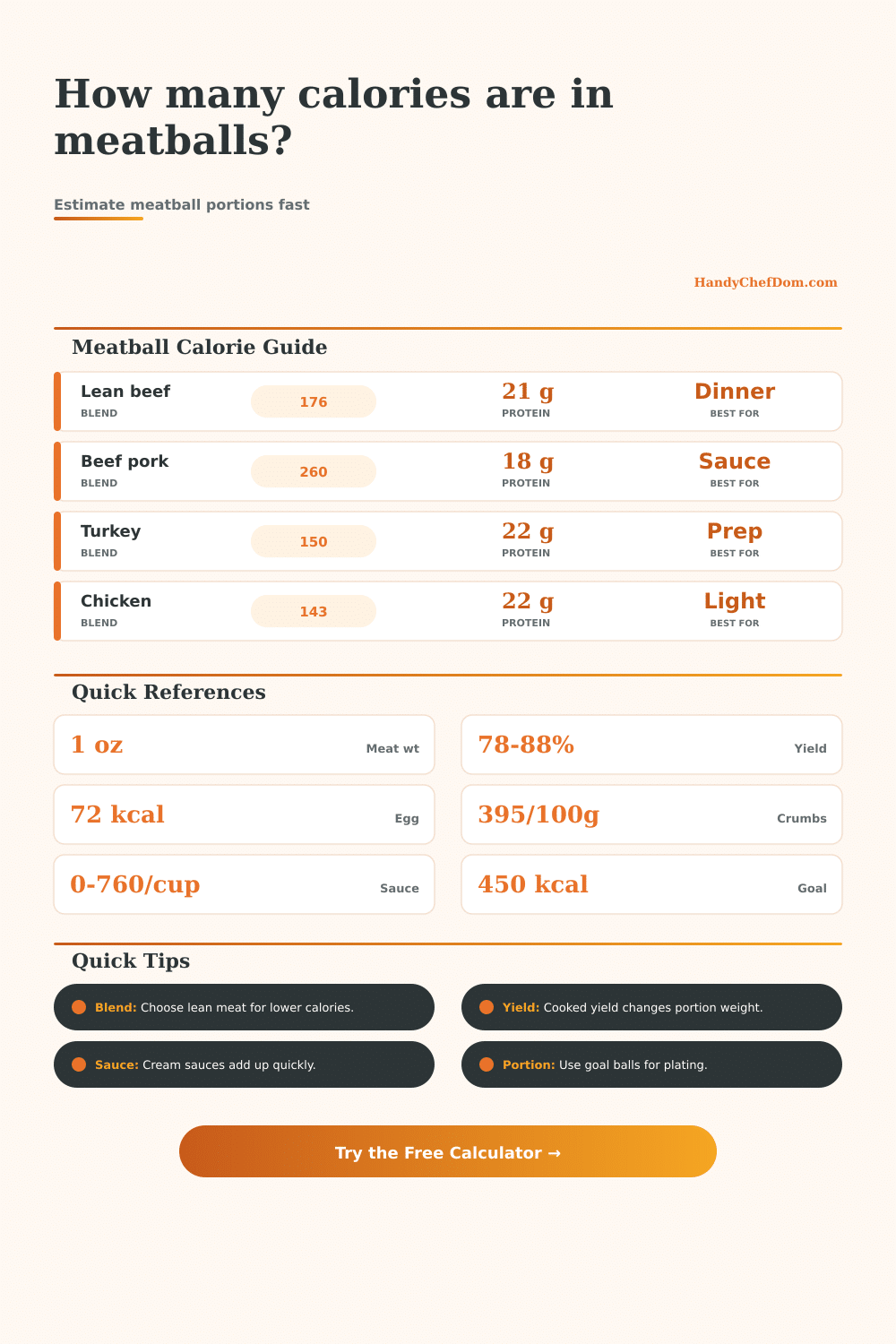
| Meat Blend | Kcal/100g | Protein | Fat |
|---|---|---|---|
| 90% beef | 176 | 21 g | 10 g |
| 80% beef | 254 | 17 g | 20 g |
| Beef pork | 260 | 18 g | 20 g |
| Sausage beef | 295 | 16 g | 24 g |
| 93% turkey | 150 | 22 g | 8 g |
| Chicken | 143 | 22 g | 7 g |
| Add-In | Kcal | Measure | Protein |
|---|---|---|---|
| Dry crumbs | 395 | 100 g | 13 g |
| Panko | 358 | 100 g | 12 g |
| Quick oats | 389 | 100 g | 17 g |
| Almond meal | 571 | 100 g | 21 g |
| Egg | 72 | 1 large | 6 g |
| Parmesan | 431 | 100 g | 38 g |
| Sauce | Kcal/Cup | Weight | Best Use |
|---|---|---|---|
| Marinara | 140 | 245 g | Classic |
| Tomato basil | 160 | 245 g | Pasta |
| Swedish | 280 | 240 g | Bowl |
| Brown gravy | 180 | 240 g | Dinner |
| BBQ glaze | 480 | 250 g | Party |
| Pesto | 760 | 220 g | Rich |
| Portion | Raw Size | Count | Serving |
|---|---|---|---|
| Cocktail | 0.5 oz | 4-6 | Snack |
| Pasta bowl | 1 oz | 3-5 | Main |
| Dinner plate | 1.5 oz | 3-4 | Main |
| Sub roll | 1.25 oz | 4 | Sandwich |
| Meal prep | 1.5 oz | 4 | Box |
| Big bowl | 2 oz | 2-3 | Hearty |
It’s also useful because it makes me think about the nutrition value in something like meatballs, which tend to be regarded as a pretty harmless ingredient in most recipes, an unimportant filler, one way or another. But depending on what kind of meat goes into the mix, and whether you add breadcrumbs, cheese, and so on, you’ve got a recipe with wildly diffrent caloric impact. Serve ’em over quinoa, or with heavy cream sauce. You can use a combination of pork and beef, or lean ground-turkey blend.
Enter the recipe ingredients of whatever batch you’re making, and calculator figures out the rest. It doesn’t require you to guess how much of those binding ingredient, cheese and bread crumbs, is adding up. “Most people think that all that matters here is the meat,” but then there are all those calories lurking in the binder ingredients, too.
How to Count Meatball Calories
An egg contributes around seventy-two calories; that starts to matter if you’re using more than one for a big batch. And then there are breadcrumbs: those is even worse, with nearly four hundred calories per hundred grams. If you’re aiming for a certain number, forgetting about the fat content of the type of cheese you use, or the sheer amount of dry crumbs, throw the whole equation off.
The first thing to note about selecting your meats is obvious: Ground Meat. But where people make mistakes is in their yield. As we heat raw ground meat, water will leave the product and fat will be rendered. A 90/10 blend of beef (which contains less fat) will shrink at a slower rate different than an 80/10 blend.
So even though you may start with one-ounce of a lean raw meat, post-cooking it become a larger amount due to reduced shrinkage. This is what you’re eating. Since raw meat shrinks differently every time, portioning by raw weight might leave you with extra meat if it doesn’t shrink as much as you expected. To account for this, the tool let you enter your cooked yield percentage, which gives you a realistic picture of how much you’ll eat per portion.
The other big one that is frequently ignored with a quick meal plan? Sauce. Sure, perhaps some marinara is just a couple of calories on a cup, but then again, maybe a rich pesto sauce or a Swedish cream gravy doubles the sauce’s caloric contribution. When it starts to fill up the kitchen with its smell, it’s all too tempting to just slop the sauce around freely without a thought. By counting the sauce as separate, you’ll be able to get a visual of what’s contributing most to the calories of your meal.
After subtracting the sauce, do you have enough calories left for meatballs if your goal is four hundred and fifty calories per serving? Instead of thinking of your meal in terms of individual balls, think of it in terms of portion size. For example, a cocktail party meatball is small: Eight to 10 won’t fill you up, but that will add up fast. A bigger, dinner plate meatball might be more filling, three or four may do just fine.
It’s the overall amount, not the number of sphere, that matters. When you set a calorie goal first, that can help you determine how many meet your needs. What this does is take the guessing out of batch cooking. If you want to substitute ground turkey for beef or ricotta for Parmesan, it’ll tell you precisely how those substitutions affects the end result. It helps you make adjustments before prepping. You can know that making that minor adjustment to the mix won’t ruin it, while still maintaining flavor.
The key is just knowing how ingredients add up to the whole, as well as what’s realy being measured. The point of meal planning ultimately boils down to awareness and balance. Just because you can’t eat meatballs doesn’t mean you shouldn’t eat them. You simply need to know what’s going in them.
Break it down into portions: meat, binder, and sauce. This give you control over the batch. Next time you make a batch, you are making a deliberate decision because you know exactly what you are eating, right down to the last calorie.