Shrimp Per Person for Boil Calculator
Estimate shrimp per guest, total pounds, piece counts, water, and seasoning for a shell-on or peeled shrimp boil.
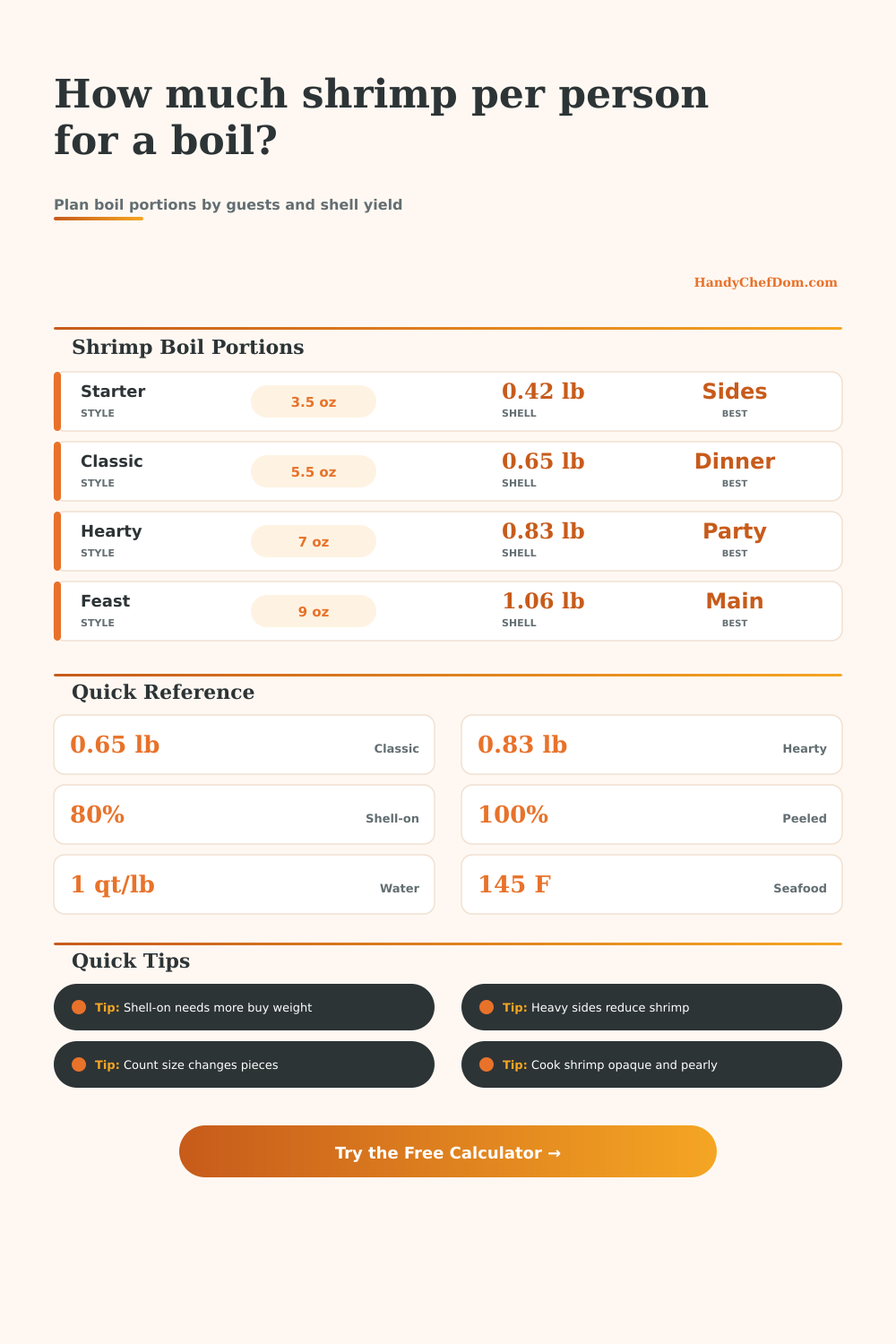
| Serving Style | Cooked Edible Target | Shell-On Buy Estimate | Best Use |
|---|---|---|---|
| Starter with many sides | 3.5 oz per guest | About 0.42 lb per guest | Small plate before a larger meal. |
| Classic boil dinner | 5.5 oz per guest | About 0.65 lb per guest | Balanced shrimp, corn, potatoes, and sausage. |
| Hearty party portion | 7.0 oz per guest | About 0.83 lb per guest | Outdoor parties and longer serving windows. |
| Shrimp-forward feast | 9.0 oz per guest | About 1.06 lb per guest | When shrimp is the main event. |
| Count Size | Average Used | Typical Pieces From 1 lb | Boil Note |
|---|---|---|---|
| 13/15 extra colossal | 14 per lb | 13 to 15 | Large dramatic pieces for feasts. |
| 16/20 jumbo | 18 per lb | 16 to 20 | Good for peel-and-eat spreads. |
| 21/25 extra large | 23 per lb | 21 to 25 | Classic shrimp boil size. |
| 26/30 large | 28 per lb | 26 to 30 | More pieces per guest. |
| 31/40 medium large | 36 per lb | 31 to 40 | Fast cooking and easy serving. |
| 41/50 medium | 46 per lb | 41 to 50 | Best when shrimp is one of many items. |
| Prep State | Edible Raw Yield | Cooked Yield Used | Planning Meaning |
|---|---|---|---|
| Peeled deveined | 100% | 82% | Buy least weight, easiest portion math. |
| Peeled tail-on | 96% | 82% | Small tail loss, common for presentation. |
| Easy-peel shell-on | 82% | 82% | Good default for shrimp boils. |
| Shell-on headless | 78% | 82% | Plan extra for shells and peeling. |
| Head-on shell-on | 55% | 82% | Whole shrimp need much more buy weight. |
| Boil Strength | Water Ratio | Seasoning Ratio | Use Case |
|---|---|---|---|
| Lightly seasoned | 0.75 qt per lb shrimp | 1.0 tbsp per qt | Mild crowds and kids at the table. |
| Classic boil | 1.00 qt per lb shrimp | 1.5 tbsp per qt | Balanced shrimp boil default. |
| Bold boil | 1.10 qt per lb shrimp | 2.0 tbsp per qt | Outdoor parties and spicy blends. |
| Large batch | 0.85 qt per lb shrimp | 1.5 tbsp per qt | Higher food load with careful stirring. |
| Guests | Classic Shell-On | Hearty Shell-On | Classic Peeled |
|---|---|---|---|
| 4 | 2.6 lb | 3.3 lb | 1.7 lb |
| 8 | 5.2 lb | 6.7 lb | 3.4 lb |
| 12 | 7.8 lb | 10.0 lb | 5.1 lb |
| 25 | 16.3 lb | 20.8 lb | 10.5 lb |
| 50 | 32.5 lb | 41.5 lb | 21.0 lb |
There is a specific kind of panic that sets in when you realize three more friend just texted that they are bringing their partner and two kids to your shrimp boil. You look at the gap in the middle of the counter where the shrimp should be and realize that one miscalculation could result in a roomful of very unhappy people, or a heap of extra frozen leftovers to loom over you in the freezer all winter long. Knowing how much something yields isn’t only important. It’s the difference between a good time and a logistical nightmare.
Most people purchase their shrimp by pound without any consideration for what that pound equate to. The second mistake most folks make is thinking a pound of head-on shell shrimp sounds great. But there’s less than half a pound of actual meat in that pound of shells, tails, and who-knows-what else. You want to serve just peeled and deveined tails? Good deal… You’re paying almost nothing but the good stuff. Want to do a more classic crawfish style boil with everyone eating off those heads? Then you gotta double (or triple) your starting raw weight to reach that same amount of meaty goodness.
How to Cook Shrimp for a Party
The calculator up top does the math behind the scenes, so you don’t have to deduct out all the inedible head-and-shell bulk from each package before deciding to buy it. It will adjust your total buy weight to match. This depend on whether you’re picking up some easy-peel shell-on shrimp, which is a tasty middle ground, or going full-head on like a real old-time porch boil.
The type of service will make a big difference as well, as sides act as a buffer for fullness. For instance, if you’re cooking spicy sausage, red potatoes, and corn on the cob along with the seafood, you might be able to serve fewer shrimp per person since there’s so much filling meat and starchy side. Usually a large serving of those heavy sides would imply a classic dinner portion. But if all you’ve got in mind is some steamed veggies and perhaps something lighter, the shrimp has to carry the whole meal. That pushes it up from a modest appetizer serving size toward a heartier main course portion. Instead of just looking at how many pounds of seafood, you have to look at the menu holistically.
There is also one other confusing element to cooking with shrimp: size. There are significantly more shrimp in a pound of medium than there are in a pound of jumbo. Even though nutritionally it’s all equal, there’s something mentally satisfying about plucking off and popping into your mouth six fat prawns compared to twenty tiny ones. Extra-colossal tails add drama to a plate, but some people love the speed of a handful of tiny pieces to pick their way through. To help you out here, the tool will estimate how many pieces there are in your order (so, for example, if you buy 41/50 medium shrimp, which is a standard industry size, it knows that means there are about 41 to 50 pieces per pound). That’ll help you picture what you’re ordering in bite-sized form… Not just an abstract number of ounces of protein.
And don’t forget: proportions matter even in making large batches. If you’re boiling a pound, you’ll need a big pot full of water, enough so everything can move around freely without some parts boiling hard while others just steam at the bottom. The amount of water needed will depend based off how many shrimp you’re cooking; the calculator factors that into account, and lets you tweak your flavor profile (light? Bold?) accordingly. Too little water leads to uneven cooking and muted flavor; too much water dilutes the seasoned broth that’s supposed to permeate every shell. You want the rich, fragrant liquid clinging to those pieces of meat as they cook.
Now the execution: timing matters. Because shrimp cook so quickly, it only takes a few minutes for them to change from clear to solid, depending on how big they are. They can gets tough and rubbery if overdone, no matter how good you may think you’ve got your portion math down. The best way to avoid this is to watch the inside temperature. The target is the safe zone of one hundred forty-five degrees. Don’t leave them sitting out for longer than necessary. Better to have some slightly undercooked ones that continue to rest on the platter than stringy, dry bits of what used to be shrimp that’ve been cooked to death in boiling water.
That’s why we love doing all this up-front work. It takes the hassle out of party day. Instead of wondering if you should grab another pack of napkins or not, you can relax and have fun because you know ahead of time how many guests you expect, which size to purchase, and roughly how many servings of each item everyone will consume. Use the calculator as a starting point for your grocery trip; then make some adjustments based on your meal selection and how hungry your guests are. Trust me, having an extra serving here and there is less expensive than being halfway through your party and dashing to the market.
In short, more than anything else, successful boils are all about balance. Both in terms of food quantity and quality. While you need plenty to feed everyone well, you don’t want to end up with a freezer full of leftovers for several weeks. Knowing the number of sides, sizes, and yields can turn what seems like guesswork into a manageable cooking task. When your friends go home, they’ll not only think fondly on the taste of the meal but also the warmth of your home. But first, stock up on some shrimp.