🥪 BBQ Sandwiches per Pound Calculator
Estimate BBQ sandwiches from cooked or raw meat weight, meat type, bun size, portion ounces, sauce, slaw, appetite, cooked yield, and planned leftovers.
Use cooked mode for pulled meat already on hand. Use raw mode for meat before cooking; the yield field converts raw pounds into sandwich-ready cooked meat.
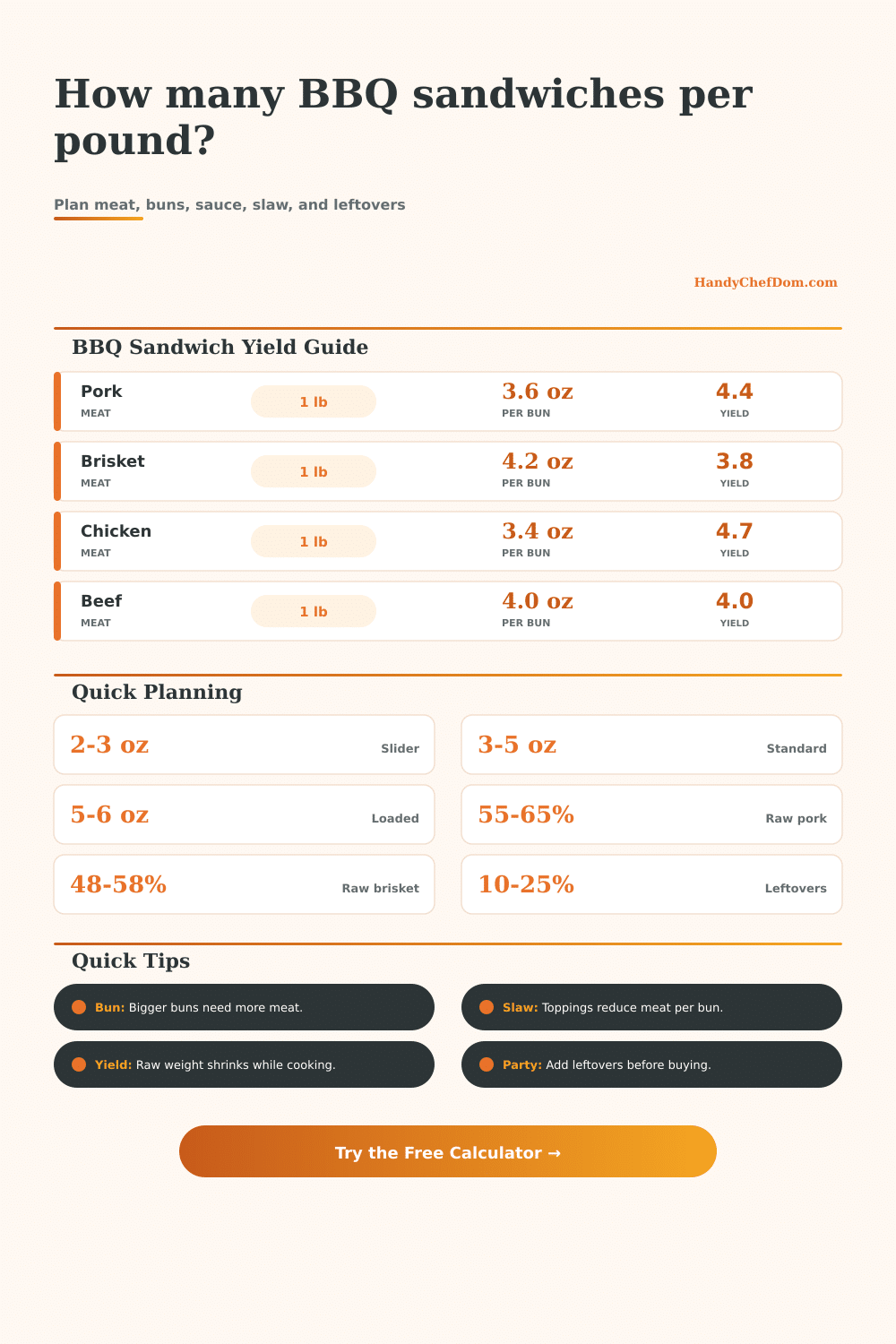
| BBQ Meat Type | Typical Raw to Cooked Yield | Common Cooked Portion | Sandwiches Per Cooked Pound |
|---|---|---|---|
| Pulled pork shoulder | 55% to 65% | 3.5 to 4.5 oz | 3.6 to 4.6 |
| Chopped brisket | 48% to 58% | 4.0 to 5.5 oz | 2.9 to 4.0 |
| Sliced brisket | 50% to 60% | 4.5 to 6.0 oz | 2.7 to 3.6 |
| Pulled chicken | 65% to 75% | 3.0 to 4.0 oz | 4.0 to 5.3 |
| Shredded beef chuck | 55% to 65% | 3.8 to 5.0 oz | 3.2 to 4.2 |
| Smoked turkey | 60% to 70% | 3.5 to 4.5 oz | 3.6 to 4.6 |
| Chopped sausage mix | 70% to 80% | 3.0 to 4.0 oz | 4.0 to 5.3 |
| BBQ jackfruit | 75% to 85% | 3.0 to 4.0 oz | 4.0 to 5.3 |
| Bun or Service Style | Meat Fill Range | Sauce and Slaw Effect | Best Planning Use |
|---|---|---|---|
| Slider bun | 2.0 to 3.0 oz | Small topping credit | Appetizers, kids, tasting tables |
| Standard hamburger bun | 3.5 to 4.5 oz | Moderate topping credit | Backyard parties and lunch plates |
| Large bakery bun | 4.5 to 5.8 oz | Slaw helps fill the bun | Hearty pulled pork or brisket meals |
| Kaiser or brioche roll | 4.8 to 6.0 oz | Sauce does little by itself | Rich brisket and premium sandwich trays |
| Hoagie or long roll | 6.0 to 8.0 oz | Needs generous slaw to stretch | Large sandwich portions |
| Open-face plate sandwich | 5.0 to 7.0 oz | Toppings rarely reduce much meat | Knife-and-fork BBQ plates |
| Target Servings | Light Cooked Meat | Standard Cooked Meat | Raw Pork at 60% Yield |
|---|---|---|---|
| 8 sandwiches | 1.5 to 2.0 lb | 2.0 to 2.5 lb | 3.5 to 4.5 lb raw |
| 12 sandwiches | 2.2 to 3.0 lb | 3.0 to 3.5 lb | 5.0 to 6.0 lb raw |
| 20 sandwiches | 3.8 to 4.5 lb | 5.0 to 5.8 lb | 8.5 to 10 lb raw |
| 35 sandwiches | 6.5 to 8.0 lb | 8.8 to 10 lb | 15 to 17 lb raw |
| 50 sandwiches | 9.5 to 11 lb | 12.5 to 14.5 lb | 21 to 25 lb raw |
| 75 sandwiches | 14 to 17 lb | 19 to 22 lb | 32 to 37 lb raw |
| Topping Plan | Sauce Per Bun | Slaw or Pickles | Meat Displacement |
|---|---|---|---|
| Dry meat, sauce on side | 0 to 0.25 oz | 0 to 0.5 oz | None to light |
| Light sauced sandwich | 0.25 to 0.5 oz | 0.5 oz | About 0.25 oz |
| Classic slaw sandwich | 0.5 oz | 1 to 1.5 oz | About 0.5 to 1 oz |
| Loaded BBQ bun | 0.75 to 1 oz | 1.5 to 2 oz | About 1 to 1.5 oz |
| Brisket with pickles | 0.25 to 0.5 oz | 0.25 to 0.75 oz | Small credit only |
| Meal prep sandwich | 0.25 oz | 0.5 to 1 oz | Keep meat count steady |
Two hours before your next barbecue, you realize you’re panicking. Your friends is coming over; the buns are lined up; the meat is smoking… but how much food do you need to feed everyone? Use the calculator at the top of page to turn guesswork into easy math. It predicts how many sandwiches you could get from some amount of meat, taking into consideration bun size, cooked yield, and even the volume occupied by any added slaw. No more fear of excess or wastefulness with pricey brisket.
So what’s wrong with barbecuing? It all comes back to raw weight, which are lying to you. Ten pounds of pork shoulder seem like a feast until you lose moisture and render some fat, leaving you with maybe six pounds of usable meat. (That’s where they screw up.) People purchase by package weight, rather then plate weight. Switching to raw mode let the tool handle the conversion for you, using a yield percentage that accounts for the shrinking of the meat as it cooks. Know that the yield isn’t just accounting for moisture loss. It’s also for structural breakdown and fat rendering. If you don’t account for that, then you’re running optimistic math, and your buffet table will be barren.
How to Know How Much Meat to Buy
Bun size makes all the difference in the world. A slider bun holds maybe three ounces of meat. It is about 3 oz. Of meat and can feeds two or even three people. At the other extreme, a large hoagie roll need nearly eight ounces to feel satisfying. You might as well be eating sandwich from Subway. In summary: if you count sliders when you are serving big buns, you’ll run out quick.
To account for this, I added a menu item to specify what kind of bun you’re using. That establishes a baseline portion size, then depending on how you are serving it (like a buffet with sides vs a meat-forward party), you adjust the menu to take into consideration amount of food people will consume overall. If they’re filling up on beans and coleslaw from a buffet, you can afford to serve less meat. For a meat-heavy party, you need to serves more protein. All these things goes into the input, adjusting up or down to account for the way food is served.
But toppings aren’t only about taste. They’re also about bulk. Pickles and slaw has a real presence in the bun. If you add two ounces of coleslaw to your sandwich, you probably don’t need all four ounces of meat to feel full. This leads us back to a concept: Displacement. When you top something with something else (the topping displaces), the calculator discounts how much meat you “need” because this guest isn’t eating a slab of pork. The guest is eating a combination of things. It is a small adjustment, but an important one when you’re ordering 30 pounds of meat.
People often forget safety nets until after they run out. Adding a % target buys you a little bit more than the absolute minimum, which is useful if you’re worried about running out, or want to keep some extra around for meal prep. This “buffer” compensates for unevenness of distribution (which will happen at any party) as well as the teenage-hungry-teenagers-take-an-extra-helping factor.
This tells you exactly how many sandwiches you get per pound. It also shows you how big a batch this is. And did we run over/under by how much on the meat itself? It turns a vague thing like “enough food” into something specific and actionable.
In the end, however, there’s a tradeoff between waste and risk. Underestimate, make a lot of runs to the store and apologize awkward. Overestimate, buy so much meat that most of it goes to waste and spend the weekend with a mountain of leftover beef. Somewhere in between is this tool. It offers a sensible system within an otherwise crazy event. Still, you’ve got to rely on some gut instinct when planning based off your specific friends. But the numbers helps you to at least have something solid beneath you. When you’re absolutely certain how many sandwiches you’re going to pull off, you can relax and smell the smoke.