🥒 Cucumber Pickling Time Calculator
Estimate cucumber pickling time from cut style, cucumber size, brine strength, vinegar acidity, sugar, mode, jar size, temperature, and crunch target.
Choose the cucumber cut and brine profile. The calculator estimates first-ready time, best crunch window, brine volume, and salt amount for the batch.
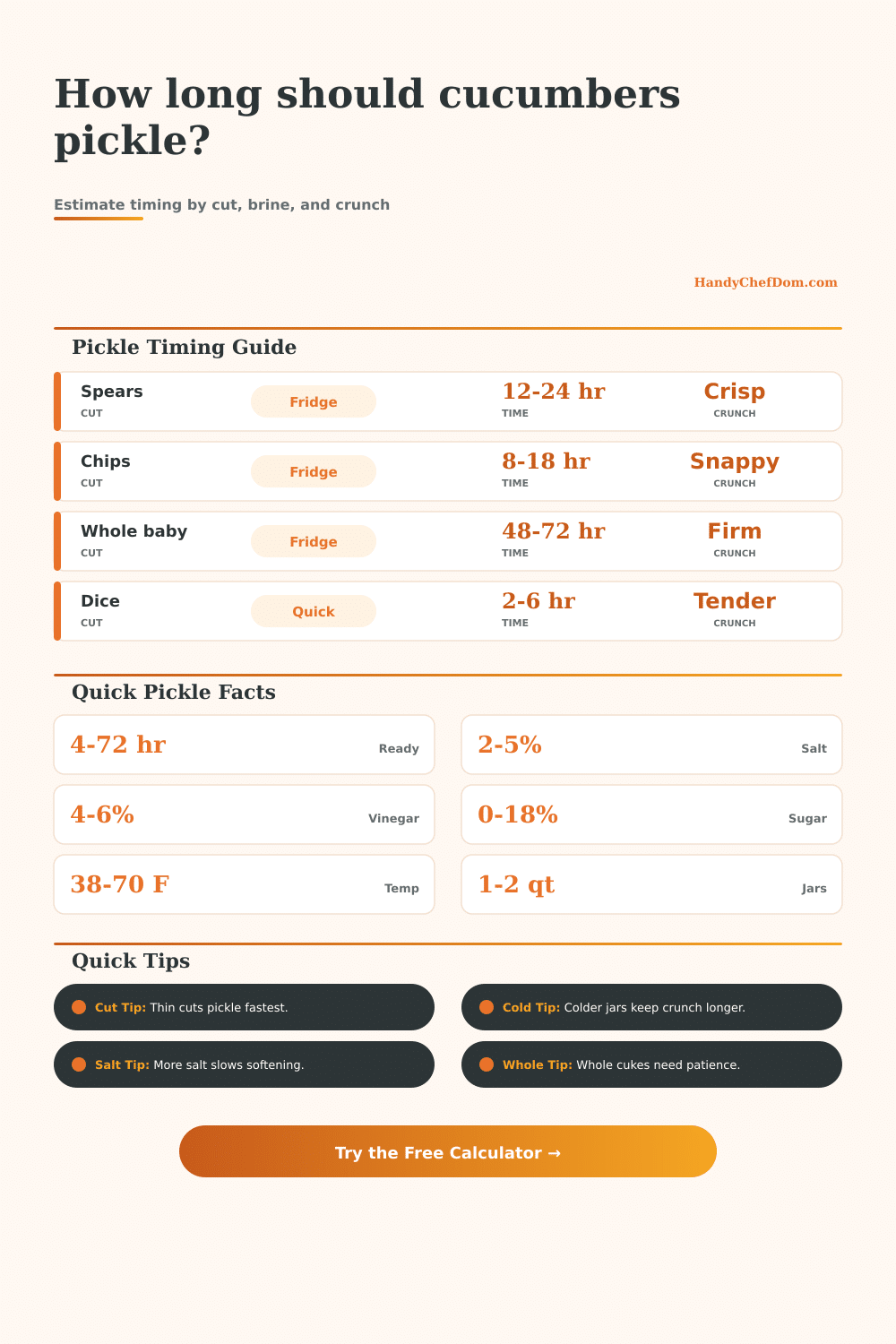
| Cut Style | Typical Thickness | Fridge First Taste | Best Use |
|---|---|---|---|
| Relish dice | 1/4 inch / 6 mm | 2-6 hours | Party relish bowls |
| Lunchbox coins | 1/8-1/4 inch | 6-12 hours | Snack jars |
| Crinkle chips | 1/4 inch / 6 mm | 8-18 hours | Overnight chips |
| Sweet slices | 1/4 inch / 6 mm | 10-20 hours | Sweet pickle jars |
| Sandwich stackers | 1/3 inch / 8 mm | 14-28 hours | Deli sandwiches |
| Quartered spears | 1/2-3/4 inch | 12-36 hours | Fridge spear jars |
| Whole baby cucumbers | 2-3 inch length | 48-72 hours | Baby dill jars |
| Whole fermenting cukes | 3-5 inch length | 3-7 days | Crock batches |
| Mode | Salt Strength | Vinegar Range | Timing Behavior |
|---|---|---|---|
| Quick vinegar pickle | 2.0-3.0% | 5-6% | Fast surface flavor, shorter crunch window |
| Fridge pickle | 3.0-4.0% | 4-6% | Balanced flavor transfer and crisp bite |
| Sweet fridge pickle | 2.5-3.5% | 5% | Sugar rounds the brine and slows sharpness |
| Fermented crock | 3.5-5.0% | 0% | Longer timing driven by salt and warmth |
| Half-sour style | 3.0-3.8% | 0-2% | Early crunch with mild tang development |
| Stacker jar | 3.0-4.5% | 5% | Wide faces absorb brine at a steady pace |
| Cucumber Size | Approx Weight | Skin Impact | Time Adjustment |
|---|---|---|---|
| Baby 2-3 inch | 35-55 g each | Thin skin | 0.82x |
| Small 3-4 inch | 55-90 g each | Thin to medium | 1.00x |
| Medium 5-6 inch | 120-180 g each | Medium skin | 1.16x |
| Large 7-8 inch | 200-280 g each | Thicker skin | 1.35x |
| Garden thick 8+ inch | 300 g and up | Thick skin | 1.55x |
| Kirby pickling size | 70-120 g each | Bumpy skin | 1.05x |
| Crunch Target | Timing Change | Best Check Point | Texture Note |
|---|---|---|---|
| Extra crisp bite | 0.82x | Early window | Bright snap and firm centers |
| Classic crisp pickle | 1.00x | Middle window | Balanced crunch and brine flavor |
| Balanced tender-crisp | 1.18x | Late window | More brine depth with softer edges |
| Mellow deli-style | 1.38x | After peak | Deep flavor and softer bite |
| Extra sweet jar | 1.12x | Late window | Sugar slows the sharp first bite |
| Warm counter start | 0.88x | Early window | Faster change, check sooner |
That’s the kind of anxiety you feel when you open the pantry door to peek at that jar of cukes: Will they be good or will they be the mushy product of an overly long brining time? There’s only so long to wait; too many hours can mean the difference between a perfect pickle and a slimy mess.
How does that work? Why does flavor travel the way it does? It take a little knowledge to get it just right, and here’s what you need to know. Most people treat pickling like magic: Just add brine and it will do what it wants with whatever is in there. No, it’s physics. Once you know what those numbers represent, it’s all about cooking smarter rather then harder.
The Science of Making Pickles
The calculator, above, eliminates that guesswork, type in the brine strength and the jar size, and it does the rest. But knowing what those numbers mean make you a better cook. Yes, salt makes things taste good. But more importantly, it extract water from the cells in cucumber via osmosis, opening up room for the briny goodness to flow inside. Too little? The cucumbers will start to release water into the jar rather than absorbs the brine, making for an unpleasantly soft pickle and a watery mess. Use too much and you stop the process before it has time to penetrate the insides with flavor.
This exchange of brine and food depend on surface area exposed by your cut. If you slice a cucumber into very thin chips, there’s more surface than volume, and that surface come into contact with the brine fast. That’s what makes baby pickles happen in several hours (though whole baby cukes may take up to three) and relish dice does too. In terms of shape, the pickle calculator knows about this; it will time the process according to how big a piece you start with, whole veggie, or a spear? Cut-style matter if you want neither mushy edges nor an underseasoned center.
This is all powered by one thing: temperature. The cold act as the brakes on the entire process; it preserves that all-important crunchy texture. A jar in your fridge at thirty-nine degrees can hold its shape for weeks, but the flavor will be quite mild and develop slowley. At room temp, the chemical reaction speeds up, and so does the pickling: the salt works faster and the vinegar can get inside more deeply, but there’s also more danger of going limp. It’s all about balancing how fast you want the flavors to develop with how intact the textures remains. Quick snack? It will have a softer chew. Do you want a cruncher for days? Wait longer.
And then there’s sugar. Not only does it add sweetness, but it also alter the chemistry. A high-sugar brine will be thicker than a low one. This slows how fast vinegar penetrates the cucumber skin, so it takes a bit longer for the inside to reach full flavor. That is, generally speaking, why you’ll need slightly more time on a sweet pickle jar as compared to a sharp dill jar. The tool accounts for this as well, knowing that you’re in a different chemical environment with a high-sugar brine.
And don’t neglect your vessel: The tighter you pack your jar, the less space there is for brine to move around inside, forcing it to squeeze past tiny openings to get to those cukes. This will result in inconsistent pickles, some sharp on the outside, some bland on the inside. Leave a little room; let the brine circulate freely so everything pick up equally. Control’s all about flow based off what’s going in.
Then, trust your eyes and your nose more than a strict timeline. Yes, the calculator will give you the best estimate, but perhaps your fridge is colder-than-average, or maybe your cucumbers are thinner-than-standard? Take one taste. Is it still mild? Let it hang out for a bit. Starting to go all soft on ya? Pull it back. You’re not following a recipe here to the T; you’re looking to that magical point at which the snap, the salt, and the acid come together in perfect balance. That’s the prize.
And when you finally bite into the very first slice, crisp, tangy, just so, you’ll know that every second of doubt was totaly worth it. You should of waited to taste!