Bananas For Banana Bread Calculator
Scale banana bread by loaf count, pan size, banana size, ripeness, mashed cup yield, recipe ratio, and moisture preference
| Banana Type | Peeled Weight | Mashed Yield | Tablespoons |
|---|---|---|---|
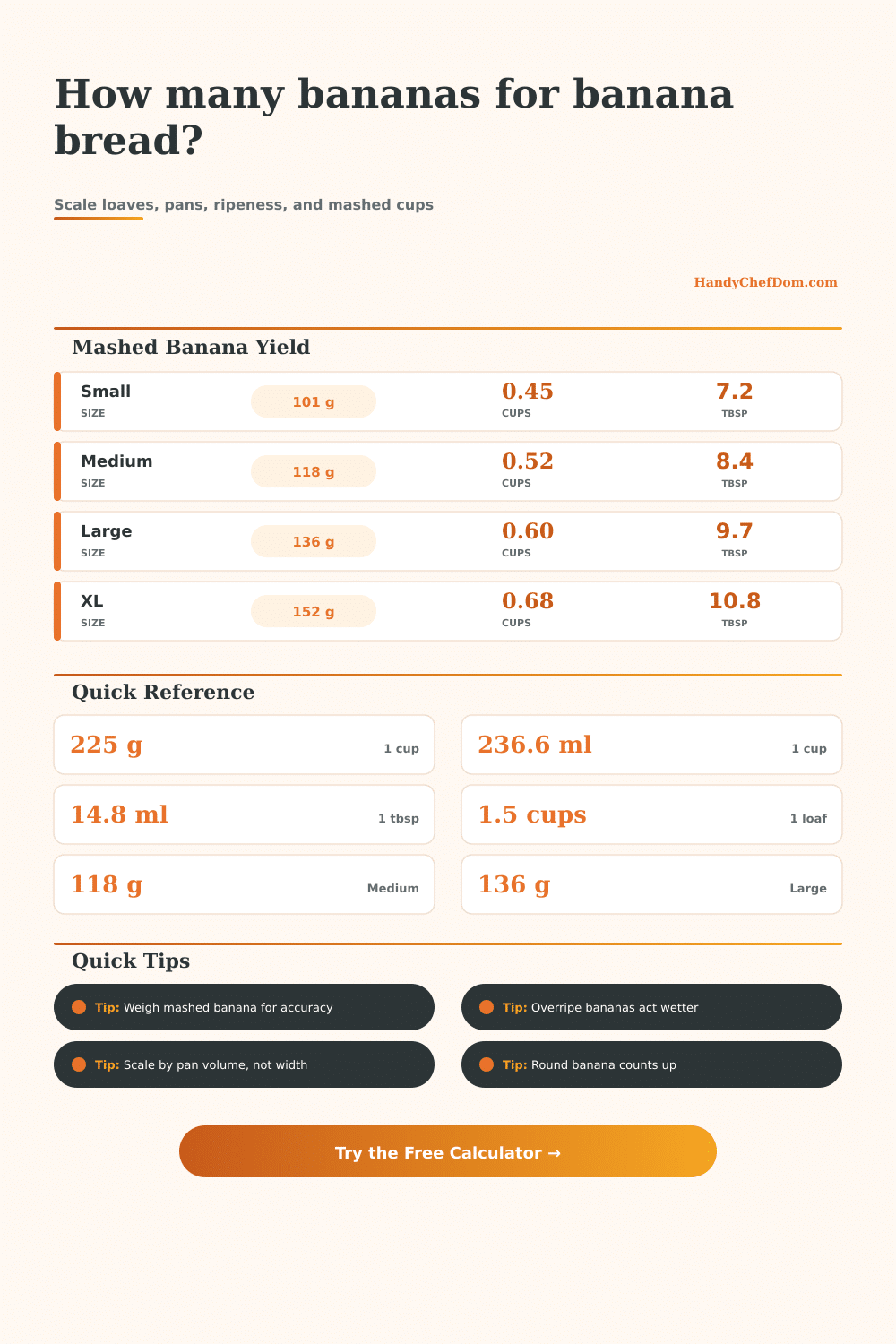
| Small banana | 101 g / 3.6 oz | 0.45 cup | 7.2 tbsp |
| Medium banana | 118 g / 4.2 oz | 0.52 cup | 8.4 tbsp |
| Large banana | 136 g / 4.8 oz | 0.60 cup | 9.7 tbsp |
| Extra large banana | 152 g / 5.4 oz | 0.68 cup | 10.8 tbsp |
| Mixed bunch average | 125 g / 4.4 oz | 0.56 cup | 8.9 tbsp |
| Thawed frozen pieces | 110 g / 3.9 oz | 0.49 cup | 7.8 tbsp |
| Pan / Output | 9x5 Factor | Banana At 1.5 Cups | Use For |
|---|---|---|---|
| 9 x 5 inch loaf | 1.00 | 1.50 cups | Standard loaf plan |
| 8.5 x 4.5 inch loaf | 0.82 | 1.23 cups | Slightly smaller loaf |
| 8 x 4 inch loaf | 0.70 | 1.05 cups | Small loaf pan |
| Mini loaf pan | 0.28 | 0.42 cup | Gift loaves |
| Standard muffin cup | 0.08 | 0.12 cup | Muffin conversion |
| Ratio Style | Cups Per 9x5 | Medium Bananas | Best Use |
|---|---|---|---|
| Light banana note | 1.25 cups | 2.4 medium | Less banana-forward |
| Classic balance | 1.50 cups | 2.9 medium | Default calculator basis |
| Full banana flavor | 1.75 cups | 3.3 medium | Stronger fruit ratio |
| Very moist style | 2.00 cups | 3.8 medium | High banana formulas |
| Batch | Mashed Cups | Medium Bananas | Large Bananas |
|---|---|---|---|
| 1 small 8x4 loaf | 1.05 cups | 2.0 | 1.8 |
| 1 standard 9x5 loaf | 1.50 cups | 2.9 | 2.5 |
| 2 standard loaves | 3.00 cups | 5.7 | 5.0 |
| 4 mini loaves | 1.68 cups | 3.2 | 2.8 |
| 12 muffin cups | 1.44 cups | 2.7 | 2.4 |
| Party batch, 4 loaves | 6.00 cups | 11.4 | 10.0 |
| Mashed Banana | Tablespoons | Milliliters | Approx Grams |
|---|---|---|---|
| 0.25 cup | 4 tbsp | 59 ml | 56 g |
| 0.50 cup | 8 tbsp | 118 ml | 113 g |
| 0.75 cup | 12 tbsp | 177 ml | 169 g |
| 1.00 cup | 16 tbsp | 237 ml | 225 g |
| 1.50 cups | 24 tbsp | 355 ml | 338 g |
| 2.00 cups | 32 tbsp | 473 ml | 450 g |
What good is having a recipe for 3 bananas and only 2 left on hand? Panic! Will it be too much and make the bread fall flat like a brick, or will it be enough and cause the bread to sink? With the calculator (above), inputting your ripeness-level of banana and its approximate size do all the math for you, so you don’t have to guess which way to shrink down that batter.
Counting fruit doesn’t cut it anymore, it’s knowing its structure, moisture, and volume. Then you’re baking confidently, not hoping. The same goes for bananas: Depending on who grew them and where they’re from, they can be very different sizes. You might only have ½ cup of mash out of one small Cavendish banana, or almost 70% more from an extra-large one. We might think all bananas is the same, but they are not. It makes a big difference whether you use two large ones or four small ones because of their weight and hydration.
How to Use Bananas for Banana Bread
This is why the tool allow you to choose the average size of your bananas, which takes into account the different weights. Otherwise, you might underestimate how much those tiny fruits actualy produced, resulting in too-dry loaf. That’s what people do wrong. They count bananas instead of measuring mash.
And then there’s ripeness: That’s also key to the end product. Starches is higher in these bananas. The flesh of a firm (but not rock-hard) banana also has less free water, which is the stuff that makes mashed potatoes creamy. This means it will form a lighter, drier mash. When bananas become soft and black, cell walls give way and the starches convert to sugar; freeing up additional moisture. Though those overripe bananas may appear dried out on their skins, they’re actually wetter ingredients. This explains why you’ll get a different texture when using them. They’ll release some of that excess juice, making your finished banana bread moister then if you’d used a firm banana.
To compensate for the increase in moisture, you could of gone for a slightly smaller banana-to-recipe ratio, but only if you like a denser, cake-y crumb. If a lighter texture is what you want, make your loaves with firmer fruit, or scale back on other ingredients, to match.
Other sneaky variables can catch bakers off guard, like the size of your pans. For instance, a 9 by 5-inch loaf pan hold a certain amount of batter, but an 8 by 4-inch one will hold much less. Forcing that typical amount of bananas into a smaller pan without adjusting the proportions will cause the batter to spill over before it can set. (The table at the top of the page spells this out in terms of scaling factors.) And while the solution might seem like simply halving the recipe when down-sizing to a smaller pan, it’s actually about ensuring the amount of wet ingredients match the capacity of the pan. Too much and you end up with cracked crusts and domed tops; too little and your loaves won’t rise properly and instead come out flat and dense.
When mashing the fruit, think about whether you’ll need volume measures for the recipe. Depending on how aggressively you mash, air pockets varies, which affects volume measurements. To measure accurately, weigh the bananas (a medium one weighs about 118 grams without the skin). That will give you approximately half a cup of mash. If you’re doubling or tripling a recipe, weighing the banana pulp is much more accurate than a cup measure. With this conversion to metric weights in the tool, there’s no guessing anymore when you’re pulling out your kitchen scale. And it makes a big difference if you have multiple loaf going into the oven, such as for a party, or want to freeze some for future use.
Banana bread isn’t so much a science of following exact ingredients as it is one of finding that sweet spot between structure and moisture. The variables within our control can be made consistent with the help of this calculator, which brings order to the heap of overripe mush you’ve got sitting on your counter.
Next time you’re staring down a sorry-looking handful of leftover bananas, don’t freak out. Measure them, judge their state of decay, and follow the math, your hand will lead you to bread that rises just right.