🍦 Vanilla Extract for Ice Cream Calculator
Scale vanilla extract, paste, beans, and powder for ice cream by base quarts, custard or no-churn style, vanilla strength, sweetness, fat level, servings, churn yield, and mix-in intensity.
Use automatic mode for a recommended vanilla level, or test your planned extract amount against the target flavor score for frozen desserts.
Your Vanilla Ice Cream Formula
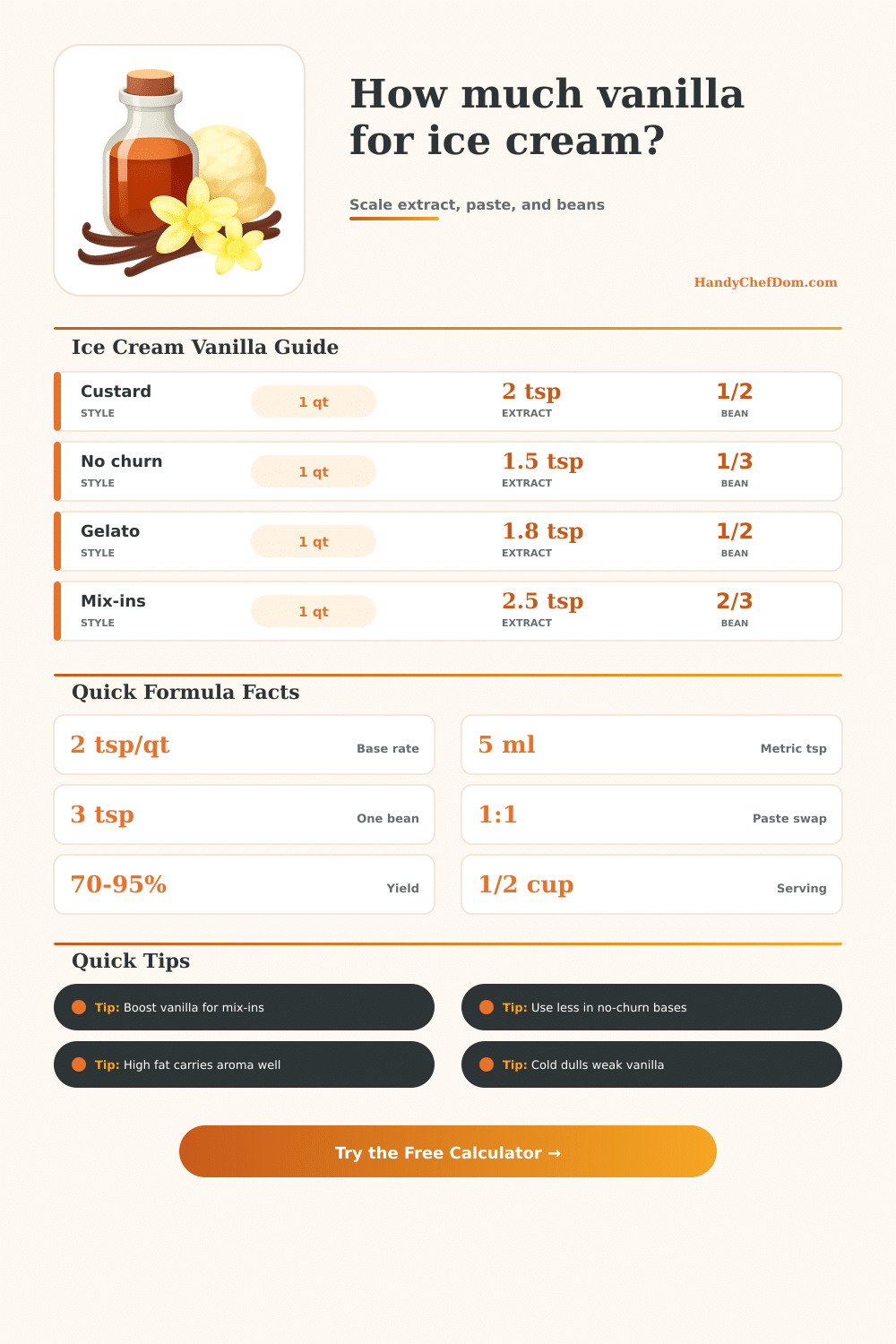
| Ice Cream Style | Extract Per Quart Base | Frozen Flavor Behavior | Calculator Note |
|---|---|---|---|
| Custard with egg yolks | 1.9 to 2.3 tsp | Rich dairy carries vanilla well | Classic default for scoop shops at home |
| Philadelphia style | 1.8 to 2.2 tsp | Cleaner cream flavor shows extract quickly | Needs slightly less than dense custard |
| No-churn condensed milk | 1.3 to 1.8 tsp | Sweet base amplifies vanilla | Calculator trims for high sugar load |
| Gelato style | 1.8 to 2.4 tsp | Lower fat can taste less round | Benefits from paste or steeped bean |
| Soft-serve mix | 2.1 to 2.8 tsp | Airy yield spreads flavor thinner | Overrun adjustment matters most |
| Dairy-free coconut or oat | 2.2 to 3.0 tsp | Base flavor competes with vanilla | Mix-in and fat factors often rise |
| Vanilla Form | Extract Equivalent | Metric Equivalent | Best Ice Cream Use |
|---|---|---|---|
| Pure vanilla extract | 1 tsp extract | About 5 ml | All-purpose churned ice cream |
| Vanilla bean paste | 1 tsp paste | About 5 ml | Visible specks without steeping |
| Whole vanilla bean | 1 bean for 1 tbsp extract | About 15 ml extract | Custard, gelato, premium plain vanilla |
| Double fold extract | 1/2 tsp for 1 tsp extract | About 2.5 ml | Strong flavor with less liquid |
| Vanilla powder | 1/2 tsp for 1 tsp extract | About 1.2 g | Low-liquid or alcohol-sensitive bases |
| Homemade mild extract | 1.25 to 1.5 tsp for 1 tsp | Variable | Use custom mode if strength is known |
| Base Volume | Dense Yield | Classic Yield | Standard 1/2 Cup Servings |
|---|---|---|---|
| 1 pint base | 1.4 cups finished | 1.9 cups finished | 3 to 4 servings |
| 1 quart base | 2.8 cups finished | 3.8 cups finished | 6 to 8 servings |
| 1.5 quarts base | 4.2 cups finished | 5.7 cups finished | 8 to 11 servings |
| 2 quarts base | 5.6 cups finished | 7.6 cups finished | 11 to 15 servings |
| 1 gallon base | 11.2 cups finished | 15.2 cups finished | 22 to 30 servings |
| Party tub base | 22.4 cups finished | 30.4 cups finished | 45 to 60 servings |
| Formula Factor | Lower Vanilla Signal | Higher Vanilla Signal | Calculator Treatment |
|---|---|---|---|
| Sugar level | Condensed milk or very sweet base | Low sugar or alternative sweetener | Ranges from -10% to +10% |
| Fat level | Super-rich cream carries aroma | Low-fat or oat base tastes flatter | Ranges from -6% to +12% |
| Mix-ins | Plain vanilla or light ripple | Brownies, coffee, cocoa, or tart fruit | Adds 0% to 28% |
| Churn yield | Dense gelato concentrates flavor | High overrun soft-serve spreads flavor | Adjusts by finished volume |
| Steep time | No rest for beans or paste | Overnight or longer steep | Small reduction for better extraction |
| Vanilla form | Double fold or powder | Clear or homemade mild extract | Converts to extract equivalent |
Getting ice cream to taste like vanilla is easy, except when you have to get it right. It needs to withstand the sugar, fat, and mix-ins. It also need to freeze without losing its aroma, which cold can mute. Too little means a flat-tasting hard ice cream. Too much? Well then, the ice cream will still be flat, but now the sharp notes of extract or the alcohol will poke through and taste off.
But it really comes down to the base composition. An egg-yolk-based custard carry vanilla in a different way than an eggless Philadelphia-type mixture. No-churn bases uses condensed milk, which results in something sweeter and requires more vanilla to achieve the same taste. Dairy-free bases using either oat or coconut milk bring other flavors into competition. It’s all about what the “correct” dose of vanilla will be in any given batch.
How to Get Vanilla Ice Cream Right
Plug in your desired strength, sugar level, fat richness, number of servings, churn yield, mix-in load, style, vanilla type, and base volume (beans, powder, paste, or extract). The calculator then does the math for you. Then it translates from one form to another, i.e., it will show you how much strength you get from a tablespoon of paste versus a tablespoon of powder. And it’s adjustable by both overrun and aging time, since both those variables impacts the taste of the finished product when you go to scoop it out and freeze it.
The common use-case is just extract bottle. No one thinks about how a high-fat base carries aroma better than a low-fat base. They also forget that adding mix-ins like coffee and brownies can overwhelm the vanilla taste unless you increase your dosage. You don’t have to calculate all these variables separately, but instead make their trade-offs visible with tool.
The other less-mentioned element is cold temperature. Tasting something balanced at room temperature may seem muted when frozen rock-solid. That’s why calculator sets the strength target higher than you’d guess based off how it tastes when warm. It wants to end up in sweet spot post-chill, not pre-chill.
Here are a few practical notes: if you use paste or beans, make your base at least a day in advance. This allows it to age and round out the flavor, which means you may be able to reduce the amount of vanilla used altogether. You should of prepared this early. The aging input will take this into account in the calculator, but really knowing why you’re doing it instead of blindly plugging in a number is where the value lies.
Vanilla’s not so much about nailing down one exact measurement as it is dialing up or down amount based off your base. It’s about knowing how mix-ins masks vanilla, what fat does to aroma, and how much vanilla has to hold its own against sugar, fat, and mix-ins. After that it’s just making little, educated adjustments instead of guessing.
Actually it is naturaly easier with help.