Potato Boiling Time Calculator
Estimate boil time from potato type, cut size, quantity, water start, salt level, pot crowding, altitude, and target texture.
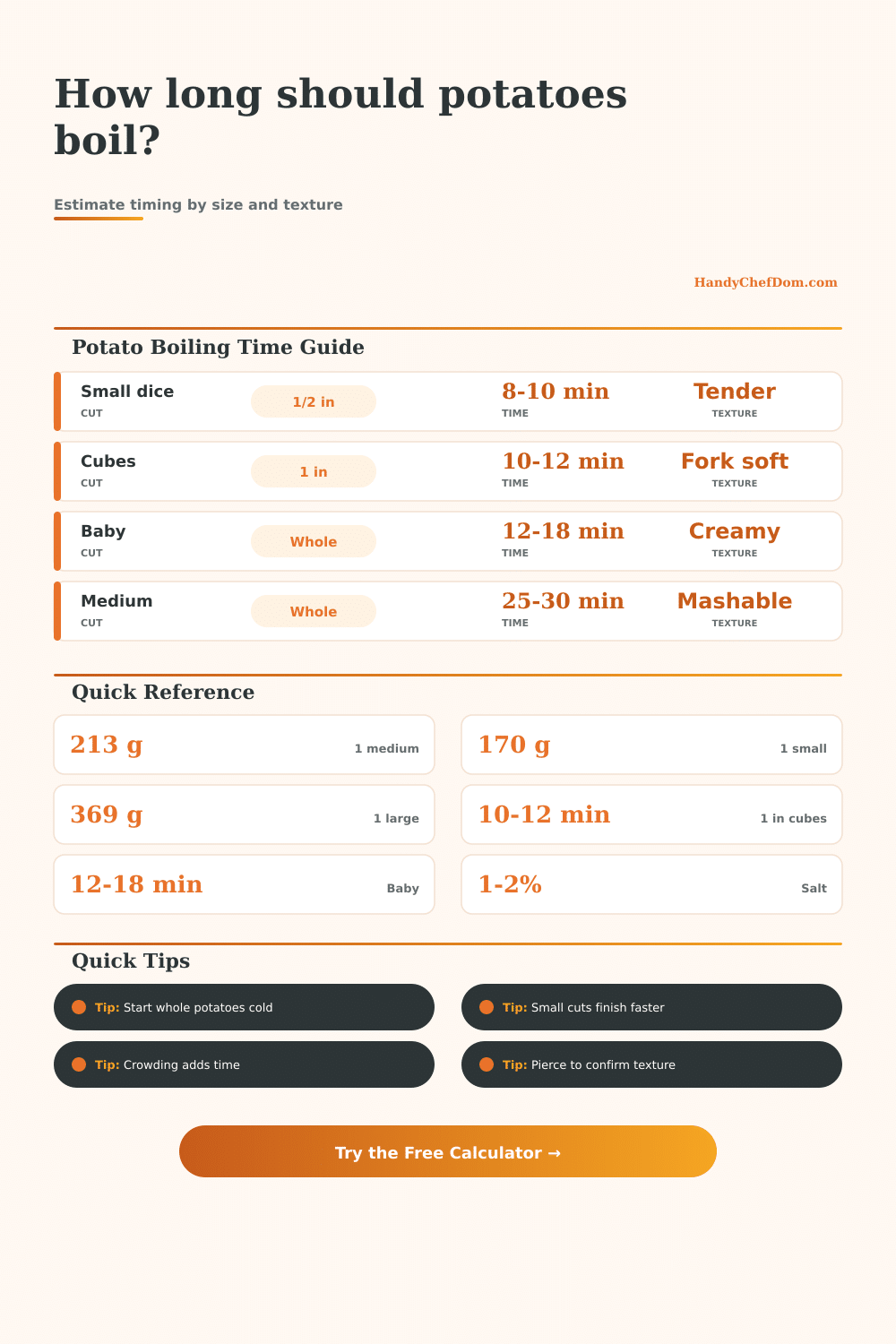
| Cut or Size | Typical Pieces | Base Time | Best Texture | Common Use |
|---|---|---|---|---|
| Small dice | 1/2 inch cubes | 8-10 min | Firm to tender | Fast sides, hash prep |
| Standard cubes | 1 inch cubes | 10-12 min | Fork-tender | Potato salad, mash |
| Large chunks | 1 1/2 to 2 inch | 14-20 min | Tender to soft | Rustic mash, stews |
| Whole baby | 1 to 1 1/2 inch | 12-18 min | Creamy | Side dishes |
| Whole medium | 2 1/4 to 3 1/4 inch | 25-30 min | Soft center | Mash or salad |
| Whole large | 3 to 4 1/4 inch | 30-38 min | Fully soft | Large batch mash |
| Type | Avg Medium Weight | Timing Factor | Cooked Yield | Texture Note |
|---|---|---|---|---|
| Russet / Idaho | 213 g / 7.5 oz | 1.00 | 98% | Fluffy and mashable |
| Yukon Gold | 180 g / 6.3 oz | 1.03 | 99% | Creamy, holds shape |
| Red Potato | 170 g / 6.0 oz | 1.05 | 99% | Waxy and firm |
| Baby Potato | 45 g / 1.6 oz | 0.96 | 99% | Small whole pieces |
| Fingerling | 55 g / 1.9 oz | 0.98 | 99% | Dense, narrow shape |
| Purple Potato | 120 g / 4.2 oz | 1.06 | 98% | Firm, dense flesh |
| Sweet Potato | 180 g / 6.3 oz | 0.93 | 97% | Softens faster |
| Variable | Setting | Timing Effect | Use In Calculator | Kitchen Check |
|---|---|---|---|---|
| Cold start | Cold water | Even center heating | +2 min vs simmer timing | Best for whole potatoes |
| Boiling start | Already boiling | Faster clock start | -1 min for small cuts | Stir gently after adding |
| Salt level | 1% to 2% | Slightly firmer texture | Up to +1.2 min | About 10-20 g per liter |
| Crowding | Very crowded | Slower return to simmer | Up to +18% | Use wider pot if needed |
| Altitude | Every 1000 ft | Lower boiling point | About +3% | Check more often late |
| Scenario | Cut | Raw Amount | Target | Est. Time | Check At | Cooked Yield |
|---|
| Group Size | Side Portion | Mash Portion | Raw Potatoes | Water Estimate |
|---|---|---|---|---|
| Dinner for 2 | 340 g / 12 oz | 450 g / 1 lb | 2 medium | 1.0 qt / 1 L |
| Family of 4 | 680 g / 1.5 lb | 900 g / 2 lb | 4 medium | 1.8 qt / 1.7 L |
| Meal prep 6 | 1.0 kg / 2.25 lb | 1.35 kg / 3 lb | 6 medium | 2.8 qt / 2.6 L |
| Holiday 12 | 2.0 kg / 4.5 lb | 2.7 kg / 6 lb | 12 medium | 5.5 qt / 5.2 L |
| Party 20 | 3.4 kg / 7.5 lb | 4.5 kg / 10 lb | 21 medium | 9.5 qt / 9 L |
It sounds easy enough: boil some potatoes. However, depending on cut and type of potato, the time required can vary. Cubed red potatoes will take less time to cook then a whole russet (the heat has to get through more potato). Keep in mind the shape of what you’re preparing which impacts the method for cooking.
It also removes some of the guesswork based off the equation with things such as how crowded your pots is and what altitude you’re at (water doesn’t always boil at exactly 212 degrees Fahrenheit). If you’re at a higher elevation, the water isn’t as active even though it’s bubbling furiously; because of that, boiling point lowers, adding minutes onto the cooking time. That can mean you end up cooking your potatoes for too long if you use sea-level standards. It will adjust baseline time according to where you are.
Tips for Boiling Potatoes Perfectly
Whole potatoes should of been started in cold water rather than dropped into already-boiling water. Many people mistakenly think that starting in hot water speeds up the cooking time. However, this often ruin the texture. For larger pieces, the texture takes precedence over time, which is why calculator assumes an initial state of cold water and therefore more uniform heating.
The other issue: overloading pot causes a huge increase in cook time. Why? Loading up your pot with those cold potatoes lowers the water temperature so it will take longer to reach a simmer again. That’s why the tool only adds time when you’re trying to cook a big batch in a smaller area. Use a looser fitting vessel (i.e., a wider one) so there isn’t any stacking and steaming; all piece will finish cooking at the same time.
The presence of salt also makes the potatoes taste better and retain their form when put through lengthy cooking times. If you’re after very firm cubes for use in a salad, for example, that’s because it slightly strengthens the potato cell wall pectins. For heavy duty firming up, a heavier brine will do the trick; a one percent saltiness are a nice baseline. Don’t skimp on the salt; regardless of other finishing touches, bland results await an undersalted water.
Remember: clocks aren’t gospel; every year’s crop is different in density. Poke with paring knife to determine if they’re ready. If it slides right in, they’re done; if it hits resistance, keep cooking the potatoes for another minute or two. As soon as you feel that they’re done, drain them… Otherwise you’ll end up with a pan of gluey spuds. Once you get the feel of it, this will become second nature and you’ll be able to sense your food instead of just watching the clock.