Chicken Roasting Time Calculator
Estimate oven roasting time for whole chicken, bone-in pieces, boneless cuts, stuffed birds, convection ovens, start temperature, rest time, and target internal temperature.
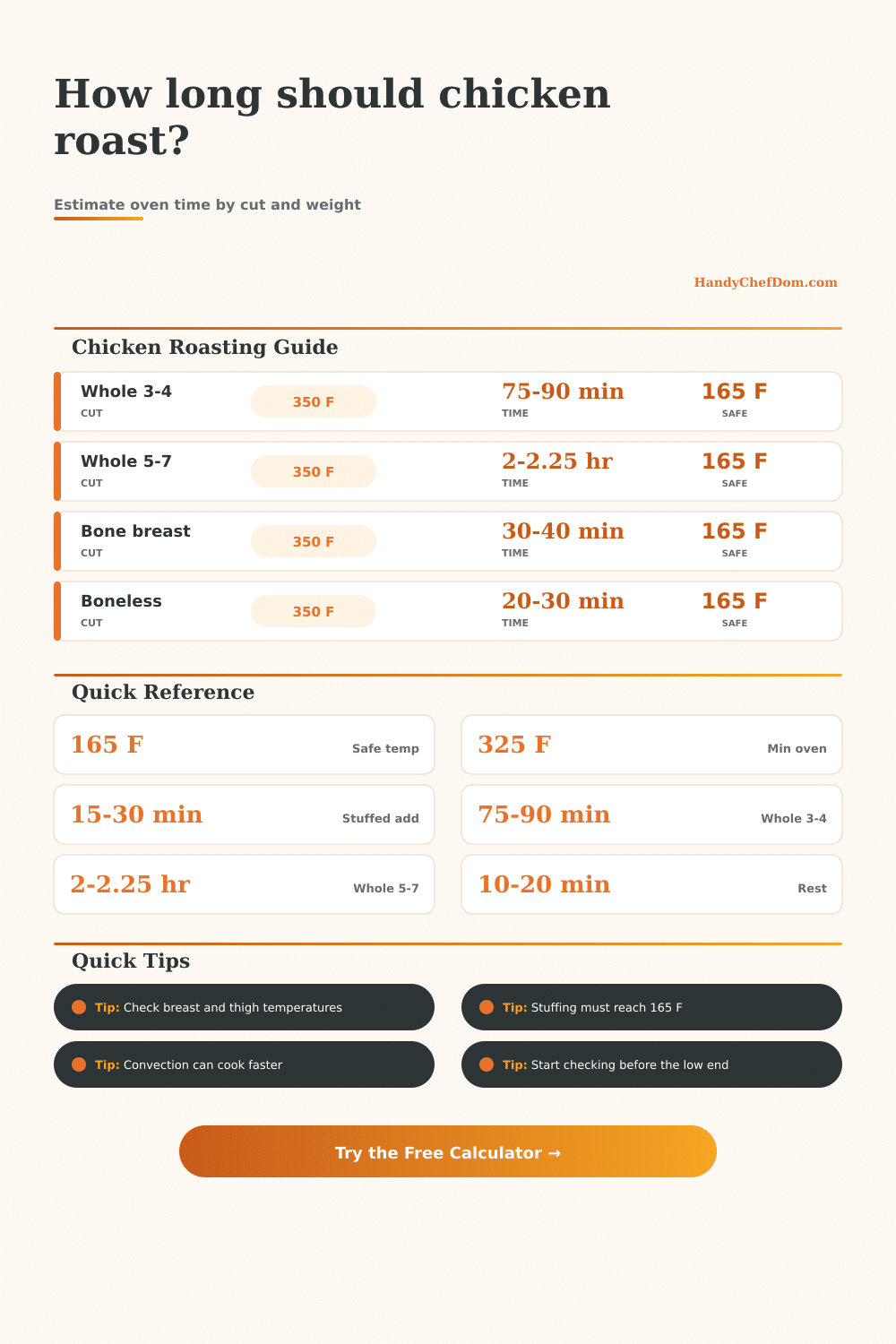
| Chicken Type | Weight | Oven | Reference Time | Thermometer Target |
|---|---|---|---|---|
| Whole chicken | 3 to 4 lb | 350°F / 177°C | 1 1/4 to 1 1/2 hours | 165°F in breast, thigh, wing |
| Whole chicken | 5 to 7 lb | 350°F / 177°C | 2 to 2 1/4 hours | 165°F in breast, thigh, wing |
| Breast halves, bone-in | 6 to 8 oz each | 350°F / 177°C | 30 to 40 minutes | 165°F in thickest part |
| Breast halves, boneless | 4 oz each | 350°F / 177°C | 20 to 30 minutes | 165°F in thickest part |
| Cornish hen | 18 to 24 oz | 350°F / 177°C | 50 to 60 minutes | 165°F in thickest parts |
| Oven Setting | Use Case | Calculator Adjustment | Check Earlier By |
|---|---|---|---|
| 325°F / 163°C | Gentle roast, larger birds | Add about 12% | 10 minutes |
| 350°F / 177°C | USDA chart baseline | No oven adjustment | 15 minutes |
| 375°F / 191°C | Balanced browning | Reduce about 8% | 18 minutes |
| 400°F / 204°C | Faster browning | Reduce about 15% | 20 minutes |
| 425°F / 218°C | Hot fast roast | Reduce about 22% | 22 minutes |
| Input | Setting | Timing Effect | What to Verify |
|---|---|---|---|
| Unstuffed | Open cavity | No added time | Breast, thigh, wing reach 165°F |
| Aromatics | Loose lemon, herbs, onion | Add about 5 minutes | Do not pack the cavity tightly |
| Stuffed | Bread or dense stuffing | Add 15 to 30 minutes | Stuffing center reaches 165°F |
| Very cold start | Icy cavity or very cold pan | Add about 10% | Check multiple thick spots |
| Counter 30 minutes | Slightly tempered surface | Reduce about 3% | Still cook to 165°F minimum |
| Scenario | Typical Input | Estimated Oven Time | Rest | Best First Check |
|---|---|---|---|---|
| Weeknight whole chicken | 4 lb, 350°F, unstuffed | 1 1/4 to 1 1/2 hours | 10 minutes | About 60 to 70 minutes |
| Large roasting hen | 6 lb, 350°F, unstuffed | 2 to 2 1/4 hours | 15 minutes | About 1 hour 45 minutes |
| Stuffed whole chicken | 5 lb, 350°F, stuffed | About 2 1/4 hours | 15 minutes | About 1 hour 50 minutes |
| Boneless breast tray | 1.5 lb, 350°F | 25 to 35 minutes | 5 minutes | About 18 to 22 minutes |
| Spatchcock chicken | 4 lb, 425°F | About 45 to 60 minutes | 10 minutes | About 35 minutes |
When I roast a whole bird I’m nervous about my kitchen timer. Based off age-old rules, I set it and then with bated breath, I monitor the oven, dreading one of two things: Either the meat will be overdone (dry!) or it will be underdone, partcularly in thickest parts. Enter a calculator. It take away the guesswork and helps you plan a meal instead of just guessing.
It factors in thing that home cooks frequently overlook. Most everyone thinks about weight. Four pounds is four pounds. Right? Wrong. Because a boneless cut lacks a bone to protect it from the heat, the heat move through it differently then it would through a piece of bone-in meat. When selecting your cut, the calculator takes into account those differences.
Why Use a Roasting Calculator
It knows a big roaster full of bones require more heat to reach deep into the meat, but a fast-cooking, flattened-out spatchcock bird has much more surface area for quicker cooking. Density and geometry are the difference here, not just size. One thing that’s important is temperature. Fat will crisp better at higher temperatures, and it does gets the skin crisper. But the outside get much hotter than the inside. So when you’re doing high-temperature (above about 400 degrees Fahrenheit), there’s more of a temperature gradient from center to outer surface of your food, which can cause problems like browning the outside before the inside has cooked up to minimum-safe temperature (like 165 degrees). Because increasing temperature doesn’t increase heat transfer in a straight line, the software tweaks estimated times depending on how hot your oven is.
Convection ovens makes things even more complicated. Since air moves in convection ovens, they take away that cool layer of air surrounding whatever you’re baking, making it cook faster. But if you aren’t careful, dryness of meat can kick in fast.
But what if you stuff it? That’s another ballgame entirely. The stuffing add insulation to keep the meaty middle cooler, and it also requires a safety buffer. Any food safety authorities will tell you that raw stuffing need to hit at least 165 degrees to be cooked. This means the bird might end up overcooked by the time the stuffing reach temperature. And since the stuffing is pretty thick, it takes some extra minutes to come to temp, time that the calculator includes in its estimate. Many people put their fresh herbs and other aromatics right into the bird rather than into a stuffing; not only do they flavor meat more fully, but there’s no worry about anything being underdone as well.
Another thing people overlook: start temperature. Placing cold refrigerator-cold chicken into a hot oven results in the exterior beginning to cook while the center is still freezing. Allow the bird to come to room temperature for half an hour. That will help level out the temperature, resulting in more even cooking (and requiring less heat energy to bring up cavity temp). So the tool takes all that into account. If the bird is cold when you put it in, it’ll adjust its estimate accordingly. The same applies to tempering the bird and rest time.
Because the meat keeps cooking after being removed from the oven, the temperature goes up as it rests. Pulling it too soon could of result in overshooting your desired doneness. Even if you’re within inches, you still need a thermometer. Knowing when things are done depends only on the temperature; timing just makes it easier. And remember: Bone, skin, and stuffing all affect cooking time, so check deep into the thigh meat and thick section of the breast.
Don’t trust your eyes… Relying on juice clarity alone is unreliable. You want to eliminate as much guessing as possible. This lets you concentrate on color and basting. Once you get the hang of how heat travels in that bird, then the timer is more like a guide than a law. Go ahead, go home confident, you’ve got a good idea of what’s going on back there in the pan.