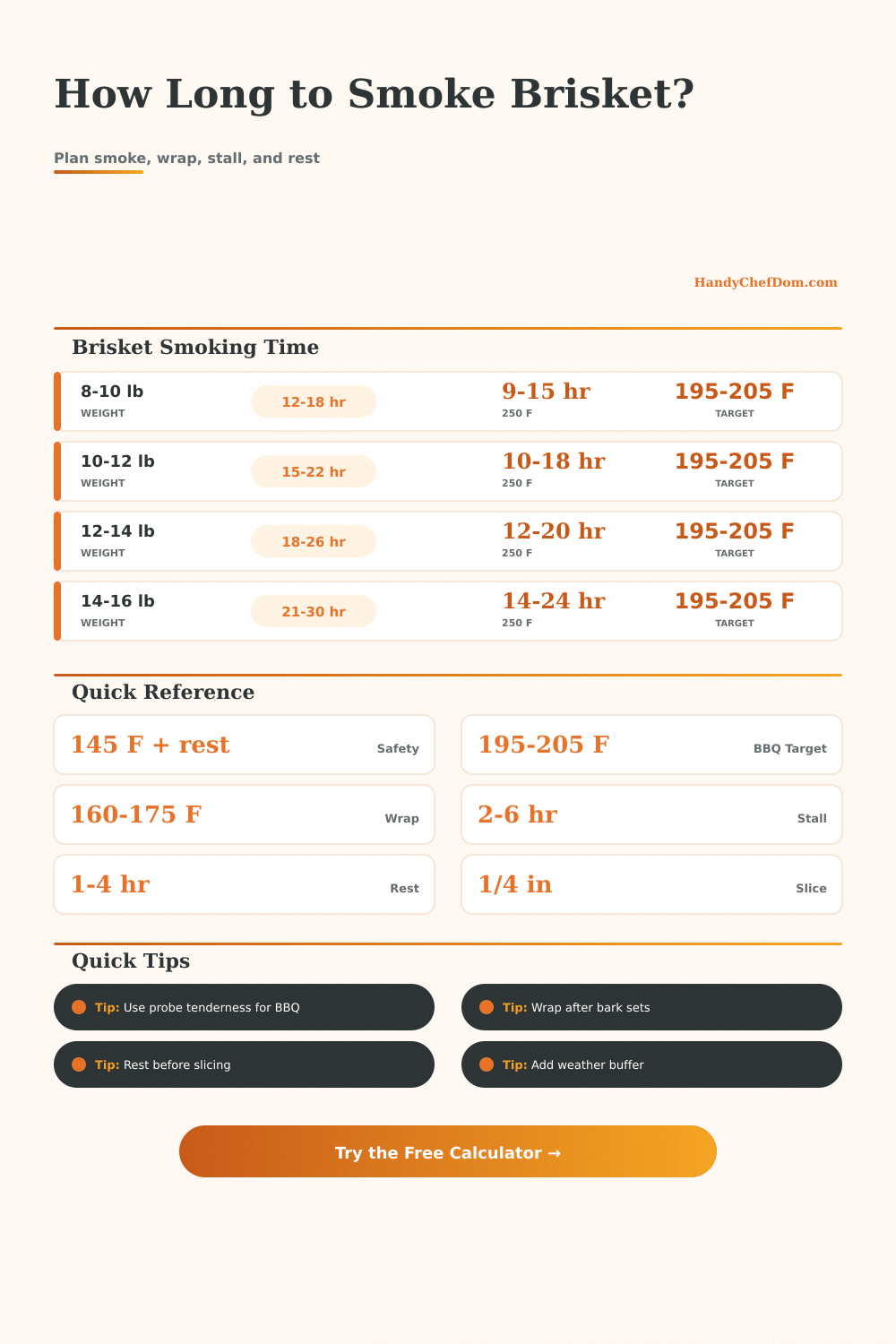
Brisket Smoking Time Calculator
Estimate brisket smoke time, stall length, wrap timing, rest, and serving yield by weight, trim level, pit temperature, weather, and barbecue finish target.
| Trimmed Weight | 225 F Low Smoke | 250 F Balanced | 275 F Faster |
|---|---|---|---|
| 8 to 10 lb | 12 to 18 hours | 9 to 15 hours | 7 to 12 hours |
| 10 to 12 lb | 15 to 22 hours | 10 to 18 hours | 8 to 14 hours |
| 12 to 14 lb | 18 to 26 hours | 12 to 20 hours | 9 to 16 hours |
| 14 to 16 lb | 21 to 30 hours | 14 to 24 hours | 10 to 18 hours |
| Target | Temperature | Rest | Use In Calculator |
|---|---|---|---|
| USDA whole-cut beef safety floor | 145 F | At least 3 minutes | Safety reference, not BBQ tenderness |
| Slice tender brisket | 195 to 200 F | 60 to 180 minutes | Firm slices with some chew |
| Classic BBQ brisket | 200 to 203 F | 90 to 240 minutes | Common probe-tender range |
| Pull or chop brisket | 203 to 205 F | 120 to 240 minutes | Softer texture for chopped beef |
| Factor | Typical Range | Time Effect | Planning Note |
|---|---|---|---|
| Brisket stall | 150 to 170 F | 2 to 6 hours | Longer on large unwrapped cuts |
| Butcher paper | 165 to 175 F wrap | About 5 percent faster | Protects bark better than foil |
| Foil wrap | 160 to 170 F wrap | About 15 percent faster | Softens bark but shortens stall |
| Cold wind | Outdoor pit loss | Add 15 to 22 percent | Use a wider finish window |
| Cut Or Trim | Raw Trim Loss | Cooked Yield | Serving Use |
|---|---|---|---|
| Whole packer, standard trim | 18 to 25 percent | 50 to 58 percent raw weight | BBQ plates and slices |
| Flat only | 10 to 18 percent | 55 to 62 percent raw weight | Lean slices |
| Point only | 8 to 15 percent | 58 to 65 percent raw weight | Rich slices or chopped beef |
| Competition trim | 25 to 35 percent | 45 to 52 percent raw weight | Cleaner shape, lower yield |
When you stare at a raw brisket on your hook, there’s one particular kind of dread that sets in. It dawns on you that you don’t realy have a clue about cooking times. The internet tells you it might be anywhere between ten hours and maybe up to thirty. How can you not be confused? Why does everyone treat smoke time like some sort of easy math problem? Doesn’t anyone understand how meat work, and the fact that collagen has to breaks down?
You need a plan that factors in more than just the clock. If you are a novice, this simple calculator can takes those variables into account (above). First comes the cut and trim level. Do you have a fat capped whole packer or a closer competition trim? Because the more muscle fiber you expose to direct heat, the quicker it will cooked.
How to Plan Your Brisket Cooking Time
Next, the tool calculates your desired temperature, how well-wrapped the brisket is, and even takes the outdoor weather into account. And it doesn’t stop at firing up grill, either. The key is controlling the thermal environment of every step of process.
Finally, there’s the difference between safe and tender, and separating the two is what the tool does best. If you just want safe meat, that stops at 145 degrees Fahrenheit. If you just want safe meat, that’s where it stops. For collagen, however, it give way to forks only at the 200 to 205 degree mark.
That’s where the majority of plans go astray: Understanding the stall. The stall occurs because the meat’s surface cools as moisture evaporates, causing the temperature to stop rising for as long as several hours. That’s why there’s a distinction in the reference table between low-and-slow and faster finishes. Wrapping too soon in foil will get you out of the stall, but soften your lovely bark and all that labor you put into creating it. Butcher paper provides the happy medium, allowing the crust to breathe but maintaining enough moisture to help power over the plateau. It is a balance, but it will decide how your food feels on the plate. Do you want something quicker, or do you want it built like a brick?
The one factor that messes up weekends is also the hardest to predict: weather. A brisket smoked on a mild afternoon inside a sheltered garage is going to behave different than one done outside on a forty-degree day in a drafty backyard. The calculator gives you some room here, so you can’t underestimate how long it’s all going to take. Without factoring in changes in ambient temperature or wind chill, you could very well plan to have dinner ready by six o’clock and find yourself waiting until nine for your meat. There’s no need to sweat it out if you give yourself a little wiggle room from the beginning. Instead of giving you an exact moment, the tool calculates a range of possible completion times, because live fire cooking always has an element of uncertainty.
Cooked yield is important, too. Serving yield matters just as much as timing. When you take a twelve-pound packer brisket out of the package, you’re not going to get twelve-pounds of finished, ready-to-eat-meat after trimming and shrinking. You lose weight during the smoke, the dry rub, and the rest time. Knowing your cooked yield prevents you from over-cooking a brisket and sending people home with leftover meat they didn’t ask for. It also keeps you from being shown up at a party by having less food than expected. The breakdown section provides a realistic idea of what your actual slice count will be. Better to go conservative and not have to apologize to those who is hungry.
Whether the clock tells you it’s time for dinner or not, it’s time to rest. When the meat comes off the smoker, that residual heat keeps working, breaking down the connective tissue. Early cuts release those valuable juices to the cutting board rather than keeping them locked inside the muscle fibers. Letting the meat rest allows each bite to be tender and moist. Don’t rush the last step and ruin what you’ve been waiting nearly a day and a half for. Respect the stall, trust the process, and let the meat do the work before your first cut. It’ll be worth the wait.