🍪 Chocolate Cookies Calorie Calculator
Estimate chocolate cookie calories, sugar, fat, carbs, protein, batch totals, baked weight, serving impact, cocoa percentage, chips, frosting, and filling adjustments.
Choose a chocolate cookie style, cocoa percentage, portion weight, chips amount, and frosting or filling option. Values use FoodData Central-style calorie-density anchors, then adjust for the actual portion.
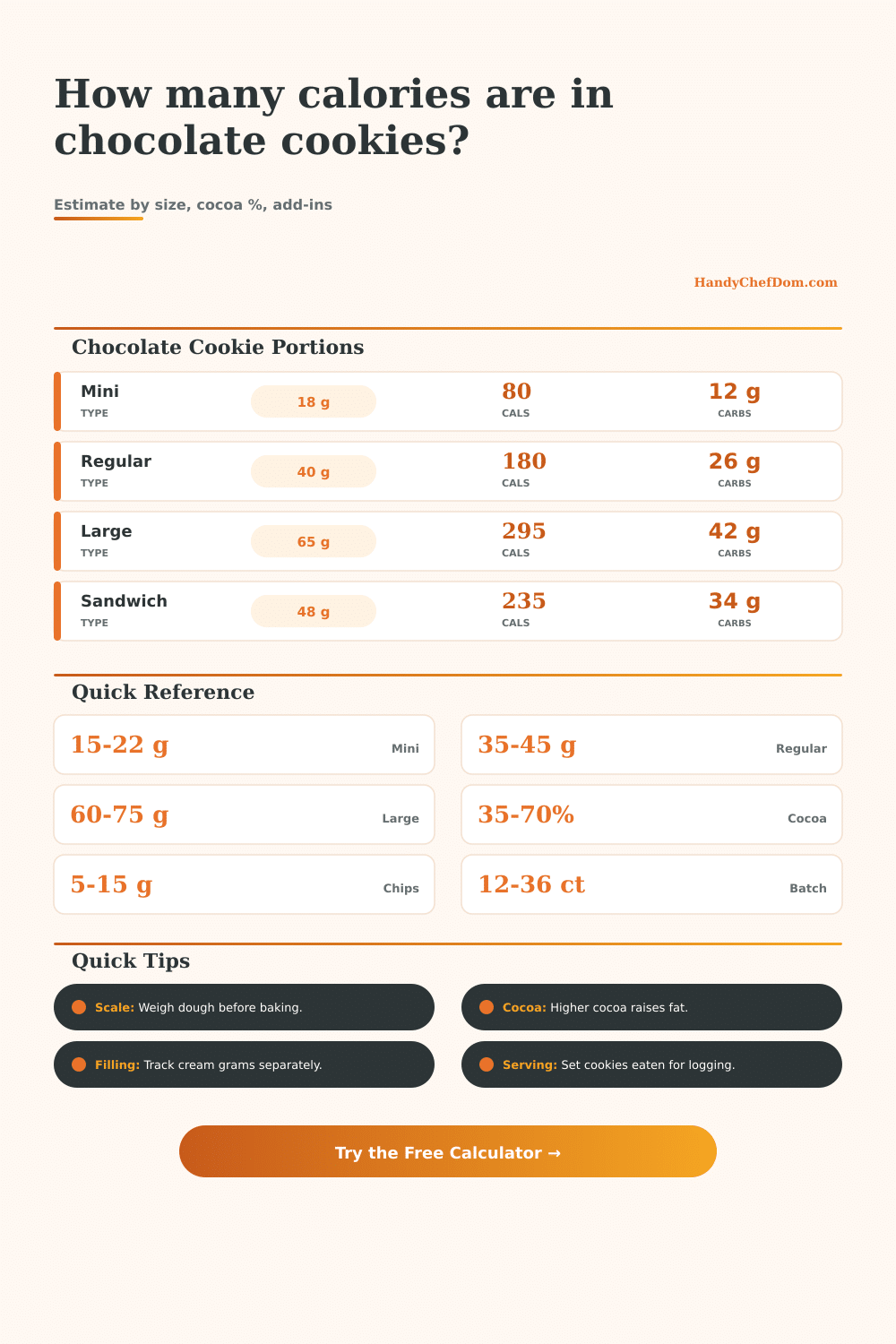
Regular chocolate cookies often start with 1.3 to 1.6 oz dough.
Use cocoa percentage for cocoa-forward dough or chocolate percentage for chopped chocolate.
| Cookie type | Cal/oz dough | Sugar/oz | Fat/oz | Carbs/oz |
|---|---|---|---|---|
| Classic cocoa cookie | 122 | 7.8 g | 5.2 g | 17.1 g |
| Double chocolate cookie | 132 | 8.5 g | 6.0 g | 18.3 g |
| Chocolate sugar cookie | 116 | 8.2 g | 4.8 g | 17.6 g |
| Chocolate crinkle cookie | 118 | 8.8 g | 4.6 g | 18.2 g |
| Brownie-style cookie | 138 | 8.9 g | 6.7 g | 18.8 g |
| Thin chocolate wafer | 128 | 8.1 g | 5.7 g | 18.0 g |
| Chocolate sandwich cookie | 146 | 9.7 g | 6.6 g | 20.1 g |
| Chocolate oatmeal cookie | 120 | 7.1 g | 5.1 g | 17.4 g |
| Portion label | Dough weight | Baked weight | Typical calories | Best match |
|---|---|---|---|---|
| Mini bite | 0.5-0.8 oz | 14-20 g | 60-105 | Snack tray |
| Small cookie | 0.9-1.1 oz | 23-28 g | 105-145 | Lunchbox |
| Regular cookie | 1.3-1.6 oz | 33-41 g | 155-210 | Classic scoop |
| Large cookie | 2.0-2.6 oz | 51-66 g | 240-350 | Bakery case |
| Jumbo cookie | 3.0-4.2 oz | 77-107 g | 360-575 | Split dessert |
| Thin wafer | 0.35-0.55 oz | 9-14 g | 45-75 | Stack serving |
| Cookie bar square | 1.6-2.4 oz | 41-61 g | 195-325 | Pan portion |
| Add-in or topping | Calorie factor | Sugar factor | Fat factor | Carb factor |
|---|---|---|---|---|
| Plain chocolate cookie | 1.00x | 1.00x | 1.00x | 1.00x |
| Chocolate chips | 1.08x | 1.10x | 1.09x | 1.06x |
| Mini chocolate chips | 1.05x | 1.07x | 1.04x | 1.04x |
| White chocolate chips | 1.10x | 1.12x | 1.13x | 1.07x |
| Chopped nuts | 1.09x | 0.96x | 1.20x | 0.98x |
| Light frosting | 1.16x | 1.24x | 1.08x | 1.18x |
| Sandwich cream filling | 1.24x | 1.29x | 1.18x | 1.22x |
| Powdered sugar coating | 1.04x | 1.10x | 1.00x | 1.08x |
| Batch count | Mini dough | Regular dough | Large dough | Jumbo dough |
|---|---|---|---|---|
| 6 cookies | 4 oz | 9 oz | 14 oz | 22 oz |
| 12 cookies | 8 oz | 18 oz | 28 oz | 44 oz |
| 18 cookies | 12 oz | 27 oz | 42 oz | 66 oz |
| 24 cookies | 16 oz | 36 oz | 56 oz | 88 oz |
| 36 cookies | 24 oz | 54 oz | 84 oz | 132 oz |
| 48 cookies | 32 oz | 72 oz | 112 oz | 176 oz |
When you bake cookies, you measure out ingredient carefully: the flour and sugar, then stir everything together until dough is formed. You slide that dough onto a tray and pop it into oven. But as the dough bakes, some of moisture evaporates unpredictably, causing it to spread out like water. To understand what’s happening… To know how many calories are in this batch, for instance, you has to stop guessing and start taking measurements.
When you switch from eyeballing the process to counting by grams, you realize that something have changed. Now you see it differently. Once you’ve entered your dough weight and chosen your add-ins, the calculator do the rest: it processes all that data for you. No need to guess at conversions or coefficients, no need to do math yourself.
How to Measure Cookies Accurately
The size of a cookie make a big difference, as does how it is made. Most people find this out when comparing a standard homebaked cookie from a scoop of dough with something from jumbo bakery version. If your usual chocolate cookie begins life as around 1.4 ounces of uncooked dough, then once baked, that cookie typically weighs between 100-200 calories… Around 170, on average. It doesn’t sound like a lot…
But remember, most batches contain dozen cookies that, while visually indistinguishable, can differ dramatically in weight if you’re eyeballing each scoop. So what exactly ARE you measuring? When the water evaporates in the oven, those calories don’t dissapear; instead, they remain trapped inside the carbs and fats. This means that a softer cookie, moist and dense; is going to have fewer calories per ounce compared to a crispy, light cookie.
Another factor in this equation is also addressed by cocoa content slider. Because darker chocolate sounds like it should be more healthful, you may think it contains fewer calories (since dark chocolate isn’t as sweet), but that’s just a culinary illusion; there’s no real nutrition behind it. Cocoa powder add volume and fiber without adding much fat, while chopped chocolate or chips introduce pure lipid energy. Chips or chopped chocolate do, they’re pure fat energy. If you choose double chocolate, the system will account for that added fat load. That little tweak make all the difference if you’re targeting certain macros.
Check out the reference table on the page, which show the shifts in fat and sugar factors depending on your toppings. Adding frosting will spike your sugar, but not move the needle much in terms of protein. Nuts do the opposite, boosting fat considerably while inching down the carb ratio a bit.
It will calculate total batches too (this is where most home bakers fail), and that’s important: if I make 24 cookies, and then eat three, I don’t want to log the whole damn tray and get all bummed out by my daily totals. You need to know per-unit cost. Log exactly how many cookies you ate and you’ll get a real picture instead of an over-inflated guilt trip. Because let’s face it: human portions aren’t even close to being standard. On some days I want a jumbo slice, on others I just want a tiny bite to pair with my coffee. These presets covers those situations: from sandwiches to crinkle bites. You won’t have to figure out each variation of each recipe.
Other less obvious variables affect the accuracy of baking loss. How much the dough shrinks when baked). Typically, dough loses about ten percent of its weight during the cooking process due to evaporation. So if you were to weigh your cooked cookie then attempt to input it back in a database full of raw dough, you would be significantly off. The calculator takes this loss into account automatically based off the percentage you put into the calculator. That way the caloric value displayed is what you hold in your hand, not some estimated mass before being heated. This level of precision eliminate the stress of wondering whether to believe your eyes or your scale.
In the end, getting accurate answers depends on realizing that chocolate cookies belongs to the category of energy-dense comfort foods. Don’t fear ’em: they’re meant to be eaten, not shunned. Calculating what they do to your system isn’t about removing them from your life, it’s about figuring out how to include them intelligently. Knowing precisely how many calories are hiding in that particular scoop allow you to make informed trade-offs throughout the rest of your day. You’ll plan for the sugar spike, and feel OK about it. Clarity is much more satisfying then restriction. It doesn’t rob anything from the taste, and it empowers you to eat the cookies with abandon, without having to keep score in the dark.
Weighing the dough before putting it on a tray may seem hard at first, but it turns an otherwise unclear way of indulging into something you can manage as part of your routine. It’s not about taking anything away from the experience; it’s about adding something back (control).