🍊 Oranges Per Cup of Juice Calculator
Estimate how many whole oranges to buy for a target amount of fresh juice, with orange size, juicer efficiency, pulp preference, and recipe buffer included.
Enter the final juice amount you want. This calculator works forward from the target cups and tells you how many oranges to prepare after efficiency, pulp, and buffer changes.
Use cups in imperial view or milliliters in metric view.
| Orange type | Typical size | Base juice | Useful note |
|---|---|---|---|
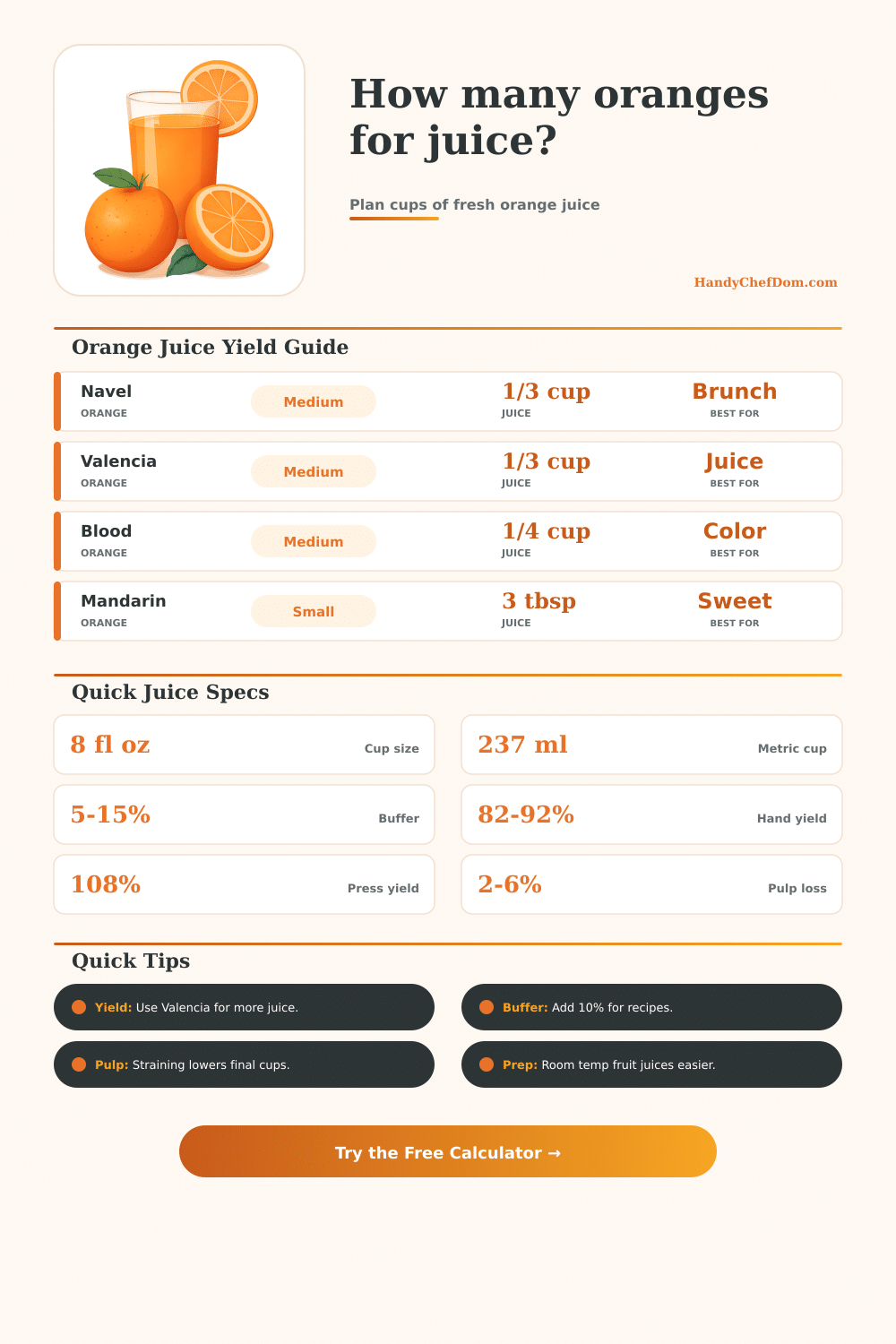
| Valencia orange | Medium | 80 ml / 0.34 cup | Best all-purpose juicing orange |
| Navel orange | Medium | 70 ml / 0.30 cup | Sweet table orange with steady yield |
| Navel orange | Large | 95 ml / 0.40 cup | Fewer fruits needed for a pitcher |
| Cara Cara orange | Medium | 75 ml / 0.32 cup | Pink flesh and gentle acidity |
| Blood orange | Medium | 62 ml / 0.26 cup | Color-rich juice for drinks |
| Mandarin orange | Small | 44 ml / 0.19 cup | Sweet but needs more pieces |
| Small juicing orange | Small | 52 ml / 0.22 cup | Good for small recipe amounts |
| Seville sour orange | Medium | 48 ml / 0.20 cup | Sharp juice for marinades |
| Juicing method | Efficiency | Best use | Planning note |
|---|---|---|---|
| Hand squeezed - casual | 82% | One glass | Add more fruit for tired hands |
| Hand reamer - careful | 92% | Small batches | Good balance of speed and yield |
| Hinged citrus press | 96% | Recipes | Consistent for measured cups |
| Electric citrus juicer | 100% | Pitchers | Baseline for the calculator |
| Countertop press | 108% | Large batches | Extracts more from membranes |
| Blend and strain | 88% | Pulp control | Some liquid stays with solids |
| Pulp or buffer choice | Adjustment | When to use | Effect on count |
|---|---|---|---|
| No pulp - fine strained | 94% | Smooth drinks and sauces | Usually adds one orange |
| Light pulp - quick strain | 98% | Breakfast juice | Slightly lowers yield |
| Medium pulp - normal juice | 100% | Everyday fresh juice | Standard estimate |
| High pulp - roomy pour | 103% | Thicker juice texture | May reduce waste |
| 5% buffer | Small | Measured recipes | Covers cling and foam |
| 15% buffer | Generous | Parties and pitchers | Prevents short pours |
| Target juice | Valencia medium | Navel medium | Blood orange |
|---|---|---|---|
| 1 cup / 237 ml | 3 oranges | 4 oranges | 4 oranges |
| 2 cups / 473 ml | 6 oranges | 7 oranges | 8 oranges |
| 4 cups / 946 ml | 12 oranges | 14 oranges | 16 oranges |
| 6 cups / 1.4 L | 18 oranges | 21 oranges | 23 oranges |
| 8 cups / 1.9 L | 24 oranges | 28 oranges | 31 oranges |
| 12 cups / 2.8 L | 36 oranges | 41 oranges | 46 oranges |
Oranges are running out, and so is guest count! Now what? Store-bought orange juice won’t cut it, and fresh squeezed beats all. How much will I need? Guess wrong, and there’s not enough. Guess right, and there’s to many left over! If only someone could of done that math for me…
Enter: Calculator. Enter your target cups and juicer type. Your desired output is figured automatically based off juicer type. No more convoluted conversion equations; no more “I hope we have enough”, just a clear figure by the time you walk out the door.
How to Calculate Your Orange Juice Needs
The math gets tricky: You can’t count an orange as a full glass of juice. The number of oranges depend on their size, which changes throughout the year and how much squeezing power you use to make juice. Thin-membraned Valencias tend to be more juicy than Navels, for instance, though it’s worth remembering that they was developed not for eating out of hand, but for extracting.
With a standard electric juicer, you’re probably getting the most bang for your buck, which means you’ll get roughly eighty milliliters from a medium-sized fruit. That is slightly less than a third of a cup. Now do the math to figure out requirements for a two-liter pitcher, and you’ll understand where past guesses went wrong.
It consider the same variables that most home cooks don’t consider, until it’s too late. Does pulp matter? Straining juice takes out some of its volume. Do you like your juice smooth (no fibrous bits) or rustic (leave the pulp in)? You’re wasting liquid if it go into colander.
Does juicing efficiency matter? A hinged press gets you more juice than a casual hand squeeze, but an electric juicer just offers maximum efficiency. That difference alone can change your shopping list by two or three fruits. That diffrence will add two or three fruits to your shopping list.
Ripeness is another thing that cuts down on your juice output. Slightly underripe fruit will be firmer and hold onto its moisture more tightly, often leading to wasted effort (and even drier pulp). You can account for this in the calculator by dialing up the buffer a bit if it’s feeling stubbornelly heavy despite your best efforts.
That’s what the buffer input is for. It accounts for small differences between piece of fruit. It also covers foam that rises when you juice and any juice clinging to the strainer. A ten percent buffer should be plenty to avoid shortages while keeping waste within reason.
Bulk-purchased oranges can seem inexpensive, until you factor in spoilage and storage space. Better to marginally over-purchase for each batch then to have twenty pounds of fruit languishing in fridge before it dries up. The page includes a clear chart showing which kinds work best, and why, under typical circumstances.
Denser flesh and thicker-skinned blood oranges produce a lot of flavor and pretty color, but they also has less juice. Mandarins cut easily for kids (and adults) and deliver sweetness in bite-size pieces, but you get far fewer whole fruit for the same amount of space compared to bigger citrus. Managing expectations in the face of natural differences is what planning new juice is all about.
No bag of fruit are alike, and no squeeze session will pull out precisely the same quantity as any other. It’s not about being perfect; it’s about being reliable. Once you understand how amount of pulp you want relates to your equipment and fruit choices, you can stop guessing and prepare yourself to match.
So when you arrive at the kitchen, you’ve got a plan that takes into account the realities of friction, instead of the ideal scenario. And then you can, you know, enjoy the brunch without worrying about empty glass.