Dates Fiber Calculator
Convert Medjool, Deglet Noor, and other dates by count, grams, pitted yield, chopped cups, servings, and baking batch scale.
Date Fiber Results
| Date type | Average edible date | Fiber per date | Fiber per 100 g | Sugar:fiber context |
|---|---|---|---|---|
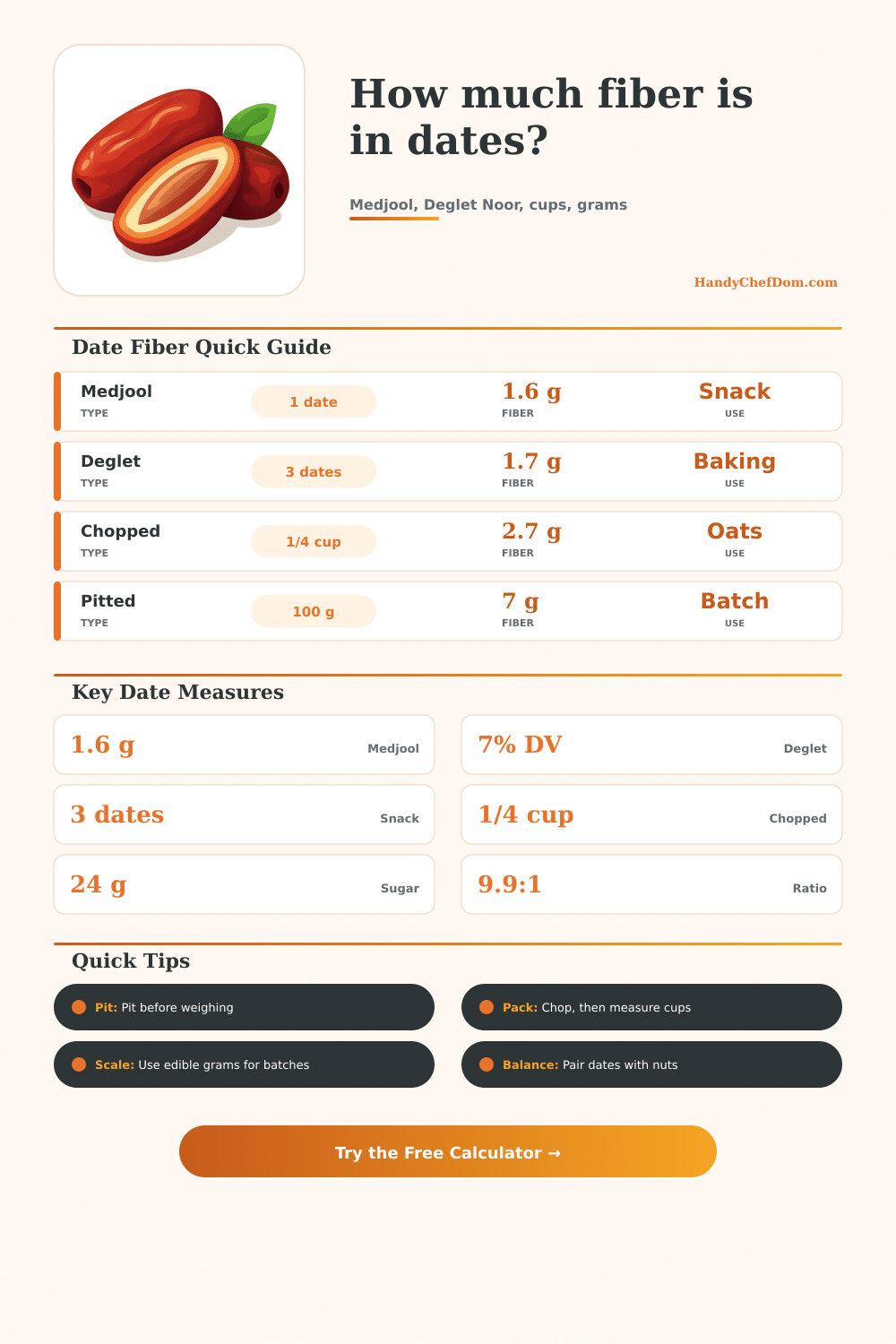
| Medjool | 24 g, soft and large | 1.6 g | 6.7 g | About 9.9:1 |
| Deglet Noor | 7.1 g, smaller and firmer | 0.6 g | 8.0 g | About 7.9:1 |
| Barhi | 16 g, tender and round | 1.0 g | 6.5 g | About 9.7:1 |
| Zahidi | 8 g, dry and chewy | 0.6 g | 7.0 g | About 9.1:1 |
| Khudri | 11 g, dark and chewy | 0.7 g | 6.8 g | About 9.6:1 |
| Sayer | 9 g, semi-dry | 0.7 g | 7.5 g | About 8.5:1 |
| Dayri | 12 g, medium-large | 0.9 g | 7.2 g | About 8.9:1 |
| Halawi | 10 g, soft and sweet | 0.7 g | 6.6 g | About 10.0:1 |
| Date form | Edible yield | Approx cup weight | Best calculator mode | Kitchen note |
|---|---|---|---|---|
| Whole dates with pits | 90% edible | 150 g per cup before pits | Count or weight | Use yield for fiber |
| Whole pitted dates | 100% edible | 165 g per cup | Count or weight | Best for snacks |
| Loose chopped dates | 100% edible | 147 g per cup | Chopped cups | Standard baking cup |
| Packed chopped dates | 100% edible | 170 g per cup | Chopped cups | Higher fiber per cup |
| Date paste | 100% edible | 225 g per cup | Weight or cups | Dense sweetener base |
| Diced baking dates | 100% edible | 160 g per cup | Chopped cups | Even recipe spread |
| Use case | Date amount | Edible grams | Approx fiber | Serving context |
|---|---|---|---|---|
| Light snack | 1 Medjool | 24 g | 1.6 g | About 6% of a 28 g goal |
| Higher fiber snack | 3 Deglet Noor | 21 g | 1.7 g | Small but chewy portion |
| Oatmeal add-in | 1/4 cup chopped | 37 g | 2.5 g | Good breakfast mix-in |
| Date loaf | 1 cup chopped | 147 g | 9.9 g | Divide by slice count |
| Energy ball batch | 12 Medjool | 288 g | 19.3 g | Divide by ball count |
| Party board | 24 Medjool | 576 g | 38.6 g | About 8 small servings |
| Date type | Calories per 100 g | Carbs per 100 g | Fiber per 100 g | Sugars per 100 g |
|---|---|---|---|---|
| Medjool | 277 kcal | 75.0 g | 6.7 g | 66.5 g |
| Deglet Noor | 282 kcal | 75.0 g | 8.0 g | 63.4 g |
| Barhi | 275 kcal | 73.5 g | 6.5 g | 63.0 g |
| Zahidi | 280 kcal | 74.5 g | 7.0 g | 64.0 g |
| Khudri | 278 kcal | 74.0 g | 6.8 g | 65.0 g |
| Sayer | 280 kcal | 75.0 g | 7.5 g | 64.0 g |
Is it a dessert? Is it a vegetable? Who knows! Well…maybe it’s both: Dates fall right on the borderline of food groups. On one hand, they’re delivering concentrated sugar, and on the other hand, there’s some serious fiber here. Whatever you do with them, you has to be careful about how many you eat. That will determine whether or not they fit into your plan.
The math can get pretty tricky, with different conversions depending of what kind of date you buy (Deglet Noor vs Medjool, for example), but we’ve got you covered on that front, thanks to the nifty little calculator up top. Just enter the form and variety of date, and let the machine figure out the rest.
Why You Should Use a Date Calculator
Not all dates is equal; most people assume they all weigh the same, but they don’t. For example, some of those giant Medjools can be over two dozen grams (and I’m talking about one), whereas some of those smaller Deglets will only be seven grams. The impact to your fiber consumption is huge: Three tiny dates barely even make a dent on the sixteen percent of your daily intake that a single larger date provide. If you grab a handful of the bigger ones, you’ve got yourself more fruit than you realized.
The scale takes into account different weights to paint a true picture of what you ate. It’s not only what kind of fruit you’re eating but how the fruit is formed that make a difference. For example, a cup of loosely chopped Medjool dates doesn’t weigh as much as a cup of whole dates; there’s space where air has filled in between the individual date chunks. Depending on what cup size your recipe is calling for, you could be underdelivering on fiber (and other grams) if you don’t press it down, and overdelivering if you have looser cups. To close that gap, the calculator will let you select whether you want to enter measurements based off cup volume, count, or weight, and convert these physical measures into nutrition without needing a scale on-hand.
So what’s the deal? Dates contains both sugar and fiber. The former is used for fast energy, the latter acts as a slow digesting food that will keep you full. That sugar:fiber ratio indicates how fast it will affect your metabolism. If there is too much sugar relative to fiber, it’ll give you an instant kick…but then let you crash. On the other hand, if it has a more balanced ratio, it will sustain you for longer. To stabilize blood sugar even more, combine those dates with some nuts or seeds to add protein and fat. This turns a carb-heavy sweet treat into something that can be included as a functional part of a meal.
The math for snacking doesn’t apply quite as well to making something like date loaf or energy balls. When you batch cook with many different fruits, it is easy to forget how much fiber each one add. The numbers feel hard to picture. A full cup of chopped dates in a loaf will contribute almost ten grams of fiber in total, but that’s spread across multiple slices (or however many servings you end up with). If you slice your loaf into two-slice pieces, for example, and eat two slices, maybe that’s only a half-gram of fiber per serving.
The calculator adjusts up to accommodate the scale of your batches. This lets you get an idea of the overall nutritional content first, and then divvy it based on what size servings you plan to serve yourself. That way, you won’t underestimate density of whatever treat you’ve created at home.
The edible output is somewhat different, though primarily the output is more convenient. If you’re working with whole dates with pits intact, remove approximately ten percent (the inedible pit) before turning fruit into fiber. With pitted dates, all of the weight will be 100 percent usable. This may not seem important until you’re aiming for an exact amount of fiber per meal, as you might be doing when planning meals. That ten percent difference accumulates across multiple days of regular consumption. The tool accepts either whole or pitted input. It will always adjust based on the type chosen so the result shows what you can actualy eat, not what is lost to waste or packaging.
If your dates are seasonal, that will affect when you purchase them (and therefore when you need to pay attention to the numbers). The market may be flooded with medjools during winter months; other types will come around summertime/fall. To keep your fiber game on-point, update your headspace about how much fruit makes a serving: When there’s nothing but fresh dates around, use whatever’s in season, but adjust accordingly! Three pieces for a snack might be needed to match the fiber of one piece from winter. As long as you adjust your expectations, your nutrition tracking stays truthful, no matter the season.
Eating well with dates doesn’t require turning into a nutritionist. It requires only that you respect their power in miniature. Think of a date as something small but mighty, a concentrated form, not an endless pile for snacking. Make your dates count. Pair them with nuts or seeds. Weigh or count, and make friends wisely. Once you get the numbers on this little fruit in your hand, the math is easy, and your next handful will be both smart and sweet.