Artichoke Steaming Time Calculator
Estimate artichoke steaming time from artichoke size, count or weight, prep style, pot crowding, altitude, starting point, and tenderness target.
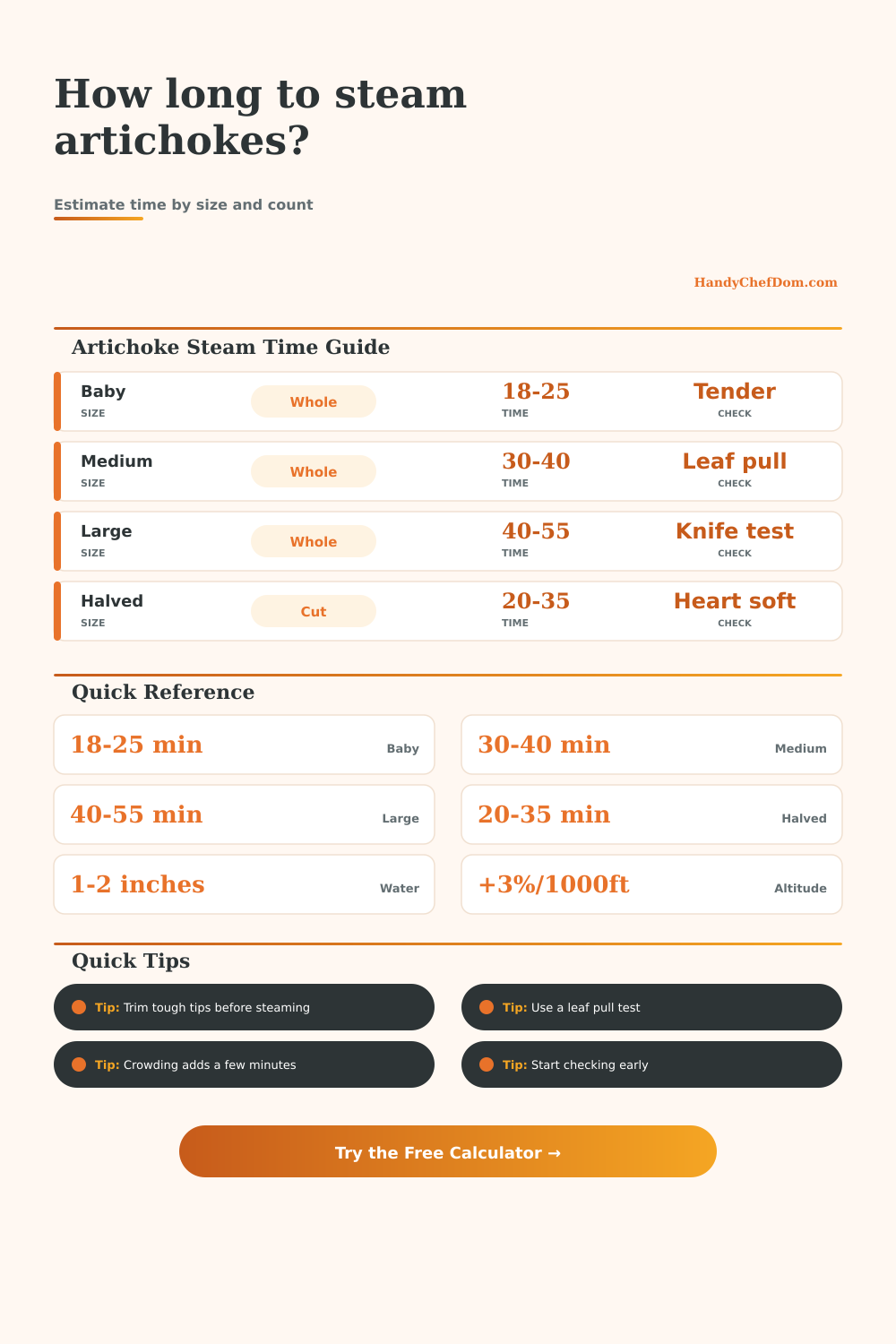
| Artichoke size | Typical diameter | Average raw weight | Whole steam time | Best check cue |
|---|---|---|---|---|
| Baby artichoke | 1.5 to 2.25 in / 4 to 6 cm | 2 oz / 55 g | 18 to 25 minutes | Stem and base feel tender |
| Small globe | 2.25 to 3 in / 6 to 8 cm | 5 oz / 140 g | 24 to 32 minutes | Outer leaf pulls with light resistance |
| Medium globe | 3 to 4 in / 8 to 10 cm | 9 oz / 255 g | 30 to 40 minutes | Knife enters base easily |
| Large globe | 4 to 5 in / 10 to 13 cm | 13 oz / 370 g | 40 to 55 minutes | Heart gives under a knife tip |
| Jumbo globe | 5 to 6 in / 13 to 15 cm | 18 oz / 510 g | 52 to 70 minutes | Center base is fully soft |
| Long-stem artichoke | 3.5 to 4.5 in / 9 to 11 cm | 12 oz / 340 g | 36 to 50 minutes | Stem and heart are both tender |
| Prep style | Time effect | Typical edible yield | When to choose it |
|---|---|---|---|
| Whole, unstuffed | Baseline | 30 to 40 percent | Classic whole artichoke servings |
| Halved, unstuffed | About 22 percent faster | 35 to 45 percent | Faster steam time with exposed heart |
| Quartered, unstuffed | About 34 percent faster | 38 to 48 percent | Small plates or platter pieces |
| Heart and stem pieces | About 48 percent faster | 58 to 72 percent | Trimmed hearts and tender stems |
| Lightly stuffed leaves | Adds about 12 percent | 30 to 40 percent | Loose filling between opened leaves |
| Fully stuffed artichokes | Adds about 24 percent | 30 to 40 percent | Dense centers that slow steam flow |
| Pot type | Good water depth | Timing effect | Use case |
|---|---|---|---|
| Wide pot with basket | 1.0 to 2.0 in / 2.5 to 5 cm | Slightly faster | Even single-layer steaming |
| Tall stockpot basket | 1.25 to 2.25 in / 3 to 6 cm | Near baseline | Medium and large artichokes |
| Small saucepan insert | 1.0 to 1.75 in / 2.5 to 4.5 cm | Slower | One or two small artichokes |
| Multi-tier steamer | 1.5 to 2.5 in / 4 to 6.5 cm | Slower upper tier | Large batches |
| Bamboo steamer stack | 1.25 to 2.0 in / 3 to 5 cm | Gentle and slower | Halves, quarters, and baby artichokes |
| Scenario | Artichokes | Prep | Raw amount | Est. time | First check | Yield |
|---|
Unlike carrots, which will cook in a flash, artichokes is a vegetable that requires patience: Rush them and the heart turns out stringy and chewy. It takes time to make sure that the tightly packed leaves allow the steam to get through without overcooking the outside layer to mush. Steaming’s tricky: You can’t eyeball it. That’s where the calculator comes in (above) to figure out how long yours will take based off what you’re using.
No need to fuss with coefficients and conversions. A larger mass can act like an insulated block that slows down heat transfer as well. Think about it: a tiny baby artichoke will cook fast with its narrow leaves, whereas a big ole globe artichoke is packed in there, providing some insulation. Even though you’d think these two look alike sitting on your counter, they’re different enough that you need to treat them to match their size (i.e., small versus large). Taking all that into consideration, the tool divide the diameter and weight categories by their thermal mass so the baseline time matches. This is why the guesses are so wildly different from size to size: a two-inch artichoke requires far less effort than a four-incher.
How to Cook Artichokes Perfectly
The type of preparation totally affects cooking time: How does it affect how the steam gets inside? Halving an artichoke opens up the heart straight to the heat source; cutting into quarters or stripping out leaves diminishes the barrier between food part and the steam, so the time get cut way back. The calculator takes that into account. You also do this when you choose to stuff it (which insulates the inside and slows down the process a bit) or leave it whole (forcing steam to penetrate all the layers). You are choosing between convenience and time here and this calculation accounts for your decision.
An essential factor in cooking the food evenly is also the pot itself. If you don’t have enough room between the food, some steam will rise up, then condense and fall again. In other words, a tall stockpot produces various temperature zones (the steam dissapears on its way up). On the other hand, using a wide pot gives the steam enough room to circulate evenly throughout.
Most importantly, many folks neglect water depth. If you don’t use enough water, there is no steam for the whole cooking time. If you use too much, it boils over or splashes on the veggies, which cools them off and starts the clock over again. Usually one to two inches is just right.
If you live above sea level (like me), keep in mind that altitude affects cook times. Because the atmospheric pressure changes as we gain or lose altitude, it change the temperature at which water boils. When the pressure decreases, so too does the temperature at which water boils. This means that while the steam rising off your pot of water will be less strong than it would be at beach level, you’ll still require additional time to get to tender perfection. The physics of boiling water doesn’t care about your schedule. Adding minutes for each thousand feet in elevation takes this into account. Small adjustment, but it makes a difference when you’re going for perfection.
It’s easier to know when to begin; it’s trickier to know when to stop. Visual clues can mislead: A loose outer leaf is encouraging, yet not necessarily certain. You have to slip a knife into the heart (the part where the stems connect) and see if it resist. When it does, you’re home free, but before that, it’ll pull off the stem easily, though the heart will remain firm if you do so. Wait too much longer, and it’ll go soggy with diluted flavor. The tool’s first check-time helps create a margin in which you can sample without stopping the operation too soon.
The gentler the method of cooking, the more it will preserve flavor and color. Steaming is gentler than boiling. Boiling also leeches nutrients out of whatever is cooked, leaving them in the cooking liquid; steaming retains the nutrients inside the vegetable. Many factors interact in complex ways as something cooks. Paying attention to this type of cooking pays off. You don’t have to stare at it all the time, but keep an ear on it. Know what’s going on and make adjustments to match when needed. A step-by-step approach to estimating time is helpful, too, since the interplay among equipment, prep, and size isn’t always clear, and then you won’t get it wrong.
Artichokes: Artichokes are built for protecting their hearts, so cooking them is about appreciating the plant’s natural structure. To eat them, you need to put them through some heat, long enough to cook away the armor without destroying the prize inside. When the knife slides into the base where the stem meets the heart with little resistance, it’s worth it… Tender, deserving of the wait. The timer puts all those elements together and makes the calculation simple.