Protein Drinks per Day Calculator
Estimate how many protein drinks fit your daily target after counting food protein, drink macros, training day needs, serving cap, and timing preference.
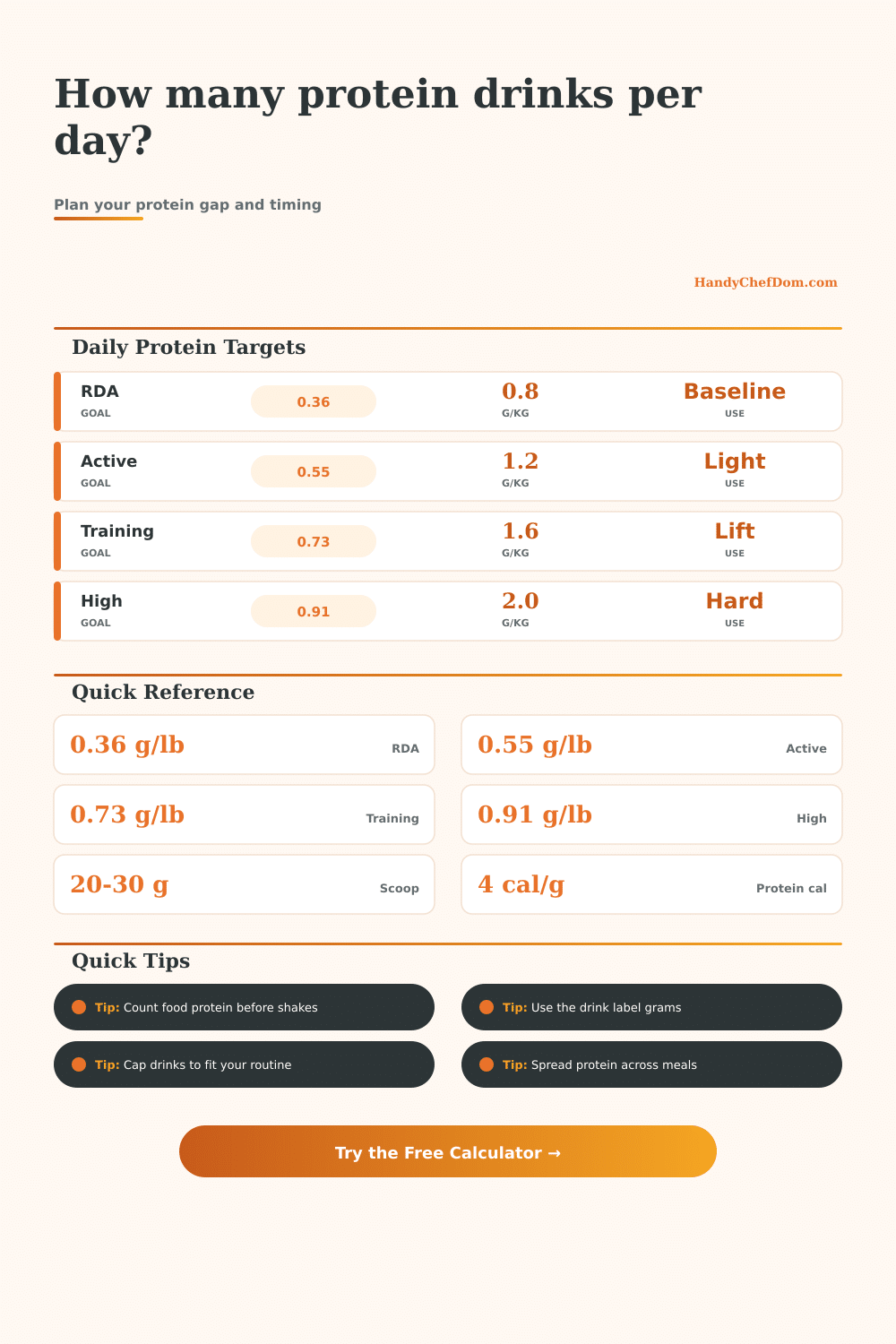
The target field uses grams per pound. For reference, 0.36 g/lb is 0.8 g/kg, 0.55 g/lb is 1.2 g/kg, 0.73 g/lb is 1.6 g/kg, and 0.91 g/lb is 2.0 g/kg.
| Use case | Protein target | g per lb | How to use it |
|---|---|---|---|
| General adult baseline | 0.8 g/kg | 0.36 g/lb | Use as a minimum reference for healthy adults, not a sport-performance target. |
| Active adult | 1.2-1.4 g/kg | 0.55-0.64 g/lb | Useful for regular activity, light training, or a modest food protein bump. |
| Most exercising people | 1.4-2.0 g/kg | 0.64-0.91 g/lb | Often used for resistance training, mixed training, and muscle retention goals. |
| Energy deficit with lifting | 1.6-2.2 g/kg | 0.73-1.00 g/lb | Use cautiously as a planning range when calories are lower and training is structured. |
| Body weight | 0.36 g/lb | 0.73 g/lb | 0.91 g/lb |
|---|---|---|---|
| 120 lb / 54 kg | 43 g/day | 88 g/day | 109 g/day |
| 150 lb / 68 kg | 54 g/day | 110 g/day | 137 g/day |
| 180 lb / 82 kg | 65 g/day | 131 g/day | 164 g/day |
| 220 lb / 100 kg | 79 g/day | 161 g/day | 200 g/day |
| Drink label | Protein | Calories | Protein calorie share |
|---|---|---|---|
| Lean powder mixed with water | 24 g | 120 cal | 80 percent from protein |
| Standard shake | 25 g | 160 cal | 63 percent from protein |
| Higher calorie smoothie | 30 g | 300 cal | 40 percent from protein |
| Ready-to-drink bottle | 20 g | 180 cal | 44 percent from protein |
| Timing preference | Best fit | Example split | Planning note |
|---|---|---|---|
| Morning catch-up | Low-protein breakfast | 1 drink early | Works when lunch and dinner already cover most of the target. |
| Post-workout first | Training days | 1 after training | Useful when a session falls between meals. |
| Split evenly | 2 or more drinks | Half AM, half PM | Keeps drink servings spread out instead of stacked at night. |
| Evening top-up | Late protein gap | 1 after dinner | Best when the calculator shows a small remaining gap. |
Reference basis: adult RDA is 0.8 g/kg, while sports nutrition position statements commonly place many exercising adults around 1.2-2.0 g/kg per day depending on training and goals.
Not sure whether to add another scoop of whey? You’ve got a tub of the stuff. You don’t know if you should use it or just save some money by skipping those extra caleries.
Some people base their protein guesses on advice from online articles. These guy don’t consider what they’ve consumed so far that day. They view supplements as magic solution rather than as simple gap-fillers, as a result, they go over their calorie budget or recover poorly.
How to Use a Protein Calculator
Stop guessing. Use the calculator to see, in detail, how many protein grams you’re still short after accounting for solid food. That’s a specific number of servings, so you can easily plan your dinner around it.
First, determine how much protein you need each day based on your daily activities. It’s based off body weight. Protein build muscle. This process repairs muscle tissue. For maintenance (not building), use standard dietary reference intake. If you exercise, such as running or lifting weights, then your muscles requires more protein. More amino acids.
The calculator factors in your training load (or lack of). So whether you’re doing a heavy training session or resting it’ll adjust to match. Your body has different metabolic needs during each one. On a heavy squat day, don’t give yourself the same amount of recovery resource as a walking day. Know what I mean? That way you won’t overeat protein when your body doesn’t actualy require it.
Then you enter how much food you’ve consumed thus far. People tend to forget yogurt and eggs and chicken in planning. These contribute a lot to your total intake, but you won’t log them unless you also log a shake. You enter the number of grams coming from your meal plan into the calculator and it deducts those from your goal. That gives you an idea of just how big or small the gap is; small enough that you could do without supplementation? Or is it large enough that you’ll need to take extra drinks to fill the hole? It forces you to think about your plate before your supplement cabinet.
The second component of this is timing aspect of these drinks within your day. For some folks, it’s a matter of having a protein right after training to begin recovery process. For others, it’s spreading out your protein equally over the course of the day to keep steady amino acids in your system. By using the timing options available with the tool, you can set up how and when you want to have the product based off your lifestyle. Do you have an action-packed morning? A shake could be a good way to catch up. Are you training at night? Maybe you want to delay the shake until afterward so it doesn’t make you feel bloated going to sleep. Protein distribution is not something there’s a hard-and-fast rule for… Consistency will trump being perfect.
And lastly, think about how many calories it takes to close the deficit. Protein drinks aren’t all amino acids; there’s also carbs, fat and other additives which all add up fast. Use the calculator to see how many calories are in all of the recommended servings combined, so that you know it fits into your energy budget. That matters if you’re trying to stay the same weight or lose fat. If you only look at protein and not calories, you could meet your protein goal but exceed your calorie goal. It helps you make a more intelligent trade-off between preserving muscle vs. Remaining in energy balance.
If you’re eating right, supplements shouldn’t take over. Supplements are supposed to fill in nutritional gaps. Knowing exactly how many servings you need removes the stress from every meal. There’s no more stressing about losing any gains. You won’t have to question whether or not you got enough. Instead, there’s confidence that you’ll have enough. And that confidence lets you focus on what actualy makes a difference, recovering from workouts through quality sleep and making sure you show up for training.