☕ Cold Brew Caffeine Calculator
Estimate caffeine in a cold brew batch from coffee grams, bean type, steep time, grind texture, extraction, dilution, servings, and cup size.
Use this as a planning estimate, not a lab result. Actual caffeine changes with the exact beans, roast, water contact, filtration, and how much concentrate you dilute before serving.
| Bean profile | Estimated caffeine | Cold brew behavior | Best use |
|---|---|---|---|
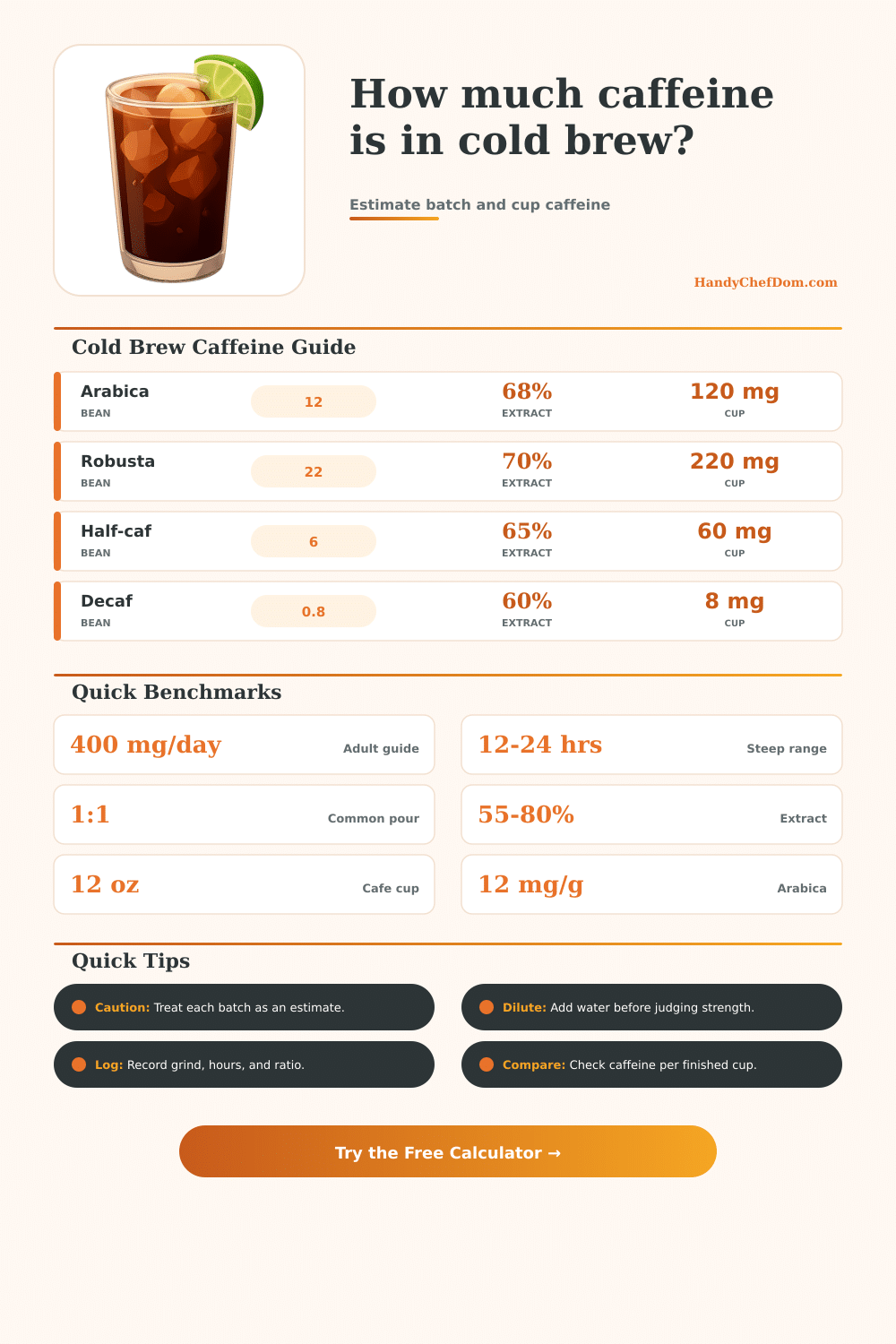
| Washed Arabica | 12 mg per g | Clean, common cafe baseline | Daily pitcher |
| Natural Arabica | 13 mg per g | Slightly higher origin estimate | Fruit-forward batches |
| Dark Arabica | 11.5 mg per g | Bold flavor with similar caffeine | Milk drinks |
| Espresso blend | 15 mg per g | Blend estimate for stronger cups | Short iced pours |
| Arabica Robusta blend | 17 mg per g | Noticeably higher caffeine potential | Morning concentrate |
| Robusta-heavy | 22 mg per g | Highest caffeine profile here | Small servings |
| Half-caf blend | 6 mg per g | Useful for longer sipping windows | Brunch pitchers |
| Decaf beans | 0.8 mg per g | Still has trace caffeine | Evening cold brew |
| Steep time | Extraction effect | Typical result | Calculator note |
|---|---|---|---|
| 8-10 hours | Lower contact | Light concentrate | Use 50-58% |
| 12-14 hours | Moderate contact | Smooth cafe range | Use 58-65% |
| 16-18 hours | Fuller contact | Classic cold brew | Use 65-72% |
| 20-24 hours | High contact | Stronger concentrate | Use 70-80% |
| Over 24 hours | Diminishing gains | May taste heavy | Keep below 85% |
| Grind texture | Modifier | Why it matters | Use with |
|---|---|---|---|
| Extra coarse | 0.88x | Less surface area, cleaner strain | Long steep |
| Coarse cold brew | 0.96x | Balanced extraction and filtration | Daily batches |
| Medium-coarse | 1.00x | Reference setting for the calculator | 16-18 hours |
| Medium grind | 1.08x | More contact, more sediment risk | Short steep |
| Fine grind | 1.15x | High contact, harder to filter | Small tests |
| Dilution setting | Ratio meaning | Caffeine impact | Serving feel |
|---|---|---|---|
| Straight concentrate | 1 brew to 0 water | Highest mg per ounce | Small pour |
| Light splash | 1 brew to 0.25 water | Still very strong | Bold over ice |
| Cafe strong | 1 brew to 0.5 water | Moderate reduction | Milk friendly |
| Classic iced | 1 brew to 1 water | Half concentrate strength | Everyday cup |
| Easy sip | 1 brew to 1.5 water | Gentler per ounce | Long glass |
| Tall glass | 1 brew to 2 water | Lowest per ounce here | Slow sipping |
Cold brew coffee do contain caffeine. Furthermore, the caffeine content in cold brew coffee can be higher than the caffeine content in hot coffee. Beyond the smooth taste of cold brew coffee, the caffeine content can have effects upon an individual in ways that they might not expect.
The amount of caffeine in a glass of cold brew coffee depend upon a variety of factors. An individual can use a calculator to take into account each of these factors, allowing the individual to determine how much caffeine will be present in they coffee. The caffeine content in cold brew coffee starts with the type of coffee bean that are used.
How much caffeine is in cold brew coffee?
Coffee beans that contain less caffeine than others, such as Arabica beans, will contain less caffeine than coffee beans that contain more caffeine, such as Robusta bean. Additionally, coffee blends and roast levels will impact the caffeine content, as will the use of Decaf beans, which still contain a small amount of caffeine. Each calculator allow the individual to select the type of bean that they use for their cold brew coffee.
By selecting the type of bean in the coffee bean calculator, the calculator will perform the math that accounts for the caffeine content that is naturaly contained within those types of coffee beans. Beyond the type of bean, another factor influencing the caffeine content is the extraction of the caffeine from those beans. The length of time that the coffee beans steep in the water will impact the amount of caffeine that is extract from the beans.
Additionally, the grind of the coffee beans will impact the amount of caffeine that is extracted, as will the contact between the water and the coffee beans. If you allow the cold brew coffee to steep for twelve to twenty-four hours, more caffeine will be extracted than if the brew is allowed to steep for only a few hours. Furthermore, the longer that the coffee beans steep in water, the less dramatic changes are made to the caffeine content after the initial sixteen-hour mark.
Finally, the coffee grounds will absorb some of the liquid from the water. The caffeine content calculator account for both these factors. Another mistake that many individual make in relation to the caffeine content of their cold brew coffee is during the step of dilution.
Cold brew concentrate contain a high amount of caffeine. Therefore, most individuals will add water or ice prior to drinking the cold brew coffee. Adding water or ice to cold brew coffee does not change the amount of caffeine in the drink unless the individual change the size of the amount of cold brew coffee pour from the container.
Beyond showing the strength of the cold brew concentrate, the caffeine calculator can also show the caffeine content of a finished cup of cold brew coffee. Finally, the calculator can help the individual to determine whether they would like to make small pours of strong cold brew coffee or large pours of diluted cold brew coffee, which is another benefit of using such a calculator when preparing cold brew coffee for others with differing tolerances to caffeine. Most adults use four hundred milligram of caffeine as a daily reference.
Four hundred milligrams is not a strict limit for caffeine intake. However, four hundred milligrams of caffeine is a useful measurement to determine how many refills of cold brew you can have during the day. A single cup of cold brew contain eighty milligrams of caffeine.
However, a single cup can contain as much as two hundred milligrams of caffeine. The calculator compares the caffeine content of your cup of cold brew to the reference of four hundred milligrams of caffeine. The calculator makes this comparison possible for you quick without requiring you to calculate the caffeine content of your brew in your head.
Using a calculator allow you to notice patterns in the way you make your cold brew. You can use the calculator to monitor your caffeine levels to determine if your grind of coffee beans contain too much caffeine for your brew. You can also use the calculator to compare the dilution of your cold brew to the strength of cold brew poured out of a café.
These comparisons can help you identify the variables that affect the caffeine levels in your cold brew. Some of the mistakes that people make when preparing cold brew include treating the concentrate as the cold brew drink, or assuming that each batch of brew will extract the same amount of caffeine from the coffee grounds. Forgetting that the ice melt into the drink and dilutes the cold brew is another mistake when preparing cold brew.
While the calculator will not measure the variables in your kitchen, the calculator allow you to remove some of these variables so that you can focus on adjusting the others. The caffeine levels in your brew can vary depending on the age of the coffee beans, the temperature of the water in which they steep, and how often you agitate the coffee grounds. While the calculator will not take into account the age of the coffee beans or the temperature of the water, the estimate that it will provide for the caffeine levels in your cold brew will be close enough to the actual caffeine content for your brew.
The calculator will provide a good estimate of the caffeine levels in your brew. However, if you wish to change the caffeine levels in your brew, you should only change one variable with your brewing process at a time. Using a caffeine calculator is helpful for people who prepare cold brew for a group of people or who wish to maintain a level of caffeine intake throughout the day.
Using the calculator, you can determine whether the batch of cold brew should be prepared to be strong and poured into cups as is or poured and diluted to a given preference. By making these preparations before brewing your cold brew, you can ensure that the taste of the brew remains the same. By using the calculator to determine your variables and what your cold brew will contain, you will not be surprised by the amount of caffeine contain in your cold brew.
If you use these steps in the brewing process regularly, they will become automatic. You will look at the type of coffee beans that you are using and the number of individual that you are preparing cold brew for. Then, you can use the calculator to determine the variables of your brew.
Your cold brew process will become simple and your caffeine levels in your cold brew will be predictable.