🐔 Chicken Defrosting Time Calculator
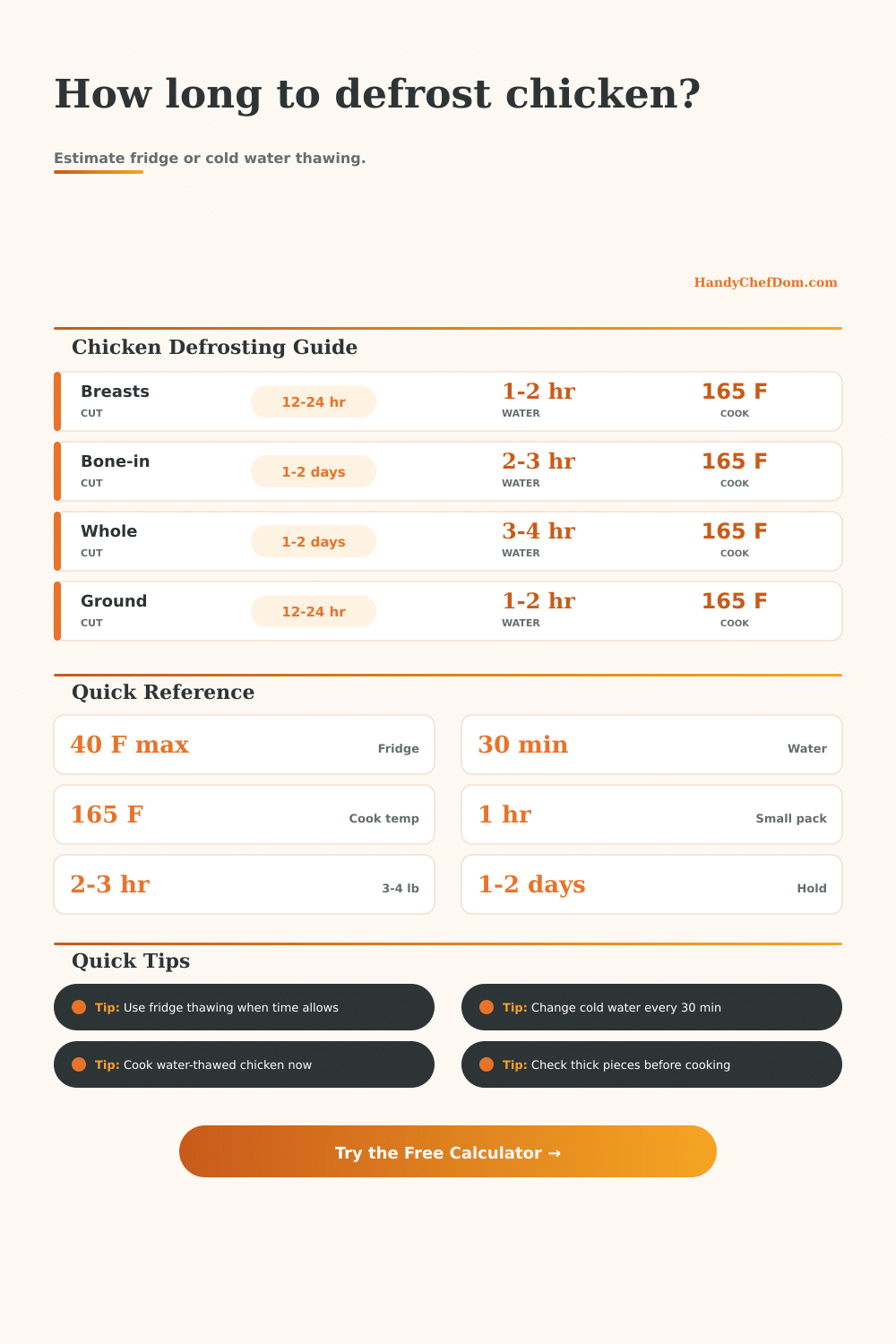
Estimate safe refrigerator or cold water defrosting time by chicken cut, package weight, thawing method, frozen form, fridge temperature, deadline, and safety buffer.
USDA and FoodSafety guidance supports thawing chicken in the refrigerator, in cold water, or in the microwave. This calculator estimates refrigerator and cold water timing; microwave-thawed chicken should be cooked immediately.
| Method | Official Guidance | Calculator Use | After Thawing |
|---|---|---|---|
| Refrigerator | Plan ahead; keep food at 40°F or below | Best for all chicken cuts | Raw poultry can stay 1 to 2 days |
| Cold water | Use leak-proof package and change water every 30 minutes | Fast method with active attention | Cook immediately |
| Microwave | Follow appliance instructions | Not timed here because ovens vary | Cook immediately |
| Counter or hot water | Not a safe thawing method | Excluded from calculator | Do not use |
| Chicken Cut | Fridge Planning Range | Cold Water Range | Readiness Check |
|---|---|---|---|
| Boneless breasts, 1 to 2 lb | Overnight to 24 hours | About 1 to 2 hours | Pieces bend apart |
| Bone-in pieces, 2 to 4 lb | 1 to 2 days | About 2 to 3 hours | No hard icy center |
| Whole chicken, 3 to 6 lb | 1 to 2 days or longer | About 2 to 4 hours | Cavity is thawed |
| Ground chicken, 1 to 2 lb | Overnight to 24 hours | About 1 to 2 hours | Package is flexible |
| Fridge Reading | Calculator Treatment | Timing Impact | Food Safety Signal |
|---|---|---|---|
| 32 to 36°F | Very cold refrigerator | Adds a small cushion | Safe cold range |
| 37 to 40°F | Standard refrigerator thaw | Uses normal timing | USDA target zone |
| Above 40°F | Temperature warning | Timing is not treated as safe | Correct appliance |
| Unknown | Use an appliance thermometer | Calculator uses entered value | Verify before thawing |
| Frozen Form | Why It Matters | Calculator Adjustment | Best Fit |
|---|---|---|---|
| Single pieces | More surface area exposed | Faster estimate | Breasts, tenders, thighs |
| Loose bag | Pieces touch but separate | Standard estimate | Wings or mixed pieces |
| Flat tray | Moderate thickness | Small time cushion | Retail packs |
| Frozen block | Center thaws slowly | Larger time cushion | Bulk freezer bags |
| Dense package | Low surface area | Largest time cushion | Whole or compact packs |
| Scenario | Best Method | Typical Timing | Water Changes | Deadline Fit | Cook Target |
|---|---|---|---|---|---|
| 1 lb separated breasts | Refrigerator or cold water | 12 to 24 hr or 1 hr | 2 changes if cold water | Good same-day backup | 165°F |
| 2.5 lb tray of thighs | Refrigerator | 1 to 2 days | 5 to 6 if cold water | Plan a day ahead | 165°F |
| 4 lb wing bag | Cold water finish | 2 to 3 hours cold water | 5 to 7 changes | Needs attention | 165°F |
| 5 lb whole chicken | Refrigerator | 1 to 2 days or longer | 7 to 9 if cold water | Start early | 165°F |
| Frozen block of pieces | Fridge plus cold finish | Depends on block thickness | Higher than loose pieces | Check center carefully | 165°F |
| Microwave defrosted chicken | Cook immediately | Follow appliance manual | None | Immediate cooking only | 165°F |
It’s dinner time, and you grab A package of chicken from the freezer. When dinnertime rolls around, however, it’s still as hard as a rock. Panic time: Do I leave it out on the counter? Should I put it in hot water? Dangerous shortcuts like counter thawing or using a microwave is risky, dangerous in terms of bacteria, and disastrous in flavor and texture.
How to thaw chicken isn’t just about food safety, it’s also about food quality. Refrigeration works best because not only does it keep meat below danger zone temperatures, but it slowly thaws the cells so there won’t be any watery mess once it defrosts. Planning ahead is necessary, but benefits of quality and safety are worth it.
How to Thaw Chicken Safely
For those times when the clock is ticking, than the next best choice would be cold water thawing, but remember to replace water every half hour. Using the calculator will help figure out what cut and how much need to thaw so you can match it up to timing that works for you.
It’s not just about how heavy the chicken is, but also what shape it’s in. Thawed pieces will thaw faster than one big frozen block because there’s less mass to heat. Heat move from outside-in. By the time the inner core warms up, outer edge is already defrosted.
To get the right answer, the tool wants to know if the food is a single block, a tray (that may be flat) or separate pieces, which require different times. Getting that setting right adjust the estimated time to match these differences. If you set it for a bunch of breasts and then feed it a block of solid meat, some will still be partially frozen by the time you want to cook them, leading to uneven doneness and potentially dangerous temperatures at the core. Knowing that will help you choose the right timing and prepare for outcome.
The math, however, is very much dependent on one thing: the temperature of your fridge. Home refrigerators typically range from 35 to 40 degrees Fahrenheit. The warmer your fridge gets, the faster things will thaw. It also become more likely that bacteria will grow. To fine tune the guesswork, the calculator takes into account your own refrigerator’s temp. You can then adjust it according to what timeframe works best for you.
For instance, if you’re hosting a dinner party with a tight timeline or you want to do some meal prep, this is a handy tool. And by setting a buffer zone, you know that even if your fridge has off days, you won’t have ruined plans. It’s about having information, yes, but also peace of mind.
How many home cooks forget to check their packaging when defrosting food in cold water? To preserve nutrients, keep that chicken airtight so no liquid escapes. Any leakage means cross-contamination with other dishes in the sink. That’s the line between good judgment and guesswork.
The charts make it clear which practices are safe and which ones aren’t. For instance, you should of never counter-thaw because the outside of the meat will reach the danger-zone range but the inside will still be solid. That’s just asking for trouble. Germs can grow until serving time.
Thawing chicken is a science experiment in patience and physics. It is the process of heat moving through fat and protein within certain safety limits. If you rush it, you get not only more health risk but worser-tasting results. Enter your details into this calculator, and you’ll understand how far you can go. Whether that’s two hours in cold water or twentyfour hours in the fridge.
Knowing the limitations will save you from panicking. All you want is some juicy chicken that won’t hurt you, no worries needed about guesswork. Plan ahead, take your time, and leave the math up to your thaw instead of your nerves.