Brazil Nuts per Day Calculator
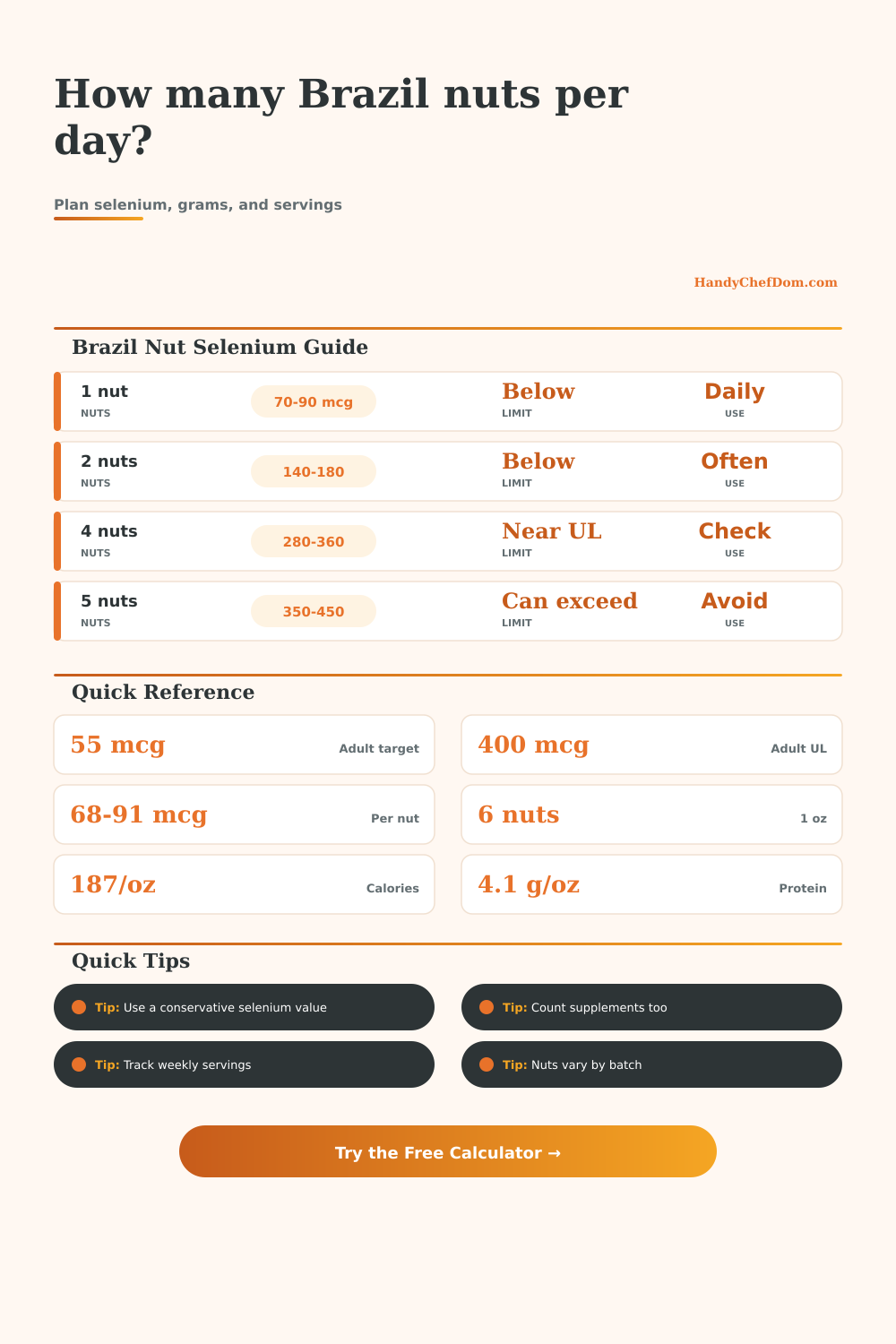
Estimate Brazil nut count, gram weight, selenium per nut, daily target coverage, adult upper-limit distance, weekly servings, calories, fat, and protein.
The upper-limit card uses the NIH adult selenium UL of 400 mcg/day from all sources. Brazil nuts vary by soil and batch, so the selenium per nut field is adjustable.
| Measure | Weight | Calories | Fat | Protein | Carbs |
|---|---|---|---|---|---|
| 1 average nut | 4.7 g | 31 kcal | 3.2 g | 0.7 g | 0.6 g |
| 2 average nuts | 9.4 g | 62 kcal | 6.3 g | 1.3 g | 1.1 g |
| 1 ounce serving | 28.35 g | 187 kcal | 19.0 g | 4.1 g | 3.3 g |
| 100 grams | 100 g | 659 kcal | 67.1 g | 14.3 g | 11.7 g |
| Reference | Selenium | How calculator uses it | Planning note |
|---|---|---|---|
| Adult daily value style target | 55 mcg/day | Default target field | Change if your label or diet plan uses another target. |
| Adult tolerable upper limit | 400 mcg/day | Fixed UL reference | Counts selenium from all foods and supplements. |
| NIH Brazil nut estimate | 68-91 mcg/nut | Default 85 mcg per nut | Use the lower or upper end for cautious scenarios. |
| USDA 1 oz selenium basis | About 544 mcg | Whole-ounce comparison | An ounce can exceed the adult daily UL. |
| Plan | Nuts per day | Serving days | Nuts per week | Weekly selenium |
|---|---|---|---|---|
| Daily single nut | 1 | 7 | 7 nuts | 595 mcg at 85 mcg/nut |
| Every other day | 1 | 3 | 3 nuts | 255 mcg at 85 mcg/nut |
| Two-nut snack | 2 | 3 | 6 nuts | 510 mcg at 85 mcg/nut |
| One ounce snack | 6 | 1 | 6 nuts | About 544 mcg by USDA |
| Count | Approx grams | Approx ounces | Calories | Selenium at 85 mcg/nut |
|---|---|---|---|---|
| 1 nut | 4.7 g | 0.17 oz | 31 kcal | 85 mcg |
| 2 nuts | 9.4 g | 0.33 oz | 62 kcal | 170 mcg |
| 4 nuts | 18.9 g | 0.67 oz | 125 kcal | 340 mcg |
| 6 nuts | 28.35 g | 1.00 oz | 187 kcal | 510 mcg |
| Food | Typical serving | Selenium estimate | Calculator takeaway |
|---|---|---|---|
| Brazil nuts | 1 nut | 68-91 mcg | Small count changes matter. |
| Brazil nuts | 1 oz | About 544 mcg | A full ounce can exceed 400 mcg. |
| Sesame seeds | 1 tbsp | Low single digits | Not comparable to Brazil nuts. |
| Mixed nuts | 1 oz | Varies by blend | Only Brazil-heavy blends need this math. |
Reference basis: NIH Office of Dietary Supplements lists 400 mcg/day as the adult selenium upper limit and notes Brazil nuts can contain about 68-91 mcg per nut. USDA-style dried Brazil nut nutrition is used for calories and macros.
Selenium is packed into Brazil nuts, and it’s packed so densely that getting an excess of it from eating them isn’t merely a matter of consuming extra calories; it becomes health problem. It seems like the more healthy foods you eat, the healthier you should be right? Well, not exactly when it comes to trace minerals. Vitamins work in a wider variety of ways, while trace minerals does not. A handful of nuts may be the difference between adequate selenium and excessive amounts.
Instead of having to guesstimate what quantity you’re consuming (the amount varies greatly from one Brazil nut to another), plugging it into calculator above will take care of the math for you. To begin, it asks whether you want to enter by weight or count each individual nut, since sizes can differ greatness. If you just grabbed a handful without weighing it, you could easly double your intended dose. You’ll get a much more accurate estimate different than using a generic table look-up by adjusting the calculator’s assumption about average nut size to correspond to what’s realy in that jar.
How Many Brazil Nuts Should You Eat?
The catch with selenium: It’s good for your immune system and assists thyroid function, but there’s a cap on how much your body can handles each day. According to the National Institutes of Health, the upper level of safe intake for adults is four hundred micrograms per day. This doesn’t sound so high; until you realize that one medium-sized Brazil nut contain between seventy and ninety micrograms.
If you’re consuming five nuts in one sitting, you could be pushing past the safe daily limit, especially if you also eat egg yolks, tuna, and/or take a multivitamin which are all rich in selenium. This is where most folks go wrong: They think that they must reach their target intake on each and every day, but the tool takes into account the fact that you can accumulate throughout the week. For instance, maybe you consume two nuts three times per week. Even though those days may have been high, your average number of nuts consumed per day will remains far below the upper limit of safety. Looking at it week by week lets you avoid panicking when you snack too much occasionally, but it still won’t let you chronically overdo it.
These nuts are also an interesting source nutrition-wise. They delivers big doses of protein and healthy fats in a relatively small package. An ounce will provide about two-hundred calories and almost twenty grams of fat. This isn’t necessarily bad news because most of the fats is unsaturated, but it still doesn’t make them a low-calorie filler for trail mix. According to the reference data, even a couple of nuts can represent important macros and calories. This is, after all, why portion control feels counterintuitive; you’re getting a ton of nutritional bang for your buck.
The selenium content of your nuts will also depend massively on condition of the soil they were grown in. Nuts grown in selenium-rich soil will have much more selenium than those grown in areas where the soil has been depleted. You can use calculator to adjust amount of selenium in each nut to account for this uncertainty. Want to be conservative? Bump it up if you know your package came from an area known to be high in the mineral. When it comes to trace minerals, it is always better to use less.
Bottom line: Yes, Brazil nuts are incredibly potent, but this is no reason to avoid them altogether, they’re an amazing food packed full of nutrients that most people is lacking in their diet. Simply understand their power, and follow the guide to figure out how many will give benefit without approaching the danger zone. From there on, eat them freely, safe in the knowledge that you know your number. You should of not worry about labels anymore, don’t worry about overshooting, and enjoy your nutty goodness!