🧇 Waffles Calorie Calculator
Estimate calories for Belgian waffles, frozen waffles, protein waffles, mini stacks, Liege-style treats, and topping-heavy brunch plates.
Use prepared waffle calorie averages, cooked-yield estimates, and common topping calories. Enter toppings per waffle so a board, stack, or single snack distributes correctly.
| Waffle Style | Calories | Default Size | Cooked Yield |
|---|---|---|---|
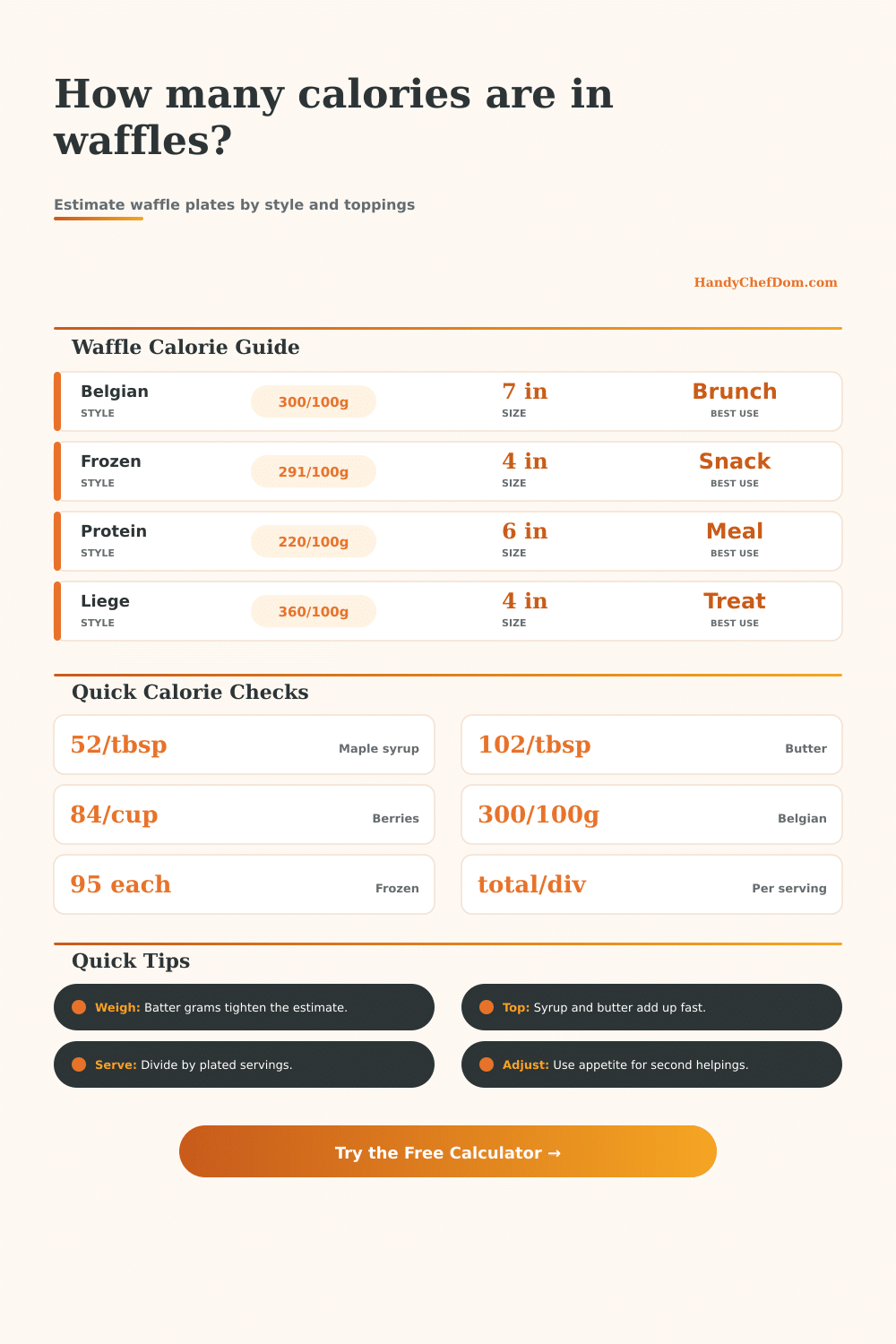
| Belgian waffle | 300 cal/100 g | 7 inch | 88% |
| Buttermilk waffle | 280 cal/100 g | 6 inch | 90% |
| Frozen toaster waffle | 291 cal/100 g | 4 inch | 98% |
| Mini waffle | 295 cal/100 g | 3 inch | 92% |
| Protein waffle | 220 cal/100 g | 6 inch | 91% |
| Whole-grain waffle | 260 cal/100 g | 6 inch | 90% |
| Liege sugar waffle | 360 cal/100 g | 4 inch | 94% |
| Gluten-free waffle | 305 cal/100 g | 6 inch | 89% |
| Almond flour waffle | 330 cal/100 g | 5 inch | 88% |
| Topping | Calculator Unit | Calories | Typical Waffle Use |
|---|---|---|---|
| Maple syrup | 1 tbsp | 52 cal | 1 to 2 tbsp |
| Pancake syrup | 1 tbsp | 55 cal | 1 to 2 tbsp |
| Honey drizzle | 1 tbsp | 64 cal | 0.5 to 1 tbsp |
| Berry compote | 1 tbsp | 35 cal | 1 to 3 tbsp |
| Chocolate sauce | 1 tbsp | 50 cal | 1 tbsp |
| Butter pat | 1 tbsp | 102 cal | 0.5 to 1 tbsp |
| Whipped cream | 1 tbsp | 13 cal | 2 to 4 tbsp |
| Nut butter | 1 tbsp | 95 cal | 0.5 to 1 tbsp |
| Plate Scenario | Waffles | Serving Split | Calorie Watch Point |
|---|---|---|---|
| Weekday mini stack | 3 mini | 1 serving | Small waffles, easy syrup |
| Belgian brunch plate | 2 large | 2 servings | Butter can double toppings |
| Frozen waffle snack | 2 toaster | 1 serving | Check label weight |
| Kids breakfast pair | 2 small | 2 servings | Split toppings evenly |
| Protein waffle meal | 2 medium | 1 serving | Add sides separately |
| Berry waffle board | 8 mixed | 6 servings | Use board overage |
| Serving Goal | Per Person | Best Adjustment | Calculator Check |
|---|---|---|---|
| Light breakfast | 1 small waffle | Subtract 15% | Fruit-heavy plate |
| Standard breakfast | 1 large waffle | No change | Balanced toppings |
| Brunch seconds | 1.5 waffles | Add 10% | Shared table |
| Hungry stack | 2 waffles | Add 20% | Syrup control |
| Buffet board | 1 to 2 waffles | Add 35% | Guest variability |
Pour your batter, then listen for sound of your waffle being done (that’s the good sound). But what happens next?
Waffles are the calorie-magnets of mornings: they trap toppings like no other flat pancake could ever hope too. Butter and syrup and sugar gets stuck in deep pockets, turning a modest breakfast into an energy-dense block of calories. You can eat the right amount of waffle without knowing exactly what you are eating. We usually think about the waffle itself, but in truth that’s really only half the story.
How to Count Your Waffle Calories
Even if you’re starting with a plain, standard frozen toaster waffle, there’s probably somewhere between 90-95 calories in it at this point. But then you slap a pat of butter onto it and a spoonful of maple syrup, and suddenly you’ve added almost two-hundred calories. And that’s not even a side dish… That’s a second-waffle’s worth of fuel.
Use the calculator above to run through those numbers yourself. Break down base ingredients from the heavy stuff. Separate out the liquid sugars from solid fats and from structural carbs themselves. You’ll see exactly where all that weight come into play. Surprise, your toppings may be doing far more heavy lifting than the batter itself.
It all goes back to style. A protein waffle isn’t a Liege sugar waffle. A Liege sugar waffle feature pearl sugar, which turns toasty and crunchy as it caramelize in the iron. That sugar’s also really heavy, sweeter by the gram, pushing your calorie count much higher then with a normal yeast-leavened batter waffle.
Conversely, a lot of protein waffles substitutes out some of the flour for whey or casein. These is lighter, sometimes approaching two hundred calories per hundred grams. Because ingredients themselves have such a different density, there’s a big difference in how much energy you can get into same physical space. Small thing, but when you’re on a quest for a specific daily number, it matters.
Then there’s the other trap: adjusting your appetite. What we think will fill us up isn’t always what does in real life. So when you drizzle too much syrup in the kitchen, or sprinkle on some extra berries because they’re looking good, that’s why it accounts for variation with the tool.
You can choose a standard portion size or get seconds at a brunch. And that makes sense: if you are cooking for oneself versus cooking for a group, it’s a different thing. If you are hosting a breakfast board, then you have to know how heavy the whole spread weighs, and not just an idealized plate. That page has a reference table which explain how different scenarios change the totals. It’s useful, because we all know how wild portions gets around the shared table.
The most honest measurement you have is weight. The volume measurement are misleading. A cup of chopped strawberries occupies space but doesn’t bring many calories with it. A cup of chocolate chips does.
So by weighing your toppings (or even your batter), you make estimate much closer. You guess, and then you err. You weigh, and you get clear. If you’re strictly tracking, go grab yourself a scale. If you’re just curious, the default averages will put you in a solid ballpark. It’s all about going from guessing to knowing either way.
Consider the math: breakfast = balance sheet. Principal = the waffle. Interest = the toppings. A higher principal isn’t so important without interest; similarly, lower-interest topping won’t make up for a high-principal waffle.
Consider the lower calorie base. Drown that sucker in some whipped cream and chocolate sauce and all is lost. On the other hand, add some fresh fruit to an already rich Belgian waffle and lightly dust with powdered sugar; that still keeps things on the right side of reasonable. It’s all about the mix, not parts.
Before sitting down, take a look at that plate. See the butter dish? The syrup bottle? And check your numbers. The math’s here, and it will tell you whether or not that extra drizzle is worth it today. Sometimes it is. Sometimes it isn’t.
But either way, you’re making the decision with your eyes open, which is the only way to eat waffles without regret. It should of been done sooner.