🥪 Sandwich Calorie Calculator
Estimate sandwich calories from bread type and slices, protein ounces, cheese, spreads, vegetables, extras, servings, portion multiplier, and cooking fat.
Nutrition values use common USDA-style estimates and typical deli labels. Use the custom fields when your bread slice, cheese slice, or spread label differs.
| Bread type | Serving used | Calories | Nutrition note |
|---|---|---|---|
| White sandwich bread | 1 slice | 75 cal | About 14 g carbs and 2.5 g protein |
| Whole wheat bread | 1 slice | 80 cal | More fiber, about 4 g protein |
| Sourdough slice | 1 slice | 90 cal | Often larger and higher sodium |
| Rye bread | 1 slice | 83 cal | Moderate calories with about 2 g fiber |
| Multigrain bread | 1 slice | 100 cal | Higher seeds and about 5 g protein |
| Large wrap tortilla | 1 wrap | 150 cal | Use 1 count for one sandwich wrap |
| Bagel half | 1 half | 135 cal | Use 2 halves for a full bagel sandwich |
| Protein filling | Calculator unit | Calories | Protein estimate |
|---|---|---|---|
| Deli turkey breast | 1 oz | 30 cal | 5.5 g protein |
| Deli ham | 1 oz | 45 cal | 5.0 g protein |
| Roast beef | 1 oz | 50 cal | 7.0 g protein |
| Chicken breast | 1 oz | 47 cal | 8.8 g protein |
| Tuna salad | 1 oz | 65 cal | 5.0 g protein |
| Egg salad | 1 oz | 70 cal | 4.0 g protein |
| Cooked bacon | 1 oz | 151 cal | 10.0 g protein |
| Spread or extra | Serving used | Calories | Calculator note |
|---|---|---|---|
| Mayonnaise | 1 tbsp | 94 cal | Main spread default |
| Light mayonnaise | 1 tbsp | 35 cal | Lower calorie swap |
| Yellow mustard | 1 tbsp | 10 cal | Low calorie flavor |
| Hummus | 1 tbsp | 35 cal | Adds fiber and plant protein |
| Mashed avocado | 1 tbsp | 25 cal | Fat and fiber add-on |
| Peanut butter | 1 tbsp | 95 cal | Dense sweet sandwich spread |
| Cooking oil | 1 tbsp | 119 cal | Three teaspoons per tablespoon |
| Named sandwich | Typical build | Common range | Biggest calorie driver |
|---|---|---|---|
| Turkey club | Wheat, turkey, bacon, mayo | 500 to 750 cal | Bacon and mayonnaise |
| Ham and Swiss | Rye, ham, Swiss, mustard | 380 to 560 cal | Cheese and ham amount |
| Tuna melt | Sourdough, tuna salad, cheddar | 520 to 780 cal | Tuna salad and griddle fat |
| Grilled cheese | White bread, cheddar, butter | 380 to 650 cal | Cheese slices and butter |
| Veggie hummus wrap | Wrap, hummus, vegetables | 300 to 500 cal | Wrap size and hummus |
| Peanut butter jelly | White bread, peanut butter, jelly | 350 to 650 cal | Peanut butter amount |
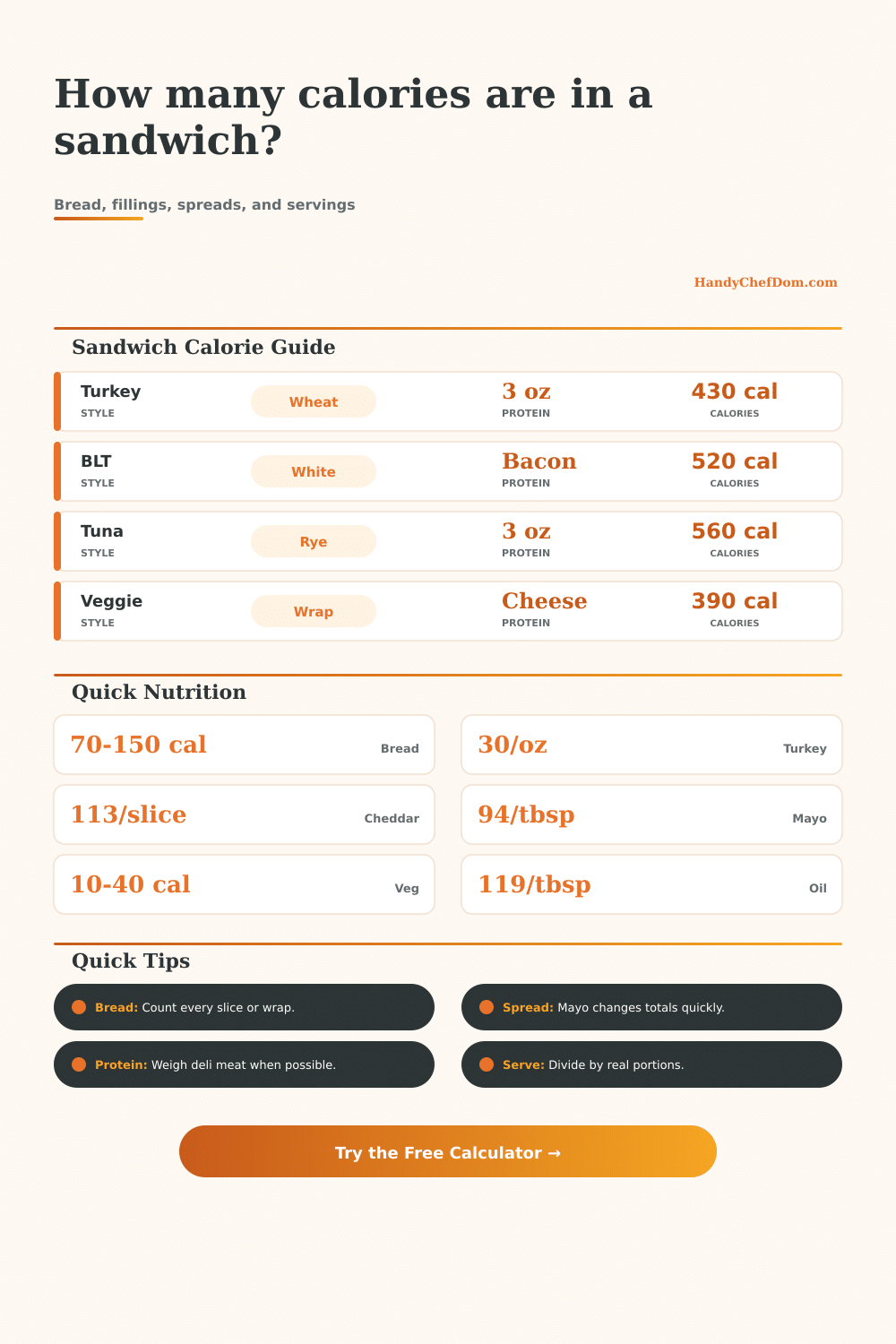
It’s easy to make a sandwich until you start counting calories. Convinced that you’re having a low-calorie lunch, you reach for bread and pick up a few leaves of lettuce and some turkey. Turns out, that sandwich is more like seven-hundred calories if it’s a club, or four-hundred or less if you go for lean turkey on wheat.
What makes the difference? Typically three thing: the cooking fat, the spread, and bread base. And most folks nail the protein but skimp on condiments.
How to Count Sandwich Calories
After plugging in your own ingredients, the calculator up top will do the numbers for you. Everything from the mayo layer to each piece of sourdough slice gets broken down. All it really needs are simple inputs such as weight of the proteins used, the kind of bread, etc., but where it comes into its own is with those other variables.
Where people drop the ball on their calorie count is with spreads. Mayonnaise alone add a whopping ninety-four calories per tablespoon, more than what most turkey sandwiches has in some instances. That’s where they go off track: they concentrate on meat while overlooking the sauce. Letting users choose between mustard and light mayo as spread options force them to consider that trade-off.
If you swap the regular mayo for mustard, you’re saving yourself eighty calories per sandwich, all without sacrificing much flavor.
The bread is base for the energy source. A big piece of white bread has roughly seventy-five calories per slice, whereas a big wrap or flour tortilla might be up at 150. This is all laid out nicely in the reference table on the page, and it explains why sometimes wraps with veggies has more calories than sandwiches made from rye. It is also important to consider how bread affects satiety (that feeling of being full). Multigrain and whole wheat choices will includes more fiber that will slow down digestion, leaving you fuller longer.
For those who track their macros, this is a distinction. Depending on what kind of bread you choose the calculator will adjust its numbers of carbs and proteins accordingly so you get a better idea of your nutritional intake.
Cooking fat is the other silent calorie enhancer. Sure, some foods might comes cooked with no fat added, but who hasn’t had a grilled cheese sandwich? You need some kind of fat to give it its golden crust. A single tsp of oil will add thirty-four calories. One tbsp? It is one hundred nineteen. If you’re eyeballing how much fat goes into your food, that’s a pretty hefty margin of error.
The tool lets you input exactly how much cooking fat you used and what type it was. It also takes into account extras like an egg, avocado, or bacon, which all taste delicious but add significant amounts of protein and fats. Common-sense presets like Tuna Melt or BLT offers a place to start, but using more specific inputs will produce the most precis results.
The last variable is portion size. Home-made sandwiches are typically smaller than a deli version (a typical sub shop sandwich is twice as big). To account for that variability, the calculator allows for a portion multiplier. If you’re eating a double stacker for a post-workout snack, make it a double stack. Want a half portion for your kids? That is no problem.
It accounts for your reality so you don’t fall into the trap of thinking that ‘one’ serving = ‘one’ regular sandwich. Whether it’s making meal prep for the week or choosing an order for lunch, knowing these variables help you to make better decisions.
You don’t have to give up your favorite sandwich, just be aware of what it’s made of and how much is in it. The math shows the tradeoff and enables you to adjust the components to suit your needs. Food is fuel, food is comfort. It’s all about finding balance. Make those tweaks to the behind-the-scenes stuff so you get to eat what you like.
Watch that cooking fat, use less mayo, pick out the whole grain bread. Small changes makes a big difference.
With the calculator, there’s no more guessing; you get an exact number instead of a vague estimate. In the end, you’ve got more control over what you’re putting in your body without losing any of the enjoyment. Next time you assemble a sandwich, think about the layers before taking a bite. Awareness is the first step to smarter eating.