🍓 Strawberry Calorie Calculator
Estimate calories, carbs, fiber, vitamin C, edible grams, whole cups, sliced cups, and snack portions after strawberry hull loss.
Choose how you measured the berries, then set cup style, berry size, hull loss, and portion goal. Nutrition uses raw strawberry values per 100 grams.
| Strawberry amount | Edible grams | Calories | Carbs | Fiber | Vitamin C |
|---|---|---|---|---|---|
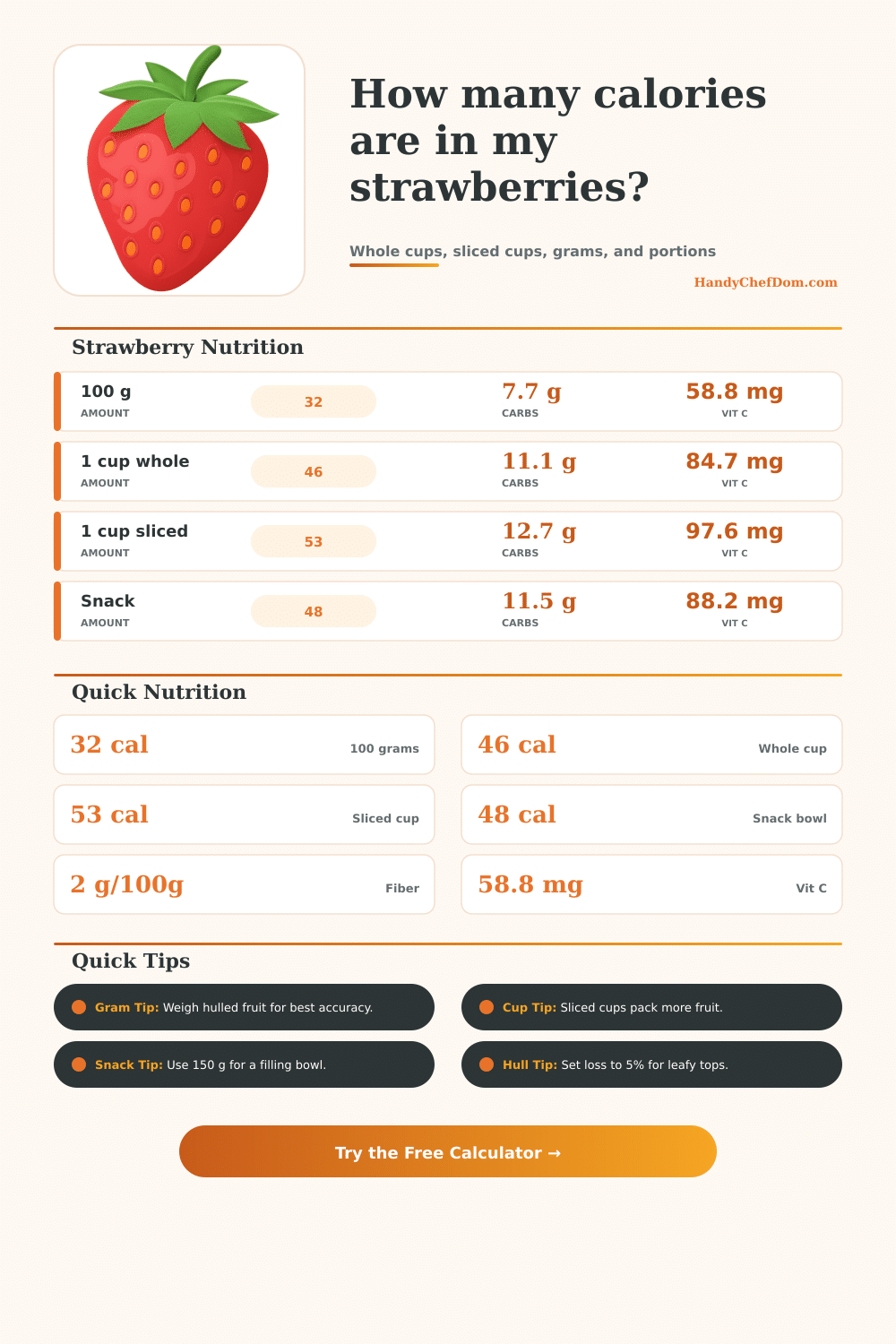
| 100 g fresh strawberries | 100 g | 32 cal | 7.7 g | 2.0 g | 58.8 mg |
| 1 cup whole strawberries | 144 g | 46 cal | 11.1 g | 2.9 g | 84.7 mg |
| 1 cup halved strawberries | 152 g | 49 cal | 11.7 g | 3.0 g | 89.4 mg |
| 1 cup sliced strawberries | 166 g | 53 cal | 12.7 g | 3.3 g | 97.6 mg |
| 1 cup mashed strawberries | 232 g | 74 cal | 17.8 g | 4.6 g | 136.4 mg |
| 1 oz fresh strawberries | 28.3 g | 9 cal | 2.2 g | 0.6 g | 16.7 mg |
| Portion style | Serving grams | Calories | Carbs | Fiber | Vitamin C |
|---|---|---|---|---|---|
| Yogurt topping | 50 g | 16 cal | 3.8 g | 1.0 g | 29.4 mg |
| Kids side | 75 g | 24 cal | 5.8 g | 1.5 g | 44.1 mg |
| Dessert topping | 100 g | 32 cal | 7.7 g | 2.0 g | 58.8 mg |
| Snack bowl | 150 g | 48 cal | 11.5 g | 3.0 g | 88.2 mg |
| Smoothie fruit | 175 g | 56 cal | 13.4 g | 3.5 g | 102.9 mg |
| Meal prep cup | 200 g | 64 cal | 15.4 g | 4.0 g | 117.6 mg |
| Measured form | Grams per cup | Calories per cup | Best use | Pack note |
|---|---|---|---|---|
| Whole strawberries | 144 g | 46 cal | Snack bowls | More air space |
| Halved strawberries | 152 g | 49 cal | Dessert plates | Light pack |
| Sliced strawberries | 166 g | 53 cal | Shortcake topping | Dense pack |
| Diced strawberries | 160 g | 51 cal | Parfait layers | Even pack |
| Mashed strawberries | 232 g | 74 cal | Sauce base | Very dense |
| Frozen unsweetened | 150 g | 48 cal | Smoothies | Loose pack |
| Berry size | Approx grams | Berries per 100 g | Berries per whole cup | Calories each |
|---|---|---|---|---|
| Small strawberry | 7 g | 14 berries | 21 berries | 2 cal |
| Medium strawberry | 12 g | 8 berries | 12 berries | 4 cal |
| Large strawberry | 18 g | 6 berries | 8 berries | 6 cal |
| Extra large strawberry | 25 g | 4 berries | 6 berries | 8 cal |
| Mixed pint average | 14 g | 7 berries | 10 berries | 4 cal |
| Trimmed berry average | 11 g | 9 berries | 13 berries | 4 cal |
If you eat a lot of strawberries, odds are good that you think about them by the handful. There is no need to weigh them on a scale. Just grab a handful here and there. Toss some into your yogurt each morning or throw a messy pile onto your cutting board as you chop them up. Nice and easy!
This is perfect if all you’re doing is enjoying the fruits (ha!) of your labor, but it is a recipe for disaster if you’re monitoring your diet in precise terms like calories, macros, and micronutrient levels such as vitamins.
How to Measure Strawberries Correctly
The Weight of a Cup Changes With How You Prepare Your Berries
Whole strawberries don’t have the same weight density as sliced strawberries. In fact, they’re lighter because the slice-and-stack method packs the berries closer together. This means a cup of sliced strawberries fits more actual strawberry flesh into a space than a cup of whole berries which leave more air in between them. So, now that you know what size you’re thinking about when you measure your fruit, the calculator does the rest of the math for you.
A cup is a cup (or so most people think), no matter how it’s prepared. But this one lets you tell it if you’re using whole, halved, sliced, diced, or maybe even mashing up some berries for a smoothie. Because the surface area of your fruit changes its weight to create a difference, depending on the state (the bigger and flatter the surface area, the less it weighs per cup; there’s more air displaced). Slices fill into the spaces where whole berries had left gaps. Mashing the pulp removes all the air. This calculator factors in the starting weight of each version so your calories represents the actual mass of edible food that ends up in your mouth instead of the space in your measuring cup.
Hull loss is another variable that messes up regular nutrition labels. Commercial data often shows values per hundred grams of raw, unprocessed fruit. But when you take out the core and cut off the green leaves, there’s less stuff in your hand. If you began with a hulled-out bunch, you’re not actualy consuming one hundred grams of raw product anymore. Enter a percentage for hull and trim loss into the tool, which will account for average waste incurred when caps are removed. Five percent seems reasonable. Set it here if you’re planning on consuming hull-less varieties.
Your final nutritional count will match the food that ends up on your plate, not the produce you left behind at the store. This is a tiny adjustment that can prevent overestimation (if you’re strictly counting calories) or underestimation (if you need strawberries for certain nutrient targets, such as vitamin C).
The other thing this does is convert numbers to volume (of course). By selecting the correct berry size, it can calculate the number from the volume. So if you have a bag of smallish berries and the recipe requires 6 large ones, you’ll know how much more fruit will get you up to those 6. The estimate works by assuming all berries are small, medium, large, or extra-large. While not perfect, it accounts for the gap between an estimated guess and the actual weight.
For example, if you’re making something where you want to portion berries out equally in containers, like meal prep, you don’t really have to weigh them one at a time. Just input how many berries you want in there, select the size category, and it will figure out the rest for you.
One of the outputs I’m keen to see is how much Vitamin C it provides. That’s one of the vitamins in strawberries where more is better (though less isn’t bad either). How many do you get in a small handful? Or how many do you get in 1 cup? You can compare what you pick to the daily value recommendations for kids, adults, and those with higher needs. For example, if you’re trying to hit high levels, it will tell you what percent of your goal is covered by that serving size. Is that sufficient? Do you want to add something else too? Then you know! And there’s a table on the page showing all of that quickly so you don’t have to run the analysis each time you want to check, just look up the number from the table:
Berries (strawberries, for example) can be used in various ways, such as being a frozen ingredient in a smoothie. That’s not going to have the same caloric impact as fresh strawberries cut into slices! They lose water and their weight profile changes when they freeze. The calculator accounts for nuances like frozen berries having a different weight profile than fresh fruit.
To help with those details, the calculator lets you enter your measurements in ounces or grams. You can also use pre-set portion sizes, such as the amount needed for a party tray or for a kid’s lunchbox. No need to remember if whole berries is denser than mashed berries. The calculator takes care of all that for you. All you have to know is how you’re consuming it.
But all that said, how you track food is ultimately about precision: making sure you’re measuring what you eat in a way that matches the nutrition info. Use grams if you weighed your hulled fruit. Choose the right kind of cup if you measured by volume. This calculator connects both worlds so that it’s always clear whether you’ve got an accurate picture of what you ate.
It makes a mysterious handful solidify into a real number you can believe in. You know just what’s going into your body, without having to own a lab-grade scale or know your way around a degree in food science. Choose your format, account for any stems you trimmed off, and let the tool spell out what those red berries will do for you.