🍲 Roast Pressure Cooker Time Calculator
Estimate pressure cook minutes, natural release, total pot time, liquid, and servings for chuck, pork shoulder, lamb shoulder, and beef round roasts.
Enter the roast shape and cooking target. The calculator adjusts pressure time for thickness, frozen start, pressure level, release minutes, chunk size, and altitude.
| Roast Cut | Slice Time | Fork Time | Shred Time |
|---|---|---|---|
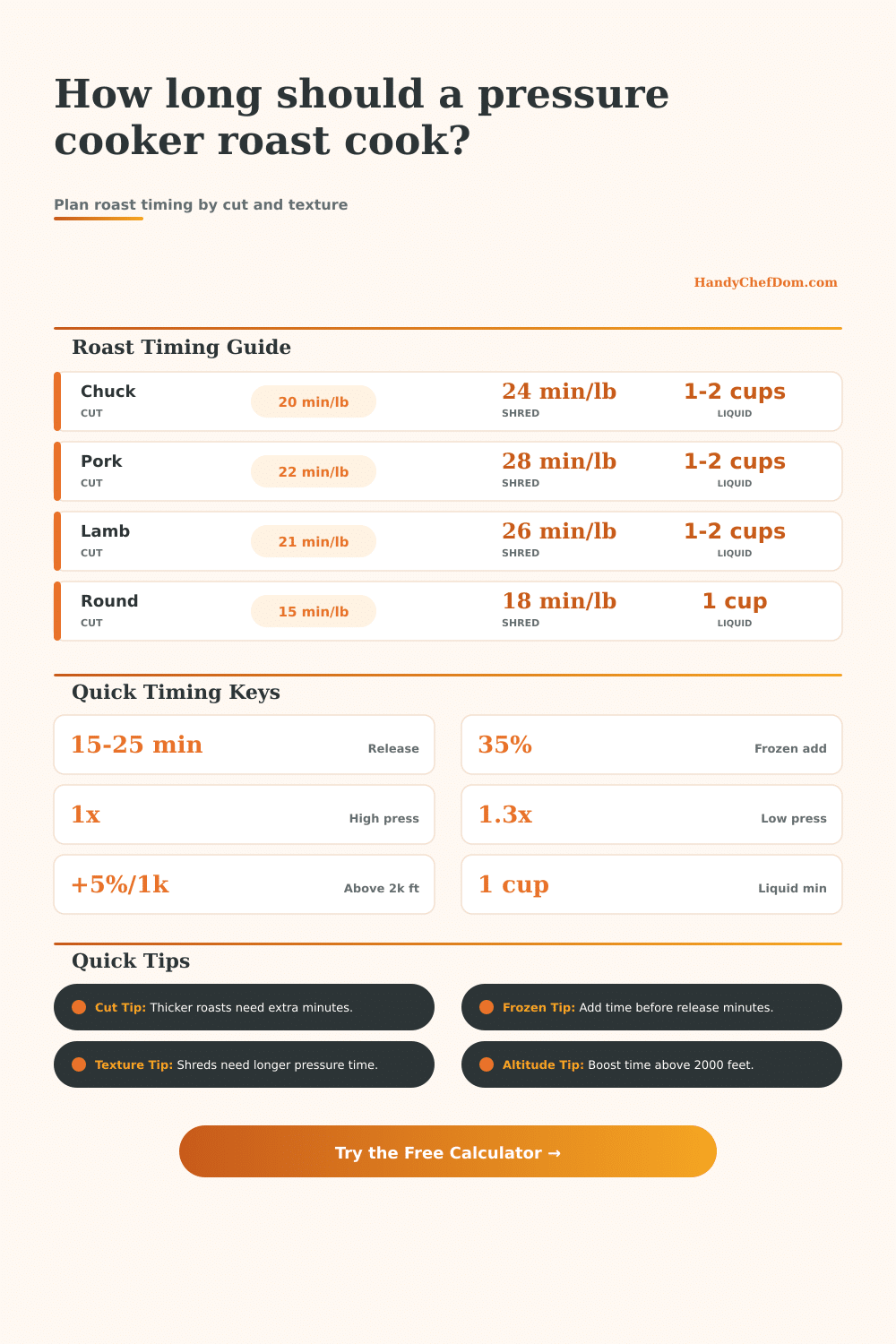
| Beef chuck roast | 20 min/lb | 22 min/lb | 24 min/lb |
| Pork shoulder roast | 22 min/lb | 25 min/lb | 28 min/lb |
| Lamb shoulder roast | 21 min/lb | 24 min/lb | 26 min/lb |
| Beef round roast | 15 min/lb | 17 min/lb | 18 min/lb |
| Start State | Time Factor | Pressurize Add | Best Use |
|---|---|---|---|
| Fresh or thawed | 1.00x | 12 to 18 min | Most predictable roast timing |
| Partially frozen center | 1.18x | 16 to 22 min | Cold core or icy edges |
| Fully frozen roast | 1.35x | 20 to 28 min | No-thaw pressure plan |
| Frozen thick roast | 1.45x | 24 to 32 min | Use when over 3.5 inches thick |
| Chunk Size | Timing Factor | Sear Add | Texture Result |
|---|---|---|---|
| Whole roast | 1.12x | 8 min | Clean slices, classic platter |
| Large 2 to 3 inch chunks | 1.00x | 7 min | Chunky fork-tender servings |
| Medium 1.5 inch chunks | 0.90x | 6 min | Faster tender pieces |
| Small stew-style chunks | 0.78x | 5 min | Fast shreds or stew portions |
| Altitude | Adjustment | Example Add | Planning Note |
|---|---|---|---|
| 0 to 2000 ft | 0% | 0 min | Use base timing |
| 3000 ft | 5% | 3 min on 60 | Small boost for steam pressure |
| 5000 ft | 15% | 9 min on 60 | Noticeable timing increase |
| 7000 ft | 25% | 15 min on 60 | Build in extra pot time |
But what if you purchase a 3lb chuck roast and don’t know where to start? How many minutes do I puts this thing on high for? Too many times we guess and end up with overdone or underdone meals.
Once you input the weight of your cut, the thickness measurement, and your texture goal, calculator figures out the rest. No need to memorize a chart for each situation; just input some variables and voila, dinner plans is set. The vague worry turns into a definite meal.
How to Use the Calculator
Texture are the biggest variable. Not only do you need to know weight but also what texture you desire. If it’s for shredding, then your cooking time will be different than if it’s for slicing. Sometimes it can be as little as a couple minutes a pound more or less which makes all the difference in whether it’s a fork-tender roast or sliceable roast. But those minutes alters the structure of the meat.
Do you want a shredded piece of meat (like pulled pork) that you cook until fibers give up entirely? Or do you want a slice for a sandwich you’ll stop cooking before all collagen has melted away? A lot of folks mess this up. They take a roast they intended for slicing and cook it until it shreds, then wonder why their meat falls apart when sliced on the plate.
The thicker you cut something the longer it takes to cook even if it’s not as heavy. Even though two roasts may be equal weight, one is a long skinny thing while the other is a fat meaty chunk. But it will take the fatter one longer for its center to hit desired temperature, because it’s farther away from the heat. You’re asking how thick it gets. That’s a dimension most generic recipes don’t account for. Small input. There is a big difference between being perfectly cooked and having an overcooked exterior while the inside are still raw.
The altitude of your home also has an impact on how well something roasts. Above two thousand feet, water reaches boiling point at a lower temperature. That means that the steam in your pot isn’t as hot as it would of be down at sea level. You need to add some extra time to make up for the loss of heat being transferred. Thankfullly, the calculator already figures this out for you. Knowing why helps though, the air is thinner so there’s not as much pressure, which makes it take longer to tenderize meat.
Freezing roasts is convenient, but they tend to result in an unevenly-cooked final dish. Sure, you could cook them while frozen (albeit for longer), but thawing takes time. However, because there’s a frozen center when you start, you’ll have to factor in some extra energy required to bring that frozen core up to cooking temperature. Also, you must use slightly more water so the pot can come up to pressure effectively. All that water has to melt before it can help with any cooking. It’s not just a question of time, it’s a question of physics.
Time spent releasing pressure is not wasted time. It’s critical with larger roasts. Natural release allows the meat to continue cooking very gently on its own heat. There is time for juices to move back into the fibers of the meat. Meat that are released too quickly will seize up and dry out. Separating the release time from the active cook time is one of the tools you use to help plan your evening more effectively. As the pot depressurizes, you might be able to throw together a side dish. What was dead time becomes part of the productive flow in the kitchen.
There’s very little liquid needed, generally just one to two cups. Enough to provide some steam, but too much will turn the safety valve on and shut off the cooking. And it can also wash out the taste of everything else inside. How much? That depends on how big your roast is; the calculator will tell you an estimate. Always go for as little as possible to get pressure. You want to steam the meat, not boil it in broth.
It’s not so much a matter of sticking to some kind of strict timetable as it is knowing what conditions are like in your pressure cooker and how they work together: altitude, texture, and thickness. Knowing that takes you away from guessing. It means you cook with intention. Next time a roast comes out of the freezer, you won’t have to ask yourself, how long does it need to cook? You’ll know. And because you know, you’ll feel confident. Because you’re confident, a stressful meal becomes a reliable habit.