Pork Chop Sodium Calculator
Estimate sodium for boneless, bone-in, plain, brined, marinated, enhanced, or smoked pork chops using chop count, raw weight, added salt, cooked yield, servings, daily limit, and dinner scaling.
1Pork Chop Sodium Presets
2Chop Count, Weight, Prep, Salt, Yield, and Serving Inputs
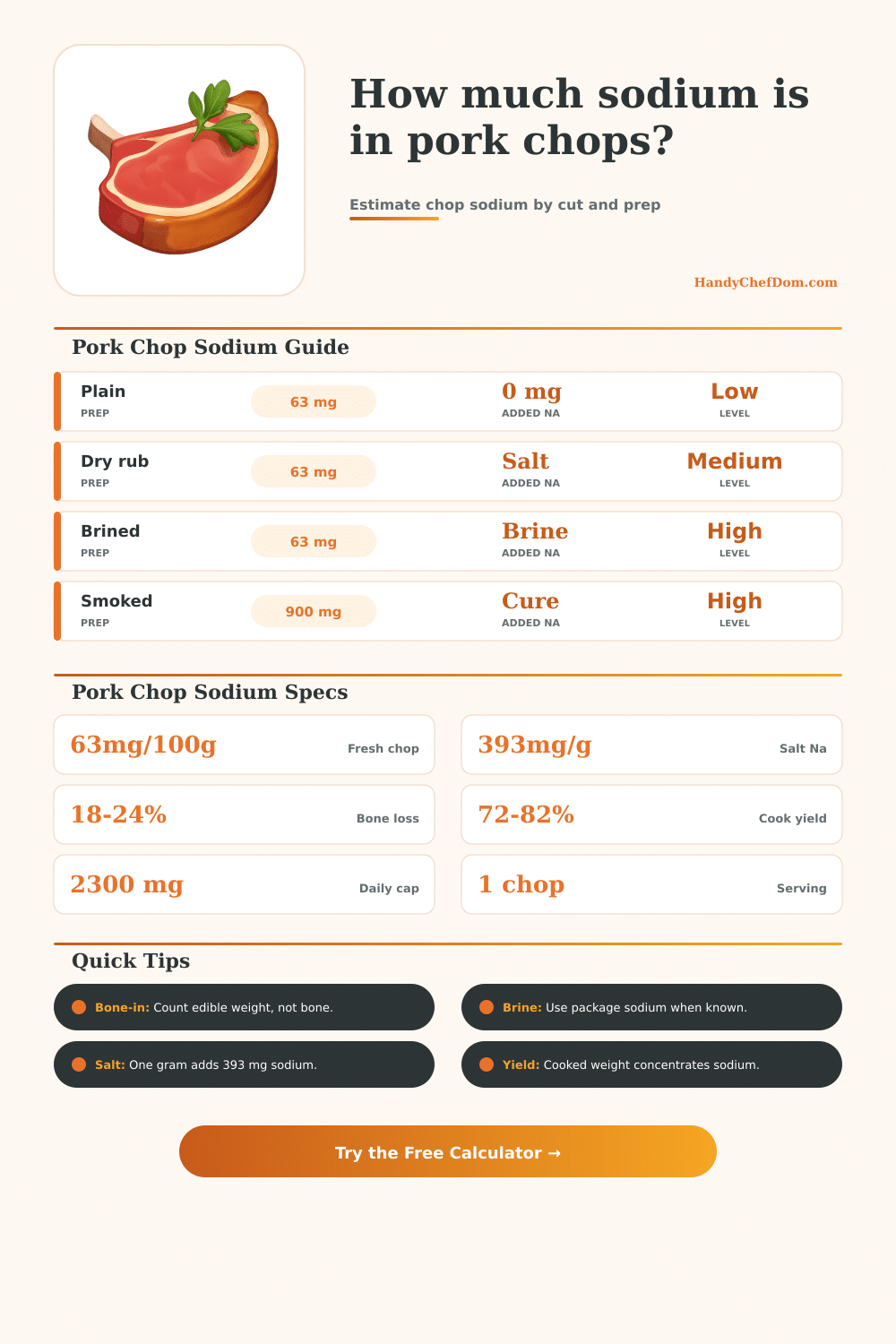
Fresh pork is naturally modest in sodium, but brines, enhancement solution, marinades, smoked chops, and measured salt can change the total quickly. Use the package sodium field when a label gives mg per serving or per 100 g.
Pork chop sodium result
Choose chop details, then calculate.
3Live Pork Chop Sodium Snapshot
4Pork Chop Cut, Prep, and Sodium Grid
| Cut or chop style | Bone or trim factor | Natural sodium estimate | Default cooked yield |
|---|---|---|---|
| Boneless center-cut loin chop | 100% edible raw weight | About 62 mg per 100 g | 78% cooked edible yield |
| Bone-in center-cut loin chop | 82% edible after bone | About 63 mg per 100 g edible | 80% cooked edible yield |
| Bone-in rib chop | 78% edible after rib bone | About 64 mg per 100 g edible | 79% cooked edible yield |
| Sirloin chop | 88% edible after trim | About 70 mg per 100 g edible | 76% cooked edible yield |
| Thin-cut breakfast chop | 96% edible raw weight | About 65 mg per 100 g edible | 82% cooked edible yield |
| Thick-cut loin chop | 100% edible raw weight | About 62 mg per 100 g edible | 76% cooked edible yield |
| Country-style pork chop | 90% edible after trim | About 72 mg per 100 g edible | 74% cooked edible yield |
| Smoked pork chop | 92% edible after trim | About 900 mg per 100 g edible | 84% cooked edible yield |
| Preparation | Added sodium assumption | Added salt retention | Best calculator entry |
|---|---|---|---|
| Plain fresh pork | No extra prep sodium | 100% of measured salt | Use added salt only if seasoning the batch |
| Salted dry rub | About 60 mg per 100 g from seasoning contact | 92% retained | Enter total salt grams or teaspoons |
| Light home brine | About 220 mg per 100 g retained brine sodium | 68% retained | Use cooked yield to reflect water loss |
| Strong home brine | About 420 mg per 100 g retained brine sodium | 74% retained | Enter any extra surface salt separately |
| Soy or salty marinade | About 360 mg per 100 g retained marinade sodium | 80% retained | Use package label if sodium is listed |
| Store enhanced or injected | About 250 mg per 100 g solution sodium | 88% retained | Package sodium per serving is preferred |
| Smoked or cured chop | Uses high cured baseline from the cut | 94% retained | Package label is strongly preferred |
| Custom label sodium | Uses your label value directly | 100% of measured salt | Choose per 100 g, per chop, or per serving |
| Dinner target | Typical chop count | Raw pork planning weight | Sodium planning note |
|---|---|---|---|
| Weeknight dinner for 2 | 2 medium chops | 12 to 16 oz raw | Plain chops often stay low before salt |
| Family dinner for 4 | 4 medium chops | 24 to 32 oz raw | Salt grams matter more than natural sodium |
| Meal prep for 8 | 8 chops or thick halves | 3.5 to 4.5 lb raw | Use per-serving sodium after cooked yield |
| Potluck tray for 12 | 12 smaller portions | 5 to 6 lb raw | Brined or enhanced pork can exceed targets |
| Holiday main for 18 | 18 portions | 7.5 to 9 lb raw | Scale salt by servings, not by pan count |
| Low-sodium dinner | 1 chop per serving | 4 to 6 oz raw per serving | Choose plain pork and weigh salt |
| Per-serving pork chop sodium | Share of 2300 mg | How to read it | Common source |
|---|---|---|---|
| Under 150 mg | Under 7% | Very low for a main protein serving | Plain unsalted fresh chop |
| 150 to 350 mg | 7% to 15% | Moderate and easy to fit with sides | Light seasoning or small chop |
| 350 to 700 mg | 15% to 30% | Watch sauce, gravy, and salty sides | Dry rub, brine, or enhanced pork |
| 700 to 1100 mg | 30% to 48% | High for one dinner protein | Strong brine or soy marinade |
| Over 1100 mg | Over 48% | Usually label-driven or cured | Smoked, cured, or heavily enhanced chop |
5Two Practical Pork Chop Sodium Tips
There’s a package of pork chops you spot; it’s got all the makings: thick-cut chops, nice marbling, and they’re priced just right. You head home and give ’em a healthy dose of whatever you think is a modest pinch of salt. Maybe add a little soy marinade for some flavor before throwing them on the grill.
And then after checking your daily sodium log, you see that you’ve already blown past over half your limit by the time you serve side dishes. Why? Because sodium in pork isn’t static. Pork have a lower baseline when fresh, but the moment you start preparing it, things go differently. That’s where calculator above comes into play to help you track that shift and make sure you don’t have to guess while cooking.
How to Track Sodium in Pork Chops
Raw pork loin contains a natural level of salt: around 60mg/100g, which is edible portion. This may not sound like much, but it’s very concentrated when all the water and fat is removed, so sodium level becomes very high once it’s cooked. And also when half the mass gets cut off (bone) without any nutrients being added.
A grilled pork chop will contain about twice as many mg of sodium as its original form when you remove that bone and then shrink it further by reducing moisture. To compensate for this loss, calculator accounts for the loss due to cooking and removes weight due to bone, then divides by number of portions. This prevents you from underestimating how much you’re eating because cooked pork chop doesn’t look as large as raw one did in your hand.
The math becomes more interesting when we move back to preparation. Brining at home (and lightly, I know) tenderizes and moistens the meat, but it also injects sodium right into the muscle fibers. The sodium don’t cook out. While the water dissapears, the salt remains and the end result ends up being saltier ounce for ounce then the initial poundage implies.
Go buy an already enhanced chop from the grocery store? Low sodium they say on the label? Yes, but only if you’re thinking of it as raw. Cook it down, and even though the portion decreases, the saltiness doesn’t. Inputting what’s actualy on the package overrides general numbers and ties your estimate to real thing.
Another blind spot is added salt. Many people season by eyeballing things, instead of weighing out their spices. But a single tsp of table salt contain almost 400mg of sodium. Sprinkle that over three chop and you’ve spiced the average far above the fresh starting point.
With this calculator, you can enter amounts in teaspoons or grams, and it will automatically convert them to the sodium equivalent. That’s crucial if you’re closely monitoring your intake. Being able to separate out the sodium from the seasoning (as opposed to the meat itself) help you make smarter choices going forward. Next time, grab salt-free rub; no need to change up the protein.
The ingredient list is only half of the equation; the serving size is equally important. If you’re going from serving two to serving a whole family, that’s a recipe scale-up, and that affects how much of each ingredient go into every serving. Double the chops and double the salt. But mix in some extra lean protein? Share sides? This also changes how much of each ingredient goes into every serving.
When meal prepping for the week, it’s easy to get your servings wrong. One “moderate” dose of something looks right to you on one portion, but becomes way too much once multiplied over eight portions. Tuning the scaling target to match what your intended dinner serves adjusts output accordingly; matching what each individual eats rather than merely what entire batch weighs in the fridge.
The missing part is context. There’s no such thing as a pork chop alone. Consider: if you’re eating unsalted roasted veggies on the side, then the meat itself can take up more of that load. But if you’ve got some processed sides and/or salty gravy, the chop has to be lighter so that entire meal stays within your daily target.
The meal context selector isn’t about protein by itself; it’s about balancing the whole plate, and forcing a wider view of what this meal is like. Some people are intimidated by food chemistry… Science versus instinct. But if you know the sodium content, then you can add flavor without blowing your daily limit. Brined meats will be tender and delicious, but you’ll keep your nutrition in mind, too.
You should of considered how much salt was already there. Know which variables shift from raw to finished product, and once you realize the weight-loss and seasoning multipliers, the math is second nature. You no longer have to stress about “sneaky” sodium because you are in control of it. A tricky nutrition riddle becomes a straightforward culinary choice.